Zhongtai Chemical After the Corrections
Revenue was restated and occupied funds were repaid. The next test is whether later filings explain the company's losses, cash generation, and continuing reliance on related-party finance.
- Company
- Zhongtai Chemical Co., Ltd.
- Ticker
- 002092.SZ
- Published
- July 2, 2026
- Information cutoff
- July 1, 2026
Why this matters
The case explains why revenue presentation, related-party funds occupation, cash-flow quality, and heavy-asset impairment assumptions remain important after a disclosure-quality event.
Evidence snapshot
The figures that frame the review
- 2025 revenue
- CNY 28.696bn Source S01
- 2025 net loss
- CNY 289m Attributable to shareholders, S01
- 2025 operating cash flow
- CNY 3.249bn Source S01
- 2022 correction
- CNY 4.25bn Revenue and cost reduction, S14
Executive summary
Zhongtai Chemical Co., Ltd. (新疆中泰化学股份有限公司, 002092.SZ; “Zhongtai Chemical” or “the company”) is not a simple cyclical chemical-company story. Public filings show a heavy-asset producer whose revenue, profit, operating cash flow, related-party arrangements, guarantees, and long-lived assets all need to be read against a specific disclosure history. In 2024, the company disclosed an administrative penalty decision by the Xinjiang branch of the CSRC. The decision found that the company’s 2022 annual report contained false records, that its 2020 and 2021 annual-report financial data were inaccurate, and that related-party transactions involving non-operating funds occupation by the controlling shareholder and related parties were not disclosed in a timely manner during 2021-2022 (S11).
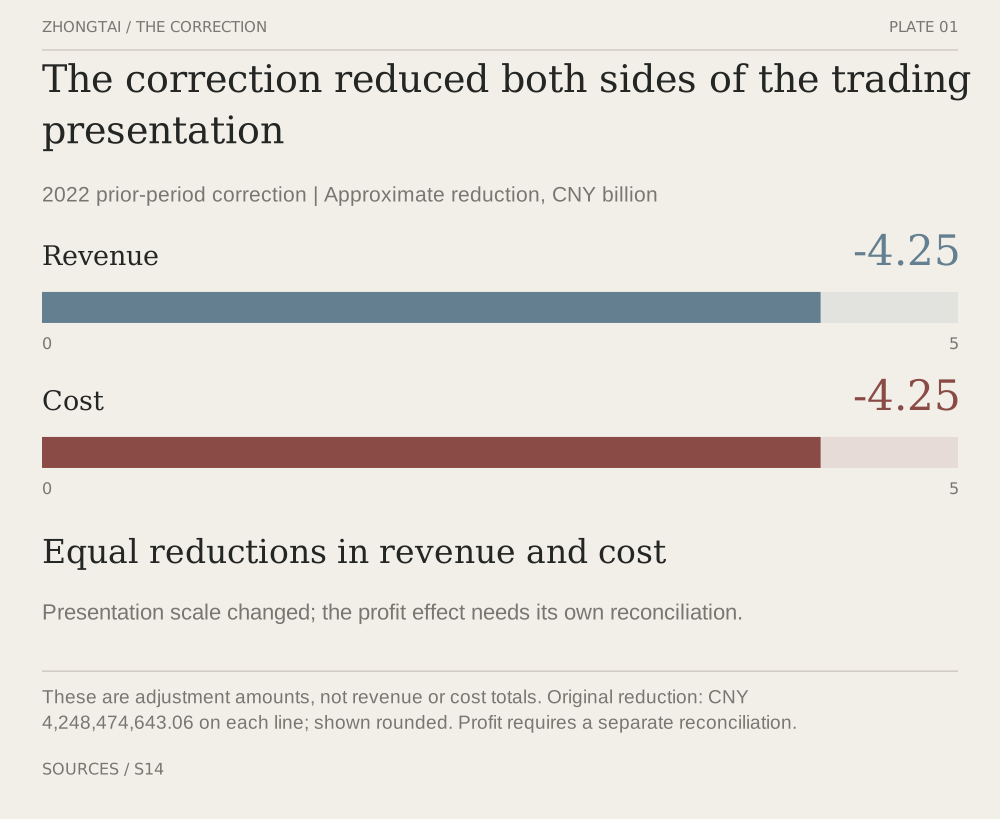
The prior-period correction reduced both revenue and cost for 2020, 2021, and 2022 by approximately CNY 0.90 billion, CNY 2.14 billion, and CNY 4.25 billion, respectively (S14). Because the correction concerns gross-versus-net presentation, revenue scale and margins need to be read on a consistent basis. It does not establish a misstatement of current-period revenue.
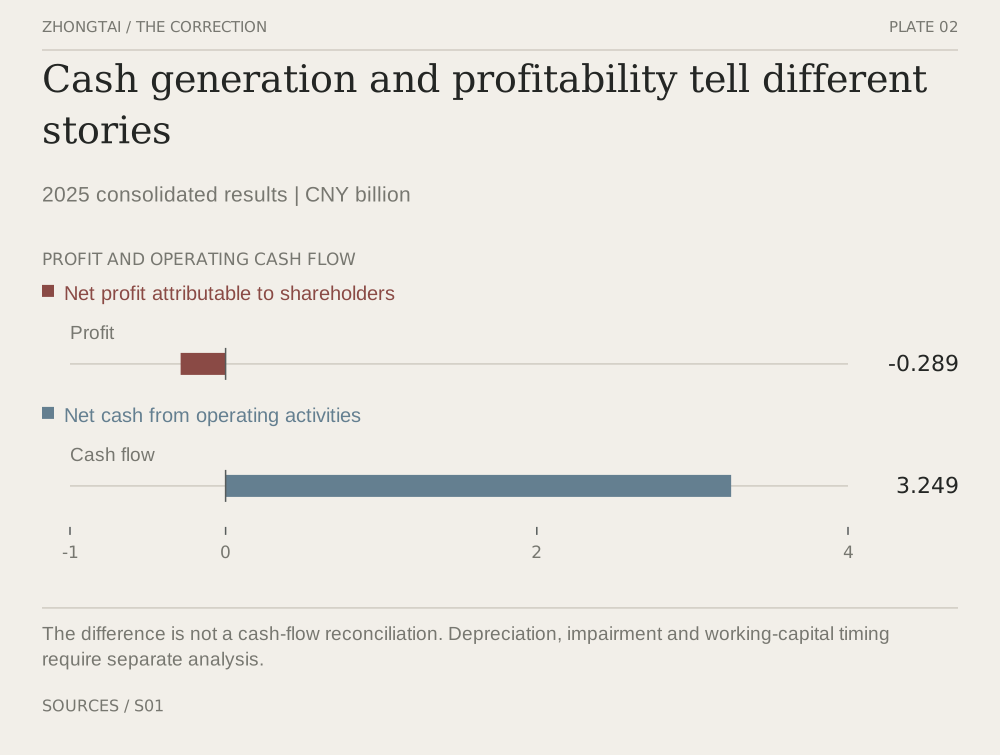
The post-correction financial picture is more nuanced than the penalty headline. In 2025, Zhongtai Chemical reported revenue of CNY 28.696 billion, a net loss attributable to shareholders of CNY 289 million, and positive operating cash flow of CNY 3.249 billion (S01). In the first quarter of 2026, the company reported revenue of CNY 7.278 billion, a net loss attributable to shareholders of CNY 143 million, and positive operating cash flow of CNY 451 million (S05). The company remained loss-making at the parent-shareholder level, but operating cash flow was positive.
That combination creates the central accounting tension in this report. Positive operating cash flow is meaningful, but it does not by itself resolve questions about revenue quality, working-capital release, related-party flows, financing structure, long-lived asset recoverability, or guarantee exposure. Public filings show that the company reported three consecutive years of net losses attributable to shareholders in 2023, 2024, and 2025, while reporting positive operating cash flow in each of those years (S08, S06, S01). That divergence deserves analysis rather than a one-line conclusion.
The governance context is also central. In its reply to the Shenzhen Stock Exchange’s 2023 annual-report inquiry, Zhongtai Chemical disclosed a 2023 year-end non-operating funds occupation balance of CNY 783 million, equal to 3.45% of net assets, and stated that the relevant principal and interest had been fully repaid (S09). The company’s 2023 internal control audit included an emphasis-of-matter paragraph concerning non-operating funds occupation by the controlling shareholder and internal-control deficiencies in related-party transaction decision-making and approval; later, the 2025 internal control audit report stated that the company maintained effective financial-reporting internal control in all material respects at year-end 2025 (S16, S03). Both points matter. Historical deficiencies should not be ignored, and later remediation evidence should not be omitted.
The best thesis is therefore not that Zhongtai Chemical is currently doing anything improper. The better thesis is that historical regulatory findings make the company’s post-correction disclosures a useful case study in how investors should read revenue presentation, cash-flow quality, related-party financing, guarantees, and long-lived asset assumptions after a disclosure-quality event.
Why this matters
This case matters because revenue presentation is not merely a technical accounting label. When a company moves from gross presentation to net-style correction for certain transactions, reported revenue and cost can both change materially without the same directional impact on gross profit. For investors who rely on top-line growth, scale, market share, and margin trends, that difference matters. Zhongtai Chemical’s correction reduced both revenue and cost for three years, including a 2022 adjustment of approximately CNY 4.25 billion (S14).
The case also matters because related-party funds occupation is an investor-protection issue. The administrative penalty decision described non-operating funds occupation by the controlling shareholder and related parties during 2021-2022, with aggregate occurrence of approximately CNY 7.72 billion (S11). The company’s later inquiry reply disclosed a 2023 year-end balance and stated that the principal and interest had been repaid (S09). That sequence creates a proper disclosure question: after historical funds occupation has been identified and addressed, what level of detail should investors expect in later related-party financing, recurring transactions, and guarantee disclosures?
Finally, the case matters because the company is still a heavy-asset cyclical manufacturer. At the end of 2025, Zhongtai Chemical reported fixed assets of CNY 47.993 billion and construction in progress of CNY 8.767 billion (S01). The 2025 audit report was unmodified, but it identified revenue recognition and long-lived asset impairment as key audit matters (S02). Those key audit matters align with the main investor questions: how reliable is the post-correction revenue story, and how should investors evaluate recoverability assumptions in a business that has recently been loss-making?
Company background and market narrative
Zhongtai Chemical is a Shenzhen-listed A-share company in the chemical industry with a heavy-asset operating profile, including chlor-alkali, PVC-related and other industrial activities disclosed in its periodic reports (S01, S08). The market narrative around the company has shifted through several layers: historical high-cycle profitability, then cyclical pressure and losses, then regulatory correction and risk-warning context, and finally a post-correction stabilization narrative based on loss reduction, positive operating cash flow, and internal-control remediation (S08, S06, S01, S03).
The company’s own filings support part of that stabilization narrative. Revenue declined from CNY 37.118 billion in 2023 to CNY 30.123 billion in 2024 and CNY 28.696 billion in 2025, while the net loss attributable to shareholders narrowed from CNY 2.865 billion in 2023 to CNY 977 million in 2024 and CNY 289 million in 2025 (S08, S06, S01). Operating cash flow was positive in all three years: CNY 4.165 billion in 2023, CNY 5.884 billion in 2024, and CNY 3.249 billion in 2025 (S08, S06, S01).
But the same filings also show why the story should not be reduced to “turnaround.” The company remained loss-making in 2025 and 2026Q1 (S01, S05). The 2025 audit report continued to treat revenue recognition and long-lived asset impairment as key audit matters (S02). The company disclosed related-party transaction estimates, related-party financial assistance applications, and related-party guarantee arrangements after the historical funds-occupation findings (S19, S20, S21, S22). These items do not establish current misconduct. They do make disclosure quality a legitimate investor focus.
What the filings show
The public record shows three evidence layers.
First, the official regulatory layer is clear. The administrative penalty decision disclosed by the company states that the Xinjiang branch of the CSRC found false records in the 2022 annual report, inaccurate financial data in the 2020 and 2021 annual reports, and untimely disclosure of related-party transactions involving non-operating funds occupation by the controlling shareholder and related parties in 2021-2022 (S11). A separate announcement disclosed a penalty decision involving the controlling shareholder and responsible persons (S12).
Second, the correction layer is measurable. The prior-period correction announcement disclosed retrospective adjustments to 2020, 2021, 2022, and 2023 interim-period financial statements. It stated that revenue and cost had been overstated by approximately CNY 0.90 billion in 2020, CNY 2.14 billion in 2021, and CNY 4.25 billion in 2022, and that the principal and interest related to funds occupation had been repaid (S14). The company’s later reply to the SZSE’s 2024 annual-report inquiry also confirmed the historical inaccurate disclosure and retrospective adjustment context (S07).
Third, the post-correction operating layer is mixed. The company reported positive operating cash flow but continued net losses in 2023-2025 (S08, S06, S01). The 2025 audit opinion was unmodified, and the 2025 internal control audit opinion was effective in all material respects for financial reporting (S02, S03). At the same time, the company’s 2025 audit report kept revenue recognition and long-lived asset impairment as key audit matters, and later announcements showed recurring related-party transactions, financial assistance arrangements, and large guarantee exposure (S02, S19, S20, S21, S22).
Financial analysis
1. Revenue corrections change the starting point for analysis
The most important accounting point is that the historical correction affected both revenue and cost. The prior-period correction announcement disclosed reductions to both revenue and cost for 2020-2022, with the largest adjustment in 2022 at approximately CNY 4.25 billion (S14). The administrative penalty decision separately stated that the company’s 2022 annual report contained false records and that specified transactions had been presented in a way that overstated both revenue and cost (S11).
This matters because investors often use revenue scale as a shorthand for business strength. After a correction of this type, the more useful question is not simply whether revenue is higher or lower. The better question is whether subsequent disclosures allow investors to distinguish production-driven revenue, modern-trade revenue, related-party revenue, and lower-margin pass-through or agency-like arrangements. The 2025 audit report’s identification of revenue recognition as a key audit matter keeps that question relevant without implying current misstatement (S02).
2. Positive operating cash flow does not eliminate profitability questions
Zhongtai Chemical reported positive operating cash flow in 2023, 2024, and 2025, while net profit attributable to shareholders remained negative in each year (S08, S06, S01). In 2025, the company reported a net loss attributable to shareholders of CNY 289 million and operating cash flow of CNY 3.249 billion (S01). In 2026Q1, it reported a net loss attributable to shareholders of CNY 143 million and operating cash flow of CNY 451 million (S05).
This is not necessarily a negative signal. In a cyclical manufacturer, operating cash flow may benefit from working-capital release, payment timing, inventory changes, customer collections, or lower cash tax and procurement outflows. But investors should separate cash-flow quality from earnings quality. Positive operating cash flow supports liquidity, but it does not by itself prove sustainable profitability or eliminate questions about asset impairment, interest burden, and related-party flows.
3. Long-lived assets remain central to the balance sheet
At the end of 2025, fixed assets were CNY 47.993 billion and construction in progress was CNY 8.767 billion (S01). The 2025 audit report identified long-lived asset impairment as a key audit matter, referencing the scale of fixed assets and construction in progress (S02). In a cyclical chemical business, recoverability depends on product prices, capacity utilization, energy and raw-material costs, environmental and safety requirements, and the economics of specific projects.
The public record supports a cautious disclosure question: when a company has large long-lived assets and has reported recent losses, impairment assumptions are material to investor understanding. That is different from saying impairment is insufficient. The current evidence supports scrutiny of assumptions, not a conclusion about misstatement.
4. Debt and interest burden constrain the turnaround narrative
The 2025 balance sheet included monetary funds of CNY 5.838 billion, short-term borrowings of CNY 5.585 billion, non-current liabilities due within one year of CNY 6.917 billion, long-term borrowings of CNY 12.349 billion, long-term payables of CNY 5.440 billion, and bonds payable of CNY 606 million (S01). The company’s 2025 annual-report data also indicate interest expense of approximately CNY 1.040 billion and financial expenses of approximately CNY 1.004 billion (S01).
Those figures make debt structure part of the disclosure story. The company can generate operating cash flow and still face earnings pressure from debt service and capital-intensive operations. The related-party financial assistance announcements in 2025 and 2026, each involving applications for up to CNY 2.0 billion from the controlling shareholder group and its subsidiaries, further show why financing structure deserves close review (S20, S21).
5. Related-party financing and guarantees deserve attention after historical funds occupation
The historical funds-occupation finding is not a license to assume current related-party arrangements are improper. It does, however, raise the standard for clarity.
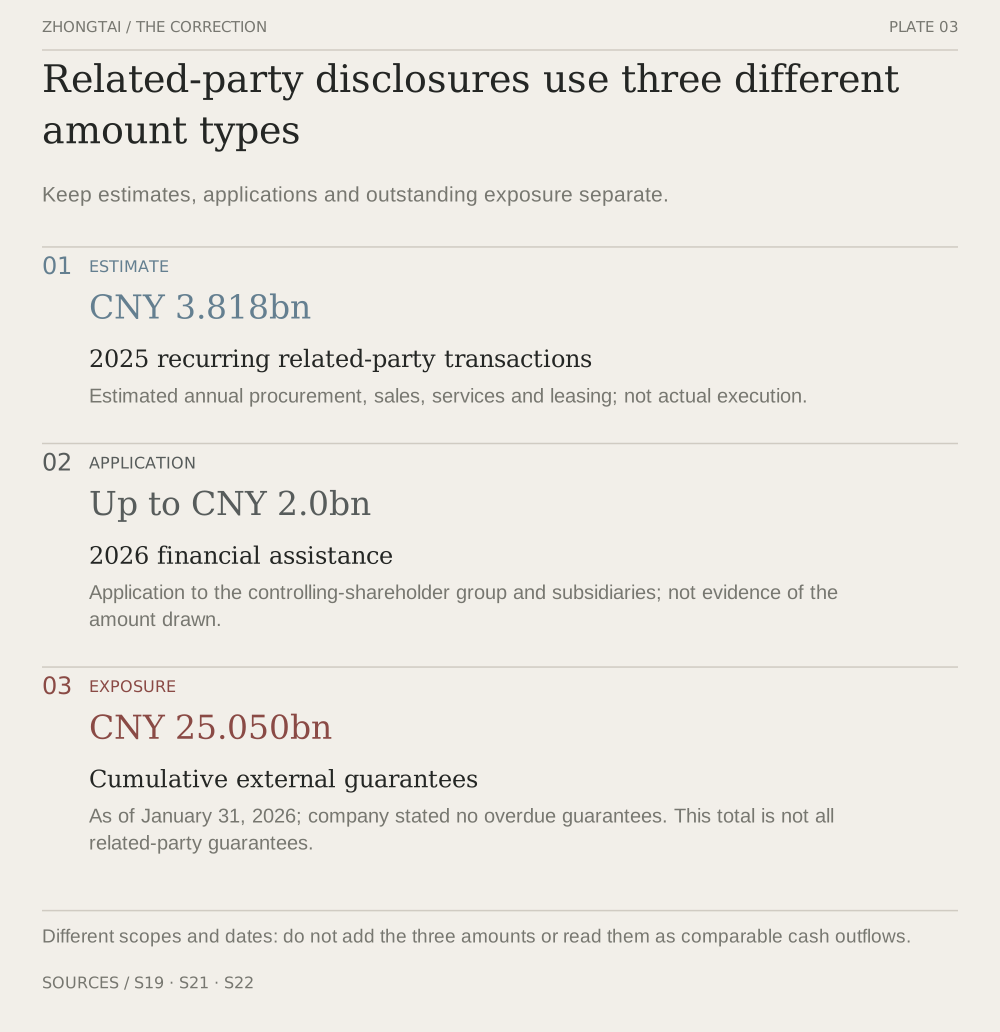
The company disclosed estimated 2025 recurring related-party transactions totaling CNY 3.818 billion across procurement, sales, services, and leasing categories (S19). It disclosed applications for up to CNY 2.0 billion of financial assistance from the controlling shareholder group and its subsidiaries in both 2025 and 2026 (S20, S21). It also disclosed a related-party guarantee arrangement in 2026, under which it proposed to provide CNY 778.357 million of guarantees in proportion to shareholding, while cumulative external guarantees as of January 31, 2026 were CNY 25.050 billion, equal to 114.99% of latest audited net assets; the company stated that there were no overdue guarantees (S22).
The investor question is not whether these arrangements are automatically problematic. The question is whether disclosures give enough detail on pricing, actual execution, balances, counterparties, approval procedures, repayment terms, guarantee beneficiaries, and any subsequent changes.
Key Disclosure Issues
-
Historical regulatory findings on revenue and funds occupation. The Xinjiang branch of the CSRC made official findings on specified historical disclosure issues, including false records in the 2022 annual report and untimely disclosure of related-party funds occupation (S11).
-
Large prior-period revenue and cost corrections. The correction announcement reduced both revenue and cost for 2020-2022, including approximately CNY 4.25 billion for 2022 (S14).
-
Positive operating cash flow alongside continued losses. The company reported positive operating cash flow but net losses attributable to shareholders in 2023, 2024, and 2025 (S08, S06, S01).
-
Revenue recognition remains an audit focus. The 2025 audit report was unmodified but identified revenue recognition as a key audit matter (S02).
-
Long-lived asset impairment remains judgment-heavy. Fixed assets and construction in progress remained large, and long-lived asset impairment was a 2025 key audit matter (S01, S02).
-
Related-party arrangements remain material after historical funds occupation. The company disclosed recurring related-party transactions, financial assistance applications, and a related-party guarantee arrangement in 2025-2026 (S19, S20, S21, S22).
-
Internal-control evidence is mixed but improving. The 2023 internal control audit highlighted related-party approval deficiencies, while the 2025 internal control audit stated that financial-reporting internal control was effective in all material respects (S16, S03).
Possible benign explanations
There are several reasonable explanations that should be kept in view.
First, the prior-period correction may reflect a corrected application of principal-agent revenue presentation rather than a continuing problem. The historical findings do not establish a misstatement of current revenue (S11, S14).
Second, positive operating cash flow may show that the operating business still generates cash even during a difficult chemical cycle. Working-capital release, inventory management, collections, and payment timing can all explain cash flow that is stronger than accounting profit (S08, S06, S01).
Third, related-party financing may be a practical liquidity tool for a state-owned or group-linked heavy industrial company. The 2025 and 2026 financial assistance announcements state that the arrangements were intended to support production and operations or improve loan maturity structure (S20, S21).
Fourth, large guarantees may relate to normal financing arrangements for subsidiaries or investees. The company stated that there were no overdue guarantees as of the 2026 related-party guarantee announcement (S22).
Fifth, the company disclosed repayment and remediation, followed by a 2025 audit opinion that financial-reporting internal control was effective in all material respects. That later evidence matters when assessing the historical deficiencies (S09, S16, S03).
Questions investors should ask
-
After the prior-period correction, how much of current revenue comes from production businesses, modern trade, logistics, related parties, or agency-like arrangements (S02, S14)?
-
What explains the gap between positive operating cash flow and net losses in 2023-2025, and how much of the cash flow came from recurring operations rather than working-capital release (S08, S06, S01)?
-
What assumptions drive the impairment testing for fixed assets and construction in progress, especially under chemical-cycle pressure (S01, S02)?
-
What actual amounts were drawn under the related-party financial assistance arrangements, and what were the repayment terms, collateral, rates, and uses of funds (S20, S21)?
-
How much of the disclosed guarantee exposure relates to consolidated subsidiaries, unconsolidated related parties, or investees, and what counter-guarantees exist (S22)?
-
After the historical funds-occupation events, what additional controls govern related-party transaction approval, execution, and monitoring (S09, S16, S03)?
-
How should investors reconcile the 2025 effective internal-control audit opinion with the still-relevant need to monitor related-party financing and guarantees (S03, S19, S20, S21, S22)?
Conclusion
The revenue corrections and historical funds occupation give investors specific reasons to examine Zhongtai Chemical’s later accounts closely (S11, S14). The findings concern identified past periods; they do not establish current misconduct. The useful follow-up is to trace how revenue is now presented, where operating cash comes from, and how related-party financing is approved and monitored.
The company’s later record is mixed. It reported positive operating cash flow in 2023-2025 and a 2025 unmodified financial-statement audit opinion (S08, S06, S01, S02). It also remained loss-making, carried large fixed assets and construction in progress, and continued to disclose material related-party transactions, financial assistance arrangements, and guarantee exposure (S01, S19, S20, S21, S22).
Later filings can answer those questions through a reconciliation of cash flow to losses, the assumptions behind asset valuations, and the actual balances and terms of related-party finance. Those details would show how much of the reported stabilization can be sustained.
Disclaimer
This report is based solely on public information available as of July 1, 2026, as reflected in the public filings cited below. It is prepared for educational and investor protection purposes only. It does not constitute investment advice, legal advice, accounting advice, tax advice, or a recommendation to buy, sell, hold, short, or avoid any security. The author does not claim that any company or individual has engaged in misconduct unless such finding has been made by a competent authority. Readers should conduct their own due diligence and consult qualified professional advisers where appropriate.
Selected source table
| Source number | Source | Date | Relevance | Link |
|---|---|---|---|---|
| S01 | 中泰化学:2025年年度报告 | 2026-03-26 | 2025 revenue, loss, operating cash flow, fixed assets, construction in progress, debt items. | CNINFO |
| S02 | 中泰化学:2025年度审计报告 | 2026-03-26 | Unmodified audit opinion; revenue recognition and long-lived asset impairment as key audit matters. | CNINFO |
| S03 | 中泰化学:新疆中泰化学股份有限公司内部控制审计报告 | 2026-03-26 | 2025 effective financial-reporting internal control opinion. | CNINFO |
| S05 | 中泰化学:2026年一季度报告 | 2026-04-25 | 2026Q1 revenue, loss, operating cash flow, and shareholder pledge context. | CNINFO |
| S06 | ST中泰:2024年年度报告 | 2025-03-15 | 2024 revenue, net loss, and operating cash flow. | CNINFO |
| S07 | ST中泰:关于深圳证券交易所对公司2024年年报问询函的回复公告 | 2025-05-10 | SZSE inquiry reply confirming correction and disclosure context. | CNINFO |
| S08 | 中泰化学:2023年年度报告 | 2024-04-30 | 2023 revenue, loss, operating cash flow, and retrospective adjustment context. | CNINFO |
| S09 | ST中泰:关于深圳证券交易所对公司2023年年报问询函的回复公告 | 2024-05-29 | 2023 year-end non-operating funds occupation balance and repayment statement. | CNINFO |
| S11 | 中泰化学:关于公司及相关责任人收到中国证券监督管理委员会新疆监管局《行政处罚决定书》的公告(更正后) | 2024-05-20 | Administrative penalty decision involving revenue presentation and funds occupation. | CNINFO |
| S12 | 中泰化学:关于控股股东及相关责任人收到中国证券监督管理委员会新疆监管局《行政处罚决定书》的公告 | 2024-05-20 | Penalty decision involving controlling shareholder and responsible persons. | CNINFO |
| S14 | 中泰化学:关于前期会计差错更正的公告 | 2024-04-24 | Prior-period correction amounts for revenue and cost; funds occupation repayment statement. | CNINFO |
| S16 | 中泰化学:董事会关于带强调事项段的无保留意见的内部控制审计报告的专项说明 | 2024-04-30 | 2023 internal-control emphasis matter and remediation discussion. | CNINFO |
| S19 | ST中泰:关于预计2025年度日常关联交易的公告 | 2025-02-20 | Estimated 2025 recurring related-party transactions. | CNINFO |
| S20 | ST中泰:公司及下属子公司向新疆中泰(集团)有限责任公司及其子公司申请财务资助暨关联交易的公告 | 2025-02-20 | 2025 related-party financial assistance application. | CNINFO |
| S21 | 中泰化学:公司及下属子公司向新疆中泰(集团)有限责任公司及其子公司申请财务资助暨关联交易的公告 | 2026-02-11 | 2026 related-party financial assistance application and related-party transaction context. | CNINFO |
| S22 | 中泰化学:关于为关联方按持股比例提供担保暨关联交易的公告 | 2026-02-11 | Related-party guarantee, total external guarantees, and no overdue guarantee statement. | CNINFO |