Dongfang Xinneng's Next Test After Restructuring
The restructuring restored positive equity. A proposed renewable-energy acquisition now puts cash funding, leverage, and future earnings under scrutiny.
- Company
- Beijing Oriental Eco-New Energy Co., Ltd.
- Ticker
- 002310.SZ
- Published
- July 7, 2026
- Information cutoff
- July 6, 2026
Why this matters
The case shows that restructuring may repair a balance sheet faster than it proves operating recovery or acquisition economics.
Evidence snapshot
The figures that frame the review
- 2025 revenue
- CNY 342m Source S01
- 2025 net loss
- CNY 76m Attributable to shareholders, S01
- 2025 operating cash flow
- CNY 91m Source S01
- Pro forma leverage
- 74.57% After proposed transaction, S29
Executive summary
Beijing Oriental Eco-New Energy Co., Ltd. (北京东方生态新能源股份有限公司, 002310.SZ; “Dongfang Xinneng” or “the company”) is rebuilding around renewable energy after a court-approved restructuring. Its earlier record includes disclosure penalties, accounting corrections, and a going-concern warning. The restructuring brought a new controlling shareholder, followed by a new company name and a proposed asset purchase. That purchase has prompted exchange questions about leverage, cash funding, and goodwill (S19, S17, S13, S24, S25, S26, S27, S29).
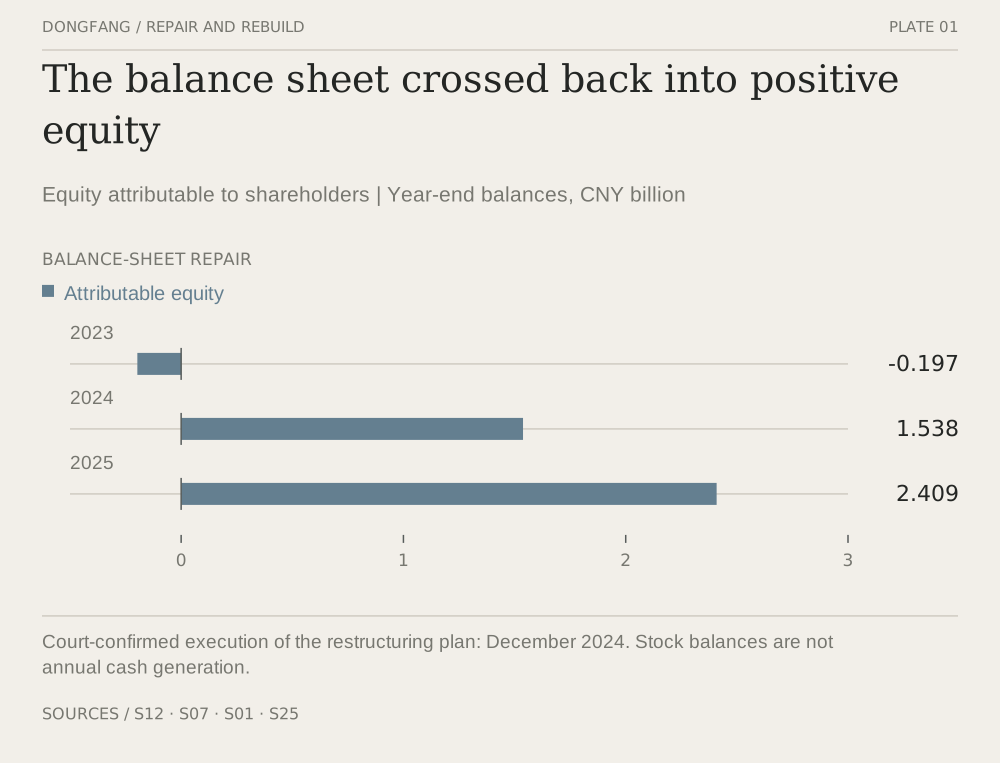
The company’s restructuring was a milestone. In December 2024, the court approved the restructuring plan and later confirmed that the plan had been executed, terminating the restructuring procedure (S24, S25). Public filings show that the balance sheet changed materially. At the end of 2023, equity attributable to shareholders was negative CNY 197 million and total liabilities were CNY 35.129 billion; by the end of 2024, equity attributable to shareholders was positive CNY 1.538 billion, and by the end of 2025 it was CNY 2.409 billion (S12, S07, S01). Annual-report data also show that financial expenses declined sharply from 2024 to 2025 (S07, S01).
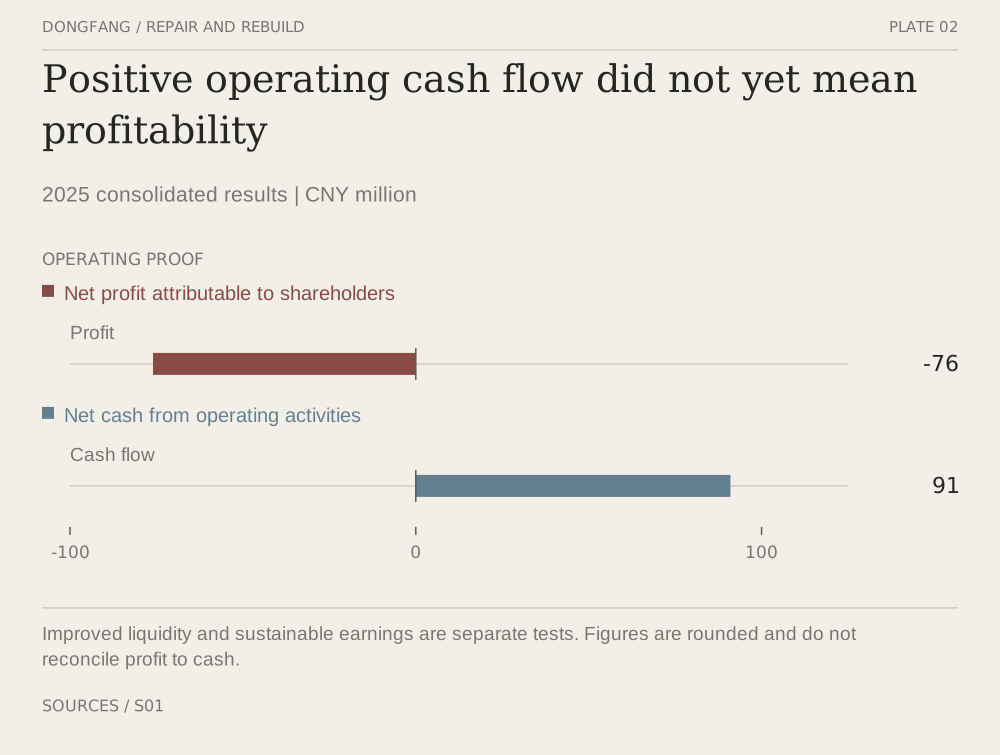
But a court-approved restructuring does not by itself prove operating recovery. In 2025, the company reported revenue of CNY 342 million, a net loss attributable to shareholders of CNY 76 million, positive operating cash flow of CNY 91 million, and year-end equity attributable to shareholders of CNY 2.409 billion (S01). In 2026Q1, the company reported revenue of CNY 32 million, a net loss attributable to shareholders of CNY 14 million, positive operating cash flow of CNY 68 million, and equity attributable to shareholders of CNY 2.396 billion (S04). The public record supports improvement in liquidity profile and balance-sheet structure, but not a conclusion that durable profitability has already been established.
The historical disclosure issue also matters. In 2024, the company disclosed an administrative penalty decision by the Beijing branch of the CSRC. The decision found that the company failed to timely reduce revenue for the Guangxi Guigang project in 2019, resulting in overstatement of revenue, profit, and assets in 2019 and understatement of revenue and profit in 2022, among other related disclosure effects (S19). The company also disclosed prior-period accounting corrections and an auditor report on the correction (S17, S18). These are official historical findings and correction materials; they should not be generalized into a current-period allegation.
Filings document the name change, the shift toward new-energy operations, and proposed purchases of renewable-energy assets (S01, S27, S28). What they have yet to establish is whether those assets can produce sustained earnings and cash flow after financing costs, guarantees, and other obligations.
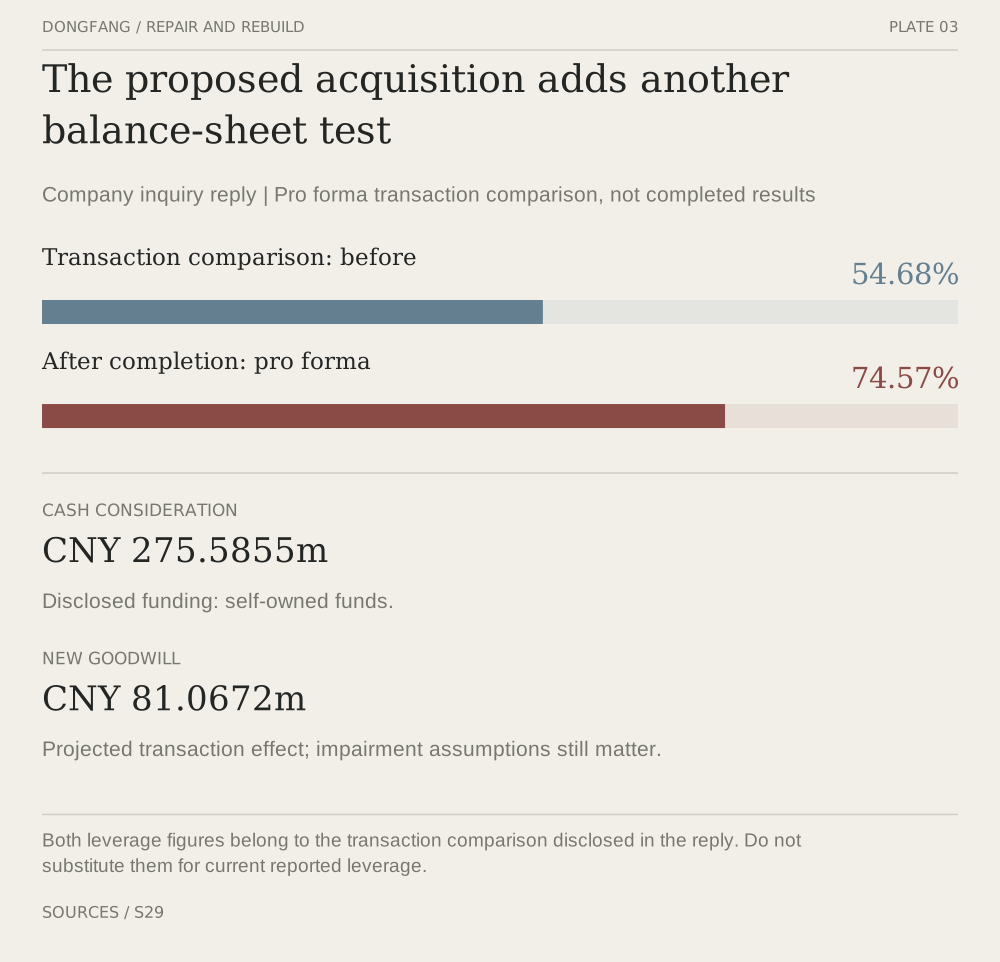
The strongest current disclosure issue is the 2026 cash major asset purchase inquiry. The company proposed to buy 100% of Haicheng Ruihai and 80% of Beijing Diantou Ruixiang in cash, and the transaction constituted a major asset restructuring (S28). In its reply to the SZSE inquiry, the company disclosed that the pro forma asset-liability ratio after completion would increase from 54.68% to 74.57%, that the cash consideration was CNY 275.5855 million and would come from self-owned funds, and that the transaction would create new goodwill of CNY 81.0672 million (S29). Those facts do not mean the acquisition is improper. They do mean that leverage, funding, valuation, goodwill, and integration deserve close investor scrutiny.
Why this matters
This case matters because restructuring can change a balance sheet faster than it changes a business model. A legal restructuring may reduce debt, reorganize creditors, transfer assets, introduce new investors, and change control. Those steps are important. But investors still need evidence that the post-restructuring company can generate revenue, cash flow, and profit without relying only on balance-sheet repair.
Dongfang Xinneng’s public filings illustrate that distinction. In 2023, before restructuring, the company reported revenue of CNY 569 million, net loss attributable to shareholders of CNY 5.083 billion, operating cash flow of negative CNY 252 million, and equity attributable to shareholders of negative CNY 197 million (S12). The 2023 audit report was unmodified but included a material uncertainty related to going concern, citing four consecutive years of losses totaling CNY 12.917 billion since 2020, negative equity attributable to shareholders at year-end 2023, and current liabilities exceeding current assets by CNY 12.358 billion (S13). By 2024 and 2025, the balance-sheet picture had changed materially after restructuring (S07, S01).
The case also matters because a new business narrative can be analytically incomplete. The company changed its name and securities abbreviation to reflect the renewable-energy direction (S27). Its 2025 annual report describes a shift after judicial restructuring from ecological engineering services toward a renewable-energy asset-holding and operating model (S01). That may be a real business transition. But investors still need to examine revenue scale, profitability, operating cash flow, related-party sales, customer concentration, guarantees, litigation, and acquisition leverage.
Finally, this case matters because historical disclosure penalties do not disappear from investor analysis after restructuring. The administrative penalty is a historical finding about specified disclosure issues; it is not proof of current misconduct (S19). But it gives investors a reason to read later disclosure with particular attention to correction quality, audit evidence, related-party transparency, and whether new transactions are explained in enough detail.
Company background and market narrative
The company was historically known as Oriental Landscape and later *ST Dongyuan. It had a legacy business in ecological engineering and related activities before restructuring (S12, S13). In 2024, the company entered pre-restructuring, then formal restructuring, and the court approved and confirmed execution of the restructuring plan by year-end (S21, S22, S24, S25). In 2025, control changed through share transfers under the restructuring plan, with the controlling shareholder changing to Chaoyang State-Owned Capital Operation Management Co., Ltd. while the actual controller remained the State-owned Assets Supervision and Administration Commission of Beijing’s Chaoyang District, according to the company’s announcement (S26). In January 2026, the company name and securities abbreviation changed to Dongfang Xinneng (S27).
This sequence supports a clear market narrative: historical engineering and debt stress were addressed through restructuring, and the company is now trying to rebuild around renewable-energy assets. The narrative is understandable. It is also incomplete.
The public filings show that the old asset-quality issues were severe. At the end of 2023, accounts receivable were CNY 6.274 billion, contract assets were CNY 9.445 billion, goodwill was material, and the company had total liabilities of CNY 35.129 billion (S12, S13). After restructuring, those legacy balances changed sharply. The question is no longer only what happened to the old engineering assets. The new question is whether the post-restructuring renewable-energy strategy can generate durable earnings and whether new acquisitions introduce fresh leverage, goodwill, related-party, or guarantee risks.
What the filings show
The filings show a company whose financial identity changed quickly.
Revenue fell from CNY 10.487 billion in 2021 to CNY 3.409 billion in 2022, CNY 569 million in 2023, CNY 877 million in 2024, and CNY 342 million in 2025, based on corrected and later periodic-report figures (S16, S15, S12, S07, S01). Net profit attributable to shareholders remained negative across those years, including losses of CNY 5.816 billion in 2022, CNY 5.083 billion in 2023, CNY 3.603 billion in 2024, and CNY 76 million in 2025 (S15, S12, S07, S01). In 2025 and 2026Q1, operating cash flow was positive even though the company remained loss-making (S01, S04).
The audit and internal-control record also changed. The 2023 audit report was unmodified but included a material uncertainty related to going concern (S13). The 2024 and 2025 audit reports were unmodified, and the 2024 and 2025 internal control audit reports were standard unmodified opinions (S08, S02, S09, S03). That is balancing evidence. It should keep the report from overstating historical problems into a current internal-control conclusion.
The restructuring record is unusually concrete. The court accepted restructuring in November 2024 (S22). The restructuring plan described a capital reserve conversion arrangement, with shares used to introduce restructuring investors, repay debt, and reserve shares (S23). The court approved the plan in December 2024 and later confirmed execution of the plan (S24, S25). Control changed through the transfer of shares to restructuring investors and certain creditors’ designated securities accounts (S26).
The April 2026 major asset purchase report described a cash purchase of renewable-energy asset companies and stated that the transaction constituted a major asset restructuring (S28). The SZSE inquiry reply disclosed the projected rise in pro forma asset-liability ratio, the funding source for the cash consideration, and the creation of new goodwill (S29). Those figures let investors compare the cost of the proposed expansion with the resources available to fund it.
Financial analysis
1. Restructuring changed the balance sheet, not the need for operating proof
The restructuring materially changed the company’s balance sheet. At the end of 2023, equity attributable to shareholders was negative CNY 197 million and total liabilities were CNY 35.129 billion (S12). At the end of 2024, after the restructuring process, equity attributable to shareholders was positive CNY 1.538 billion (S07). At the end of 2025, equity attributable to shareholders was CNY 2.409 billion (S01).
That is meaningful. A company that moves from negative equity and going-concern uncertainty to a positive-equity post-restructuring balance sheet has changed its financial starting point. But the investment disclosure question is not solved by the balance sheet alone. In 2025, the company still reported a net loss attributable to shareholders of CNY 76 million; in 2026Q1, it reported a further net loss attributable to shareholders of CNY 14 million (S01, S04). The public record therefore supports a cautious formulation: restructuring improved the balance-sheet framework, while durable profitability still requires evidence.
2. Cash flow improved, but the profit base remains small
The company reported positive operating cash flow of CNY 91 million in 2025 and CNY 68 million in 2026Q1 (S01, S04). That is a constructive signal after the pre-restructuring period. It suggests that cash conversion may have improved as legacy engineering operations were reduced and new-energy activities entered the reporting profile.
But the revenue base remained small. 2025 revenue was CNY 342 million, down 60.94% year on year according to the 2025 annual report, and 2026Q1 revenue was CNY 32 million (S01, S04). The issue is not whether the renewable-energy transition is real. Public filings show business and asset-structure change (S01, S27, S28). The issue is whether the new business model can generate stable profit and cash flow at sufficient scale.
3. Historical disclosure findings should shape, but not dominate, the current analysis
The Beijing branch of the CSRC found historical information-disclosure violations involving the timing of revenue reduction for the Guangxi Guigang project and related effects on revenue, profit, and assets (S19). The company also disclosed prior-period accounting corrections and an auditor report on the correction (S17, S18).
The findings concern historical disclosures; they do not establish that the current renewable-energy business is misstated. They make later explanations of revenue recognition, related-party transactions, asset transfers, and acquisition accounting especially relevant.
4. Legacy asset-quality issues were reorganized, but new asset risks may emerge
At the end of 2023, the company had CNY 6.274 billion of accounts receivable and CNY 9.445 billion of contract assets (S12). The 2023 audit report included key audit attention around receivables and contract assets, and a material uncertainty related to going concern (S13). After restructuring, those legacy project-asset balances no longer dominate the same way; the 2025 annual report shows the company operating under a changed business model (S01).
That does not mean asset-quality risk disappeared. It means the type of asset-quality risk changed. Public filings show that fixed assets increased to CNY 1.255 billion at 2025 year-end, largely related to renewable-energy generating assets (S01). The April 2026 acquisition inquiry reply disclosed that the proposed transaction would create new goodwill of CNY 81.0672 million (S29). For a renewable-energy asset operator, investors need disclosure on power generation assets, utilization hours, tariffs, project financing, operating costs, impairment assumptions, and goodwill sensitivity.
5. Acquisition economics are the next disclosure test
The 2026 major asset purchase is the clearest forward-looking disclosure-quality issue in the public record reviewed here. The company proposed a cash purchase of 100% of Haicheng Ruihai and 80% of Beijing Diantou Ruixiang, and the transaction constituted a major asset restructuring (S28). In the SZSE inquiry reply, the company disclosed that the transaction would increase the pro forma asset-liability ratio from 54.68% to 74.57%, that the cash consideration was CNY 275.5855 million and would come from self-owned funds, and that the transaction would create goodwill of CNY 81.0672 million (S29).
None of this proves the acquisition is problematic. Higher leverage may be common in project-financed renewable-energy assets, and goodwill may be justified if the acquired assets produce stable cash flow. But the disclosure burden rises. Investors need to understand the funding source, post-acquisition liquidity, project debt, financing leases, valuation assumptions, impairment sensitivity, and whether the acquired businesses can contribute stable earnings.
6. Related-party exposure, guarantees, and litigation remain part of the post-restructuring picture
The 2025 annual-report analysis shows that the company’s top five customers accounted for 56.85% of annual sales and that related-party sales accounted for 20.75% of annual sales (S01). Related-party sales do not mean revenue is low quality or unfairly priced. They do mean investors need transaction-content, pricing, and collection disclosure.
Guarantees and contingent matters also remain relevant. Before formal restructuring, the company disclosed overdue debt of CNY 103.4355 million and overdue subsidiary guarantees of CNY 52.3998 million (S31). In 2026, the company disclosed major litigation and cumulative litigation progress, an expected external guarantee quota, and a guarantee to an associate (S32, S33, S34). Those filings do not show that restructuring failed. They show why investors should separate historical legacy matters from new operating and financing arrangements.
Key Disclosure Issues
-
Historical disclosure penalty and corrections. The Beijing branch of the CSRC made official findings about specified historical disclosure issues, and the company disclosed prior-period corrections (S19, S17, S18).
-
Restructuring changed the balance sheet. The court approved and later confirmed execution of the restructuring plan, and equity attributable to shareholders turned positive after the pre-restructuring period (S24, S25, S07, S01).
-
Operating recovery remains unproven. The company reported positive operating cash flow in 2025 and 2026Q1 but remained loss-making at the parent-shareholder level (S01, S04).
-
Renewable-energy transition requires operating evidence. The name change and business shift are supported by filings, but durable earnings and cash-flow stability require further reporting periods (S01, S27).
-
Major asset purchase inquiry highlights leverage and goodwill. The SZSE inquiry reply disclosed pro forma leverage rising to 74.57%, cash consideration funded by self-owned funds, and new goodwill of CNY 81.0672 million (S29).
-
Related-party sales need clarity. In 2025, top-five customer sales concentration was high and related-party sales accounted for 20.75% of annual sales (S01).
-
Guarantees and litigation remain relevant. The company disclosed pre-restructuring overdue debt and guarantees, and later disclosed litigation and guarantee matters in 2026 (S31, S32, S33, S34).
Possible benign explanations
Several benign explanations deserve emphasis.
First, restructuring may genuinely have improved the company’s financial starting point. Court approval and confirmation of execution are formal legal milestones, and the balance sheet changed materially after the restructuring process (S24, S25, S07, S01).
Second, the renewable-energy transition may be real even if the current revenue base remains small. New-energy asset operations can take time to scale, and acquired generation assets may have different revenue recognition, cost, and cash-flow characteristics from legacy ecological engineering work (S01, S27, S28).
Third, positive operating cash flow in 2025 and 2026Q1 may reflect a better cash profile after restructuring and business restructuring (S01, S04). It should be evaluated over more periods before drawing conclusions about durability.
Fourth, higher leverage in renewable-energy asset acquisitions may reflect project-financing economics rather than a standalone red flag. The relevant question is whether debt service is matched by stable project cash flows (S29).
Fifth, related-party sales may arise from a reorganized state-owned or renewable-energy business ecosystem. They require transparency, not automatic suspicion (S01).
Questions investors should ask
-
Which parts of 2025 revenue came from renewable-energy generation, development, construction, or legacy activities (S01)?
-
What explains the difference between positive operating cash flow and continuing net losses in 2025 and 2026Q1 (S01, S04)?
-
Which assets and liabilities were removed, transferred, settled, or reorganized through the restructuring plan, and how do those changes affect comparability with 2023 (S12, S23, S25)?
-
What are the main assumptions behind the proposed acquisition’s valuation, goodwill, and post-transaction asset-liability ratio (S28, S29)?
-
How will the company fund the cash consideration while maintaining liquidity for operations and project development (S29)?
-
What is the business substance, pricing policy, and collection record for the related-party sales disclosed in 2025 (S01)?
-
Which litigation and guarantee matters are legacy issues from the pre-restructuring period, and which relate to the new renewable-energy platform (S31, S32, S33, S34)?
-
What subsequent announcements after July 6, 2026 confirm whether the acquisition closed, whether new financing was used, and whether goodwill or leverage assumptions changed?
Conclusion
Dongfang Xinneng’s public record contains a clear before-and-after structure. Before restructuring, the company had historical disclosure penalties, corrected financial statements, going-concern uncertainty, large receivables and contract assets, negative equity, and debt pressure (S19, S17, S18, S13, S12). After restructuring, the court confirmed execution of the plan, the controlling shareholder changed, the company adopted a renewable-energy identity, and the balance sheet improved (S25, S26, S27, S07, S01).
The remaining test is operating performance. Positive cash flow has accompanied continued losses, and the proposed acquisition would add leverage and goodwill. The April 2026 inquiry identifies the figures to follow: the cash used to close the purchase, debt service at the acquired projects, and the earnings those assets contribute (S28, S29). Later results will show whether the stronger balance sheet supports a profitable renewable-energy business.
Disclaimer
This report is based solely on public information available as of July 6, 2026, as reflected in the public filings cited below. It is prepared for educational and investor protection purposes only. It does not constitute investment advice, legal advice, accounting advice, tax advice, or a recommendation to buy, sell, hold, short, or avoid any security. The author does not claim that any company or individual has engaged in misconduct unless such finding has been made by a competent authority. Readers should conduct their own due diligence and consult qualified professional advisers where appropriate.
Selected source table
| Source number | Source | Date | Relevance | Link |
|---|---|---|---|---|
| S01 | 北京东方生态新能源股份有限公司2025年年度报告 | 2026-04-30 | 2025 revenue, loss, operating cash flow, equity, business transition, related-party sales. | CNINFO |
| S02 | 2025年年度审计报告 | 2026-04-30 | 2025 unmodified audit opinion and revenue recognition as key audit matter. | CNINFO |
| S03 | 内部控制审计报告 | 2026-04-30 | 2025 standard unmodified internal control audit opinion. | CNINFO |
| S04 | 2026年一季度报告 | 2026-04-30 | 2026Q1 revenue, loss, operating cash flow, and equity. | CNINFO |
| S07 | 2024年年度报告 | 2025-04-29 | 2024 revenue, loss, operating cash flow, equity and restructuring context. | CNINFO |
| S08 | 2024年年度审计报告 | 2025-04-29 | 2024 unmodified audit opinion and debt waiver/restructuring income key audit matter. | CNINFO |
| S09 | 内部控制审计报告 | 2025-04-29 | 2024 standard unmodified internal control audit opinion. | CNINFO |
| S12 | 2023年年度报告 | 2024-04-27 | 2023 revenue, loss, operating cash flow, equity, receivables, contract assets, liabilities. | CNINFO |
| S13 | 2023年年度审计报告 | 2024-04-27 | 2023 going-concern material uncertainty paragraph and pre-restructuring pressure. | CNINFO |
| S15 | 2022年年度报告(更正后) | 2024-03-27 | Corrected 2022 revenue, loss, and operating cash flow. | CNINFO |
| S16 | 2021年年度报告(更正后) | 2024-03-27 | Corrected 2021 revenue, loss, and operating cash flow. | CNINFO |
| S17 | 关于前期会计差错更正及追溯调整的公告 | 2024-02-01 | Prior-period accounting correction and retrospective adjustment. | CNINFO |
| S18 | 前期会计差错更正专项说明的审核报告 | 2024-03-27 | Auditor report on prior-period correction. | CNINFO |
| S19 | 关于收到《行政处罚决定书》的公告 | 2024-02-01 | Beijing CSRC administrative penalty decision and historical revenue correction issue. | CNINFO |
| S21 | 关于收到法院启动公司预重整及指定临时管理人决定书的公告 | 2024-05-10 | Start of pre-restructuring. | CNINFO |
| S22 | 关于法院裁定受理公司重整及指定管理人的公告 | 2024-11-23 | Court acceptance of restructuring and appointment of administrator. | CNINFO |
| S23 | 北京东方园林环境股份有限公司重整计划 | 2024-12-24 | Restructuring plan and capital reserve conversion arrangement. | CNINFO |
| S24 | 关于公司重整计划获得法院裁定批准的公告 | 2024-12-24 | Court approval of restructuring plan. | CNINFO |
| S25 | 关于法院裁定确认公司重整计划执行完毕的公告 | 2024-12-31 | Court confirmation of restructuring plan execution completion. | CNINFO |
| S26 | 关于向重整投资人及部分债权人指定证券账户完成股票过户暨公司控股股东变更的公告 | 2025-03-04 | Share transfer and controlling shareholder change. | CNINFO |
| S27 | 关于变更公司名称、证券简称暨完成工商变更登记的公告 | 2026-01-14 | Name and securities abbreviation change to Dongfang Xinneng. | CNINFO |
| S28 | 北京东方生态新能源股份有限公司重大资产购买报告书(草案)(修订稿) | 2026-04-14 | Cash major asset purchase of renewable-energy asset companies. | CNINFO |
| S29 | 关于对深圳证券交易所现金重大资产购买问询函的回复 | 2026-04-14 | Pro forma asset-liability ratio, cash funding source, and new goodwill. | CNINFO |
| S31 | 关于公司部分债务逾期及担保逾期的公告 | 2024-08-30 | Pre-restructuring overdue debt and guarantee overdue disclosure. | CNINFO |
| S32 | 关于公司重大诉讼、累计诉讼进展及相关事项说明的公告 | 2026-04-30 | Post-restructuring litigation and cumulative litigation progress. | CNINFO |
| S33 | 关于2026年度对外担保额度预计的公告 | 2026-05-19 | 2026 expected external guarantee quota. | CNINFO |
| S34 | 关于对参股公司提供担保的公告 | 2026-06-12 | Guarantee to associate after restructuring. | CNINFO |