Lingnan's Cash Inflow in a Shrinking Business
Operating cash flow turned positive as revenue collapsed. Project collections, overdue debt, and unresolved audit evidence determine how much that improvement can tell investors.
- Company
- Lingnan Eco & Culture-Tourism Co., Ltd.
- Ticker
- 002717.SZ
- Published
- August 6, 2026
- Information cutoff
- August 5, 2026
Why this matters
The case shows why cash collection, working-capital release and durable operating recovery must be assessed separately when audit evidence is constrained and project assets are judgment-heavy.
Evidence snapshot
The figures that frame the review
- 2025 revenue
- CNY 112m Down 86.99%, S01
- 2025 net loss
- CNY 2.336bn Attributable to shareholders, S01
- Operating cash flow
- CNY 264m 2025, S01/S04
- Asset-liability ratio
- 111.67% 2025 year-end, S01/S07
Executive summary
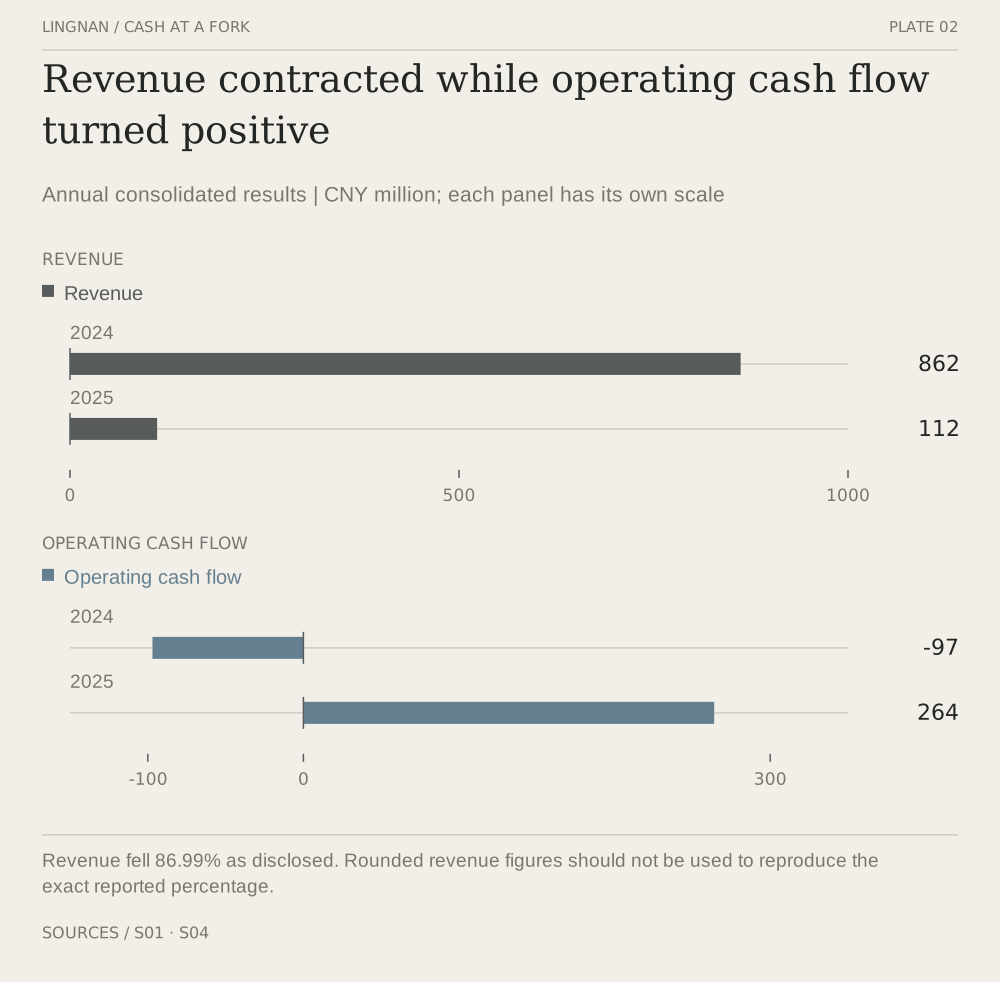
Lingnan Eco & Culture-Tourism Co., Ltd. (岭南生态文旅股份有限公司, 002717.SZ; “Lingnan” or “the company”) reported one financial indicator in 2025 that appears encouraging: net cash generated from operating activities was approximately CNY 264 million, reversing negative CNY 97 million in 2024 (S01, S04). Read alone, that movement could suggest that collections, cost control, and business contraction had begun to stabilize liquidity.
Read with the rest of the annual report, however, the cash-flow improvement becomes more difficult to interpret. Revenue fell to approximately CNY 112 million, down 86.99%. Net loss attributable to shareholders widened to approximately CNY 2.336 billion. At year-end, equity attributable to shareholders was negative CNY 1.349 billion. The company disclosed an asset-liability ratio of 111.67%, a current ratio of 0.56, and overdue debt (S01, S07).
Most importantly, the auditor issued a disclaimer of opinion on the 2025 financial statements, while the internal-control auditor issued an adverse opinion. The board’s explanation states that the auditor was unable to obtain sufficient appropriate evidence concerning matters that included going concern and other material balances and events (S03). A disclaimer does not prove that every reported figure is wrong. It means the auditor could not obtain enough evidence to form an audit opinion on the financial statements as a whole. For ordinary investors, that limitation changes how every headline number should be read.
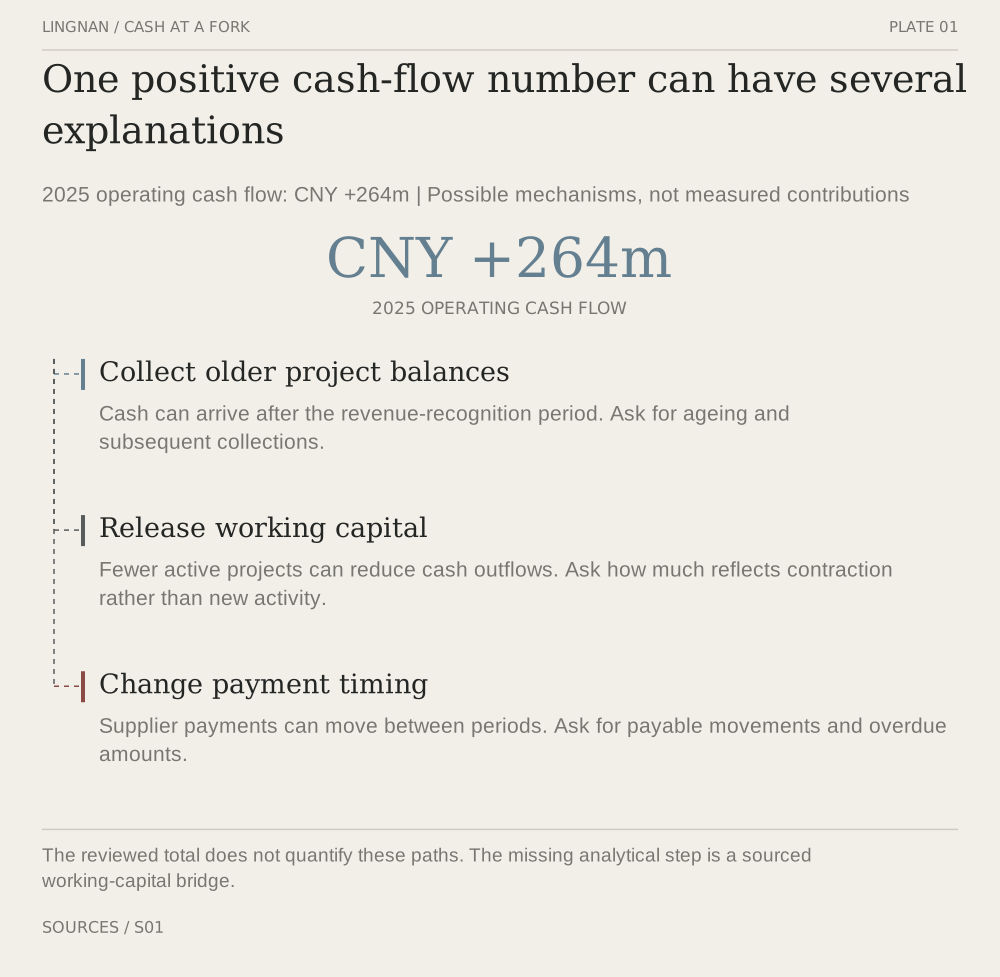
In a project-based business, positive operating cash flow can result from collecting old receivables, reducing project activity, delaying payments, or releasing working capital. Each can improve liquidity while revenue and margins remain weak. The distinction matters when judging whether the cash improvement is repeatable.
Lingnan may have credible explanations. It has described efforts to collect project balances, negotiate financing, dispose of assets, and reduce costs (S01). But the available record leaves a hard investor-protection question: when audit evidence is constrained, project assets are judgment-heavy, and equity is negative, what public evidence would be sufficient to demonstrate a durable recovery?
Why this matters
Lingnan matters because infrastructure, ecological-restoration, municipal, and cultural-tourism projects create accounting balances that can persist long after construction activity slows. Revenue may be recognized as performance obligations are satisfied, while cash depends on certification, settlement, government budgets, project-company financing, disputes, and final acceptance. Accounts receivable and contract assets therefore become central to understanding both earnings quality and liquidity.
Collections from old projects bring in cash; fewer active projects reduce cash outlays. Extending supplier payments can preserve cash while increasing unpaid obligations. A reconciliation of those movements would explain which effects drove Lingnan’s cash-flow improvement.
The audit opinion gives the issue public-interest significance. A disclaimer tells investors that ordinary audit assurance was unavailable for the financial statements as a whole. An adverse internal-control opinion separately indicates that material weaknesses prevented the company from maintaining effective financial-reporting controls in all material respects (S02, S03). These are not trading signals. They are disclosure signals: readers should reduce confidence, identify the affected claims, and demand clearer evidence.
Company background and market narrative
Lingnan is a Shenzhen-listed project company whose filings describe activities in ecological protection, environmental governance, municipal and landscape construction, water-related projects, planning, and cultural-tourism services (S01). Project-based growth historically depends on winning contracts, mobilizing working capital, completing milestones, securing acceptance, and converting project assets into cash.
The recent narrative is no longer primarily about growth. It is about contraction, collection, debt relief, asset disposal, and survival through a stressed balance sheet. The company stated that it would focus on core regions, optimize its order structure, accelerate settlement and receivable collection, negotiate loan renewals or extensions, dispose of assets, and reduce costs (S01).
Those measures may be rational responses to liquidity stress. They also make disclosure quality more important. A company that is shrinking to preserve cash must help investors distinguish deliberate retrenchment from loss of operating capacity; cash recovery from payment deferral; and accounting asset values from amounts likely to be realized within a useful period.
What the filings show
The 2025 annual report shows an exceptionally sharp contraction. Revenue was approximately CNY 112 million, compared with roughly CNY 862 million in 2024. Net loss attributable to shareholders was CNY 2.336 billion, compared with CNY 984 million in 2024. Operating cash flow improved to positive CNY 264 million from negative CNY 97 million (S01, S04).
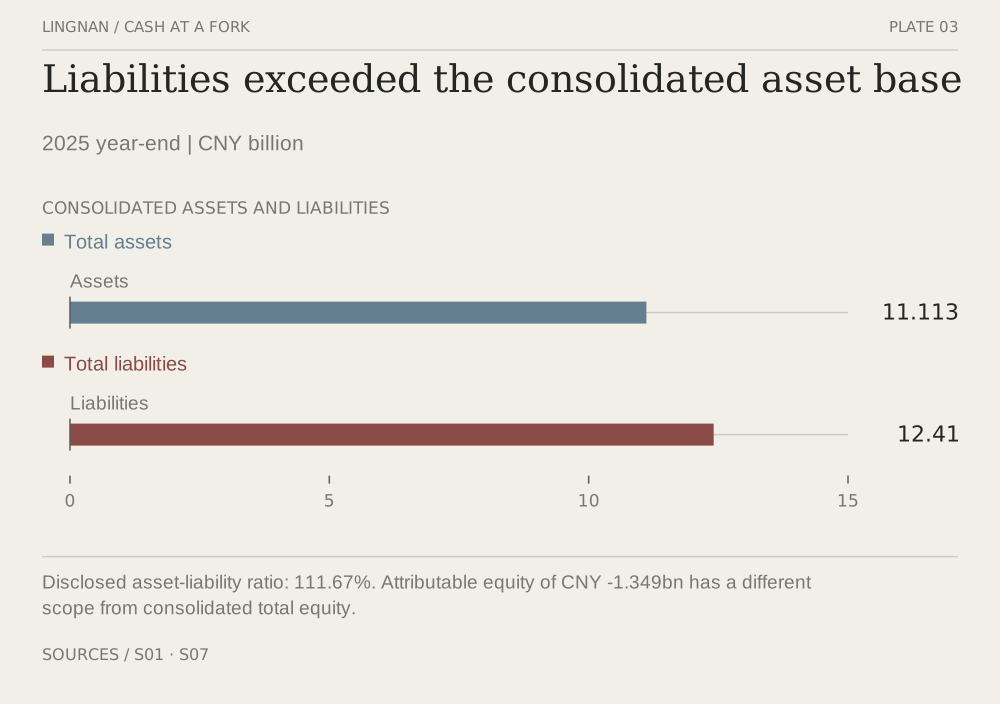
The balance sheet deteriorated at the same time. Total assets were approximately CNY 11.113 billion and total liabilities CNY 12.410 billion. Equity attributable to shareholders was negative CNY 1.349 billion. The company disclosed an asset-liability ratio of 111.67%, a current ratio of 0.56, and overdue debt. Its going-concern note states that these conditions indicate a material uncertainty that may cast significant doubt on the company’s ability to continue as a going concern, while management also described planned mitigating measures (S01, S07).
The audit layer is decisive. The annual report states that the financial statements received a disclaimer of opinion and that financial-reporting internal control received an adverse opinion (S01, S02). The board’s special explanation reproduces the basis for the audit limitation and acknowledges the auditor’s inability to obtain sufficient appropriate audit evidence in relevant areas (S03).
The regulatory record adds a separate governance issue. The 2025 annual report describes a Guangdong CSRC order to rectify concerning idle offering proceeds that had been temporarily used to supplement working capital and had not been fully returned. The company’s rectification disclosure linked the issue to severe liquidity pressure and stated that it would address repayment and management of the proceeds as normal cash flow recovered (S05, S06).
Subsequent public disclosures did not close the operating-recovery questions. The unaudited 2026 first-quarter report showed revenue of approximately CNY 39.7 million and a net loss attributable to shareholders of approximately CNY 133.5 million (S10). A July 2026 bond-trustee report continued to describe the convertible bond as unpaid at maturity and stated that certain procedures relating to pledged receivables and controlled collection accounts remained incomplete (S11). The trustee also cautioned that information quoted from company disclosures had not been independently verified. These updates do not establish the outcome of the company’s wider debt negotiations, but they show why the recovery assessment remained open at the information cutoff date.
Financial analysis
Revenue contraction changes the meaning of cash generation
Revenue fell 86.99% in 2025 (S01). At that scale of contraction, positive operating cash flow cannot automatically be treated as evidence that the underlying business model has recovered. A smaller project portfolio reduces spending on labor, subcontractors, materials, and mobilization. Collections from projects recognized in earlier periods may continue even when new production is weak. Payment timing may also alter annual cash flow.
None of these mechanisms makes the cash flow invalid. The question is repeatability. Investors need to know how much cash came from current-year revenue, collection of aged receivables, settlement of contract assets, tax refunds, deposits, or changes in payables. Without that bridge, the cash-flow improvement is useful but incomplete evidence.
Losses overwhelm the apparent liquidity improvement
The company’s CNY 2.336 billion attributable loss was more than twenty times 2025 revenue (S01). Part of the year’s result reflected major non-recurring and asset-related items. The annual report reported approximately CNY 611 million of investment income from the deconsolidation of a subsidiary following bankruptcy proceedings, yet the company still recorded a large overall loss (S01).
This matters because the income statement is not simply reporting weak margins on current work. It also reflects the reassessment, disposal, impairment, or deconsolidation of assets accumulated through prior operations. Investors should separate current operating losses from historical balance-sheet cleanup and one-off accounting effects.
Contract assets and receivables are the core asset-quality question
Lingnan’s annual report lists numerous contract-asset balances linked to project companies and government-related counterparties (S01). Contract assets represent rights to consideration that remain conditional on something other than the passage of time, often certification or completion milestones. In project businesses, recoverability depends on more than the contractual face amount: it depends on project completion, acceptance, settlement, counterparty funding, disputes, and enforceability.
The available public record supports scrutiny of these balances. It does not support a conclusion that the company understated impairment or that identified assets are uncollectible. A rigorous analysis requires ageing, project-by-project status, expected settlement dates, subsequent collections, litigation status, and the assumptions used in expected-credit-loss and impairment models.
Negative equity and overdue debt constrain operational choices
At year-end 2025, liabilities exceeded assets and the current ratio was 0.56 (S01, S07). The company also disclosed overdue debt. These figures matter because project businesses need working capital to bid, provide guarantees, mobilize subcontractors, and carry costs before settlement. Liquidity pressure can therefore affect both the balance sheet and the ability to generate future revenue.
Management disclosed possible mitigating measures: accelerate collections, seek renewals or extensions, increase financing where possible, dispose of assets, and reduce costs (S01). These are plausible responses. Their effectiveness depends on execution, creditor cooperation, asset marketability, and the timing of collections. Pre-announced measures are evidence of a plan, not evidence of completed recovery.
The disclaimer opinion limits confidence rather than proving error
A disclaimer of opinion is often misunderstood. It is not an adverse opinion stating that the financial statements are materially misstated. It is a statement that the auditor could not obtain sufficient appropriate evidence to form an opinion on the statements as a whole. That distinction is legally and analytically important (S02, S03).
For investors, however, the limitation remains serious. Reported balances may be management’s best estimates, but ordinary independent assurance is unavailable. Strong claims about recoverability, going concern, completeness of liabilities, or the sufficiency of impairment should therefore remain questions unless later evidence resolves them.
Internal-control weakness is a separate problem
The adverse internal-control opinion means that material weaknesses affected the company’s ability to maintain effective financial-reporting controls in all material respects at year-end (S01, S03). Control weakness can affect project settlement, impairment assessment, litigation completeness, debt recording, authorization, and financial-close procedures.
The company may remediate these weaknesses. But investors should look for measurable follow-through: named control owners, completed reconciliations, independent testing, audit-committee monitoring, and evidence that the relevant controls operated for a sufficient period.
Key Disclosure Issues
1. Positive cash flow requires a reconciliation
The improvement to CNY 264 million of operating cash flow is meaningful, but the 86.99% revenue decline means investors need to understand its sources (S01). A bridge between profit, project collections, contract-asset conversion, receivables, payables, and other working-capital movements would make the figure more decision-useful.
2. Project-asset recoverability cannot be assessed from aggregate balances alone
The annual report identifies substantial project-related balances across many counterparties (S01). Investors need project-level disclosure on ageing, settlement barriers, disputes, government funding, subsequent collection, and impairment assumptions. The issue is disclosure sufficiency, not a claim that the assets are misstated.
3. A disclaimer changes the confidence level of the entire report
The auditor’s inability to express an opinion means that investors cannot isolate the issue to a single ratio or balance without reading the detailed basis (S02, S03). Every strong interpretation should acknowledge the limitation.
4. Going-concern uncertainty must be stated without overreach
The company’s filings identify a material uncertainty related to going concern and describe mitigation plans (S01, S07). It would be improper to state that the company lacks going-concern ability. It would be equally incomplete to omit the disclosed uncertainty, negative equity, overdue debt, and low current ratio.
5. The offering-proceeds rectification issue links liquidity and governance
The regulatory measure concerning proceeds temporarily used for working capital and not fully returned shows how liquidity pressure can become a disclosure and compliance issue (S05, S06). The public record supports precise description of the measure. It does not support broader claims about misuse, intent, or unreported transactions.
How investors should read a project-company cash-flow reversal
The most useful way to analyze Lingnan’s 2025 cash flow is to separate four possible sources. The first is collection of receivables generated by prior-year revenue. That is economically positive because it converts accounting assets into cash, but it may not recur once the existing collection pool is exhausted. The second is conversion of contract assets after certification or settlement. This is also positive, but investors need to know which projects converted and at what discount or cost. The third is lower operating expenditure caused by reduced project activity. This preserves cash but may accompany a shrinking future revenue base. The fourth is extension of payment terms or accumulation of operating liabilities, which preserves current cash while shifting pressure forward.
The annual report’s aggregate cash-flow statement cannot, by itself, tell readers the relative importance of those mechanisms. Its reported CNY 264 million operating cash inflow is therefore a starting point rather than a complete conclusion (S01). A detailed reconciliation would materially improve investor understanding: beginning and ending receivables, contract assets, inventory, prepayments, payables, contract liabilities, payroll and tax balances, plus cash collected on major projects after year-end.
This framework avoids treating positive operating cash flow as either proof of recovery or evidence of manipulation. It recognizes the cash as reported while asking the accounting question that matters most: how repeatable was the conversion, and what obligations accompanied it?
Why project-level disclosure matters
Aggregate contract-asset and receivable balances can obscure the different economics of individual projects. A completed municipal project awaiting routine certification is not equivalent to a suspended tourism project facing a dispute. A receivable from a well-funded government entity is not equivalent to a claim against a thinly capitalized project company, even if both are classified under the same accounting caption.
For Lingnan, the annual report identifies numerous project-related balances across different entities (S01). Better investor disclosure would group the largest exposures by project stage, counterparty type, age, dispute status, expected settlement date, and subsequent cash collection. It would also explain whether claims are supported by signed progress certificates, final accounts, court judgments, guarantees, or other credit enhancements.
This information is especially important when the auditor cannot obtain enough evidence to express an opinion on the financial statements as a whole (S02, S03). Management may have performed detailed internal assessments, but the disclaimer means investors do not have ordinary audit assurance over the overall report. Project-level transparency can partly reduce that information gap, even though it cannot replace an audit opinion.
The interaction between liquidity and future revenue
Project businesses often require cash before they generate cash. They may need bid deposits, performance guarantees, materials, subcontractor mobilization, payroll, and construction spending before reaching billable milestones. Negative equity, overdue debt, and a current ratio below one can therefore affect more than near-term repayment capacity. They can constrain the company’s ability to execute new orders and maintain existing projects (S01, S07).
That interaction may help explain why revenue contracted so sharply. The company may also have deliberately withdrawn from low-return or cash-intensive work, which could improve future project quality. The public record does not allow a definitive allocation between strategic contraction and financing constraint. Investors should therefore ask for order data that distinguishes signed contracts, funded projects, active construction, suspended work, and projects awaiting settlement.
The same issue applies to asset disposals and debt extensions. Successful disposals may release cash, while extensions may reduce immediate repayment pressure. But both can have trade-offs: disposing of productive assets may reduce future earnings capacity, and extending debt may preserve principal obligations while adding interest or collateral requirements. A recovery narrative should disclose those economics, not only the completion of a transaction.
What would resolve the current audit uncertainty
The board’s special explanation gives investors the formal starting point: the auditor could not obtain sufficient appropriate evidence and therefore issued a disclaimer (S03). The next analytical step is to identify what evidence could change that result.
For project assets, the evidence may include third-party confirmations, signed settlement documents, subsequent collections, enforceable judgments, and support for impairment assumptions. For debt and litigation, it may include complete creditor confirmations, legal letters, enforcement records, and reconciliations of interest and penalties. For going concern, it may include executed financing agreements, completed asset sales, creditor waivers, funded operating plans, and cash forecasts tested against actual performance. For internal control, it may include remediation testing over a sustained period.
Investors should not assume that all of these items are absent. The point is that a disclaimer identifies an evidence gap at the audit level. A credible recovery can be demonstrated by closing that gap through subsequent public filings and a later audit report. Until then, the appropriate language is uncertainty, not accusation and not premature certainty.
A balanced interpretation of the 2025 record
The negative evidence is substantial: severe revenue contraction, a large loss, negative equity, overdue debt, a disclaimer opinion, and an adverse internal-control opinion (S01-S03, S07). The positive evidence is narrower but still meaningful: operating cash flow turned positive, management identified concrete liquidity measures, and collection efforts may have produced real cash benefits (S01).
A balanced report should preserve both sides. It should not treat the company’s mitigation plan as completed recovery. It should not treat the disclaimer as proof that every balance is misstated. It should not dismiss positive cash flow, and it should not allow that cash flow to override the audit and balance-sheet context.
Later filings can clarify the recovery through project-level collections, creditor settlements, control-testing results, and the evidence needed for the auditor to form an opinion.
Possible benign explanations
The company may have reasonable explanations for several patterns.
Positive operating cash flow may reflect successful collection of old project balances and disciplined reduction of cash outflows. Revenue contraction may be a deliberate withdrawal from low-quality or cash-intensive projects. Large impairment and loss items may represent a necessary balance-sheet cleanup. Government-related project counterparties may ultimately pay despite long settlement cycles. Creditor extensions, asset disposals, and shareholder or government support may provide time for restructuring. Control remediation may already be underway but not yet have operated long enough to change the audit conclusion.
These explanations are plausible, not proven. The right investor response is to seek subsequent evidence: collections, settlements, signed extensions, completed disposals, restored controls, and a later audit opinion with a clearly explained basis.
Questions investors should ask
- What portion of 2025 operating cash flow came from current-year operations versus collection of prior-year receivables and contract assets?
- Which payables or other operating liabilities increased or were deferred during the year?
- What are the ten largest contract-asset and receivable exposures by project, age, settlement status, and subsequent collection?
- Which balances and disclosures were most directly affected by the audit scope limitations?
- What specific evidence would the auditor need to obtain before expressing an opinion?
- What is the amount, maturity, counterparty, collateral, and current status of overdue debt?
- How much cash is unrestricted and available for ordinary operations?
- What progress has been made on returning the temporarily supplemented offering proceeds?
- Which material internal-control weaknesses have been remediated, and for how long have the new controls operated?
- How much future revenue can be supported by funded, executable orders rather than unsigned frameworks or suspended projects?
Conclusion
Lingnan’s positive operating cash flow is not irrelevant. It may reflect genuine collection efforts and tighter cash discipline. But public filings do not allow that one figure to carry the entire recovery narrative. Revenue collapsed, losses widened, shareholder equity turned negative, debt remained overdue, and the auditor could not obtain sufficient evidence to express an opinion on the financial statements as a whole (S01-S03, S07).
The company has reported cash preservation and collection. The unresolved questions are whether project assets can be realized in time to meet obligations, whether operations can return to profit, and whether the missing audit evidence can be obtained.
This is not a conclusion of misconduct, and it is not a prediction of failure. It is a disclosure-quality judgment. When a project company’s accounting depends heavily on settlement and recoverability, and ordinary audit assurance is unavailable, investors need more granular evidence than a positive cash-flow headline.
Disclaimer
This report is based solely on public information available as of the information cutoff date. It is prepared for educational and investor-protection purposes only. It does not constitute investment advice, legal advice, accounting advice, or a recommendation to buy, sell, or hold any security. The author does not claim that any company or individual has engaged in misconduct unless such a finding has been made by a competent authority. Readers should conduct their own due diligence.
Selected source table
| Source number | Source title | Date | Relevance | Public link |
|---|---|---|---|---|
| S01 | 岭南生态文旅股份有限公司2025年年度报告 | 2026-04-29 | Financial statements, cash flow, project assets, debt and going-concern disclosure | Public filing mirror |
| S02 | 岭南生态文旅股份有限公司2025年年度报告摘要 | 2026-04-29 | Disclaimer opinion and accumulated-loss warning | Public filing PDF |
| S03 | 关于对无法表示意见的审计报告和否定意见的内部控制审计报告涉及事项的专项说明 | 2026-04-29 | Basis for disclaimer and adverse internal-control opinion | SZSE |
| S04 | 岭南生态文旅股份有限公司2024年年度报告 | 2025-04-29 | Comparative 2024 financial data | Public filing PDF |
| S05 | 关于对岭南生态文旅股份有限公司采取责令改正措施的决定〔2025〕22号 | 2025-03-17 | Regulator’s original decision concerning offering proceeds | Guangdong CSRC |
| S06 | 关于广东证监局对公司采取责令改正措施决定的整改报告 | 2025-04-12 | Company explanation and remediation measures | CNINFO |
| S07 | 2025年年度报告持续经营与风险警示披露 | 2026-04-29 | Negative equity, leverage, overdue debt and going-concern uncertainty | Public filing mirror |
| S08 | 2025年度审计报告(尤振审字〔2026〕第0549号) | 2026-04-29 | Independent disclaimer of opinion and its basis | Public filing PDF |
| S09 | 2025年度内部控制审计报告(尤振专审字〔2026〕第0231号) | 2026-04-29 | Independent adverse internal-control opinion | Public filing PDF |
| S10 | 2026年第一季度报告 | 2026-04-29 | Latest periodic operating update through the cutoff | Public filing PDF |
| S11 | 2026年度第十七次临时受托管理事务报告 | 2026-07-08 | Convertible-bond, pledged-receivable, litigation and risk update | SZSE |