China Fortune Land's Unfinished Debt Workout
Debt settlements have changed reported earnings, but operating cash remains under pressure and the recovery of large contract assets depends on unresolved restructuring assumptions.
- Company
- China Fortune Land Development Co., Ltd.
- Ticker
- 600340.SH
- Published
- June 29, 2026
- Information cutoff
- June 28, 2026
Why this matters
The case shows why headline restructuring progress should be read together with operating cash flow, asset recoverability, audit qualifications, guarantees, and governance disclosures.
Evidence snapshot
The figures that frame the review
- 2025 revenue
- CNY 8.603bn Source S01
- 2025 net loss
- CNY 22.859bn Attributable to shareholders, S01
- 2025 operating cash flow
- CNY -3.573bn Source S01
- Contract assets
- 39.52% Of total assets at 2025 year-end, S01/S02
Executive summary
Debt restructuring progress at China Fortune Land Development Co., Ltd. (华夏幸福基业股份有限公司, 600340.SH; “China Fortune Land” or “the company”) is real. The company has disclosed years of debt restructuring work, pre-restructuring proceedings, asset-disposal efforts, and housing-delivery obligations after liquidity risk emerged from the fourth quarter of 2020 onward (S01, S12, S16, S21, S23). But those developments do not answer the harder investor question: whether public filings give enough clarity on operating cash flow, contract asset recoverability, contingencies, and going-concern disclosure.
The market narrative is easy to summarize: debt risk resolution and possible restructuring. The accounting record is harder to read. In 2025, China Fortune Land reported revenue of CNY 8.603 billion, a net loss attributable to shareholders of CNY 22.859 billion, negative operating cash flow of CNY 3.573 billion, and negative equity attributable to shareholders of CNY 17.743 billion (S01). In the first quarter of 2026, the company reported revenue of CNY 853 million, a net loss attributable to shareholders of CNY 1.701 billion, negative operating cash flow of CNY 778 million, and negative equity attributable to shareholders of CNY 19.080 billion (S04).
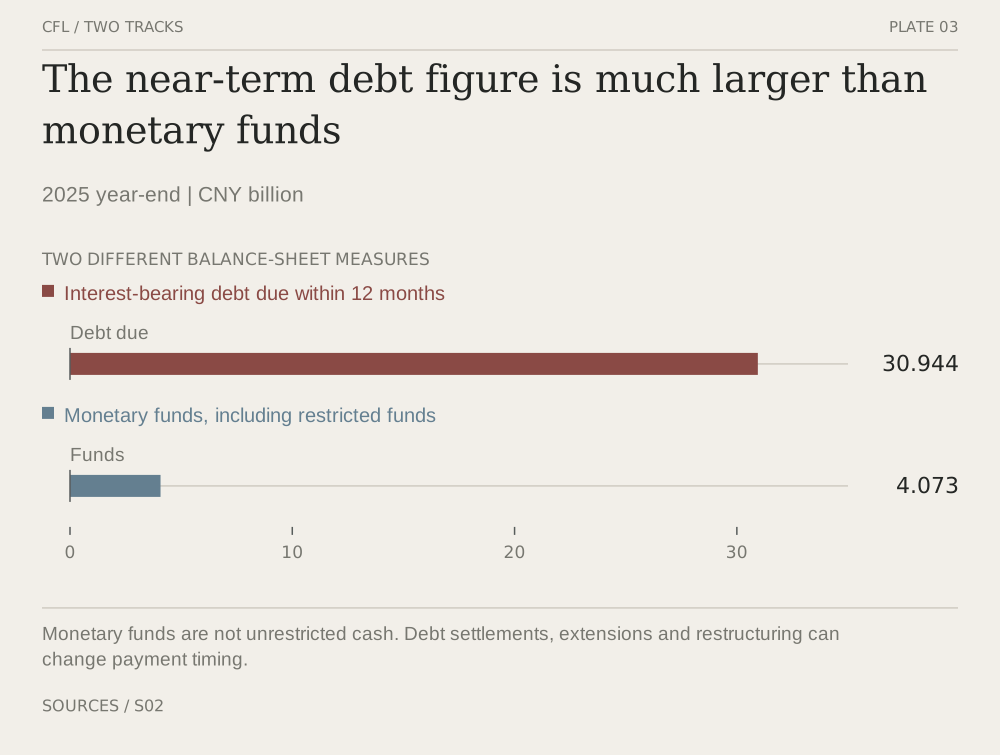
The 2025 audit opinion is difficult for investors to ignore. The auditor issued a qualified opinion on the 2025 financial statements. The qualified matters involved going-concern disclosure, contract asset impairment allowance, and contingencies (S02). The audit report stated that, at the end of 2025, the company had interest-bearing liabilities of CNY 138.068 billion, of which CNY 30.944 billion would mature within the next 12 months, while monetary funds included restricted funds of CNY 4.073 billion (S02). That combination makes it harder for ordinary investors to separate debt-workout progress from still-large uncertainty around cash flow, asset recoverability, and contingent liabilities.
The central asset-quality issue is contract assets. At the end of 2025, contract assets were CNY 100.916 billion, equal to 39.52% of total assets (S01, S02). The auditor stated that it was unable to obtain sufficient appropriate audit evidence to confirm the accuracy and sufficiency of the impairment allowance for contract assets (S02). The public record supports a powerful but narrower point: recoverability assumptions are central to understanding the company’s asset quality, and the auditor’s qualification makes that issue highly material for investors.
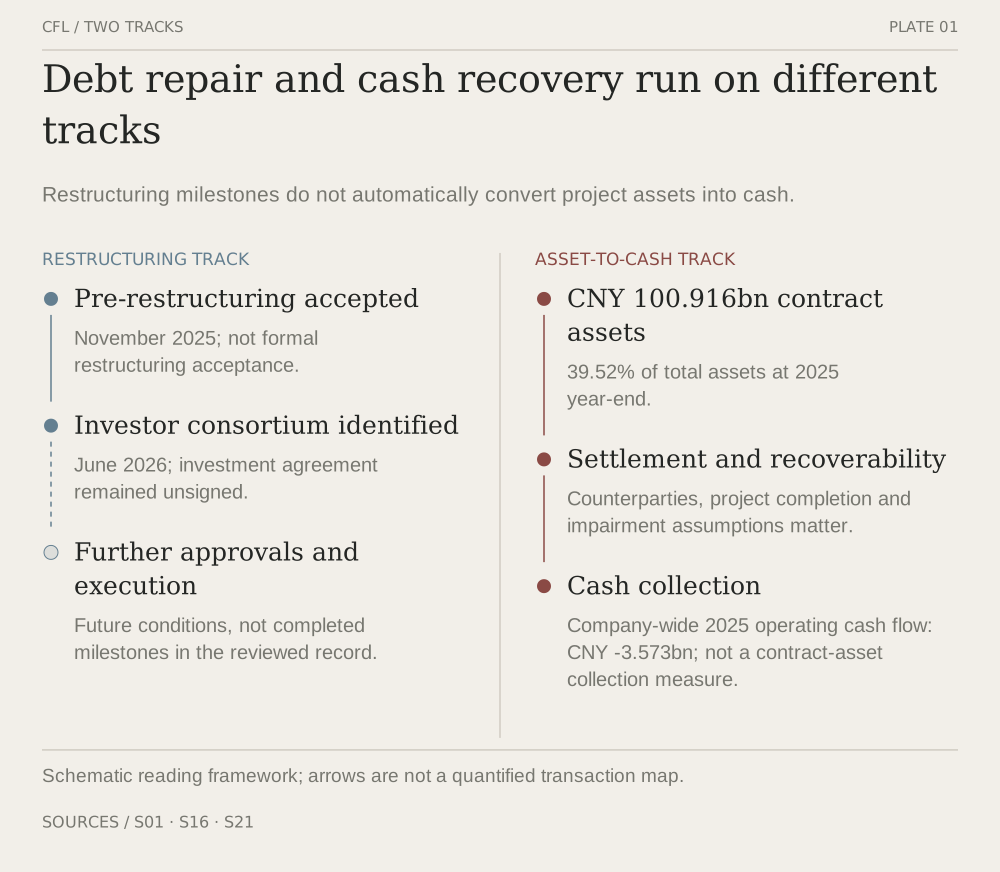
The pre-restructuring narrative also requires care. In November 2025, the court decided to accept the company’s pre-restructuring, but the company disclosed that pre-restructuring does not mean that the court has formally accepted a restructuring application, and that the success of pre-restructuring and entry into formal restructuring remained uncertain (S16). In June 2026, the company disclosed that a consortium had been selected as the restructuring investor, but that the restructuring investment agreement had not yet been signed and uncertainty remained (S21).
Finally, the governance context belongs in the financial analysis. In June 2026, China Fortune Land disclosed that its controlling shareholder, 华夏幸福基业控股股份公司, held 520.09 million shares, or 13.36% of total share capital, and that 413.14 million of those shares had been frozen, equal to 79.44% of the controlling shareholder’s holdings (S22). The same announcement disclosed that the controlling shareholder had overdue financing principal of CNY 4.617 billion as of May 31, 2026 and faced multiple material lawsuits or arbitration proceedings (S22). Another June 2026 announcement disclosed that the controlling shareholder and parties acting in concert had pledged 484.77 million shares, equal to 82.81% of their holdings, and that the controlling shareholder’s China Fortune Land shares were subject to forced liquidation risk (S25). The company also disclosed that the controlling shareholder and parties acting in concert did not harm the listed company’s interests through non-operating funds occupation, improper guarantees, or related-party transactions (S25). The tension is governance-related rather than accusatory: controlling-shareholder debt stress, share freezes, pledges, and restructuring uncertainty all complicate how investors assess control stability.
Why this matters
China Fortune Land sits at the intersection of several issues that matter beyond a single listed company.
First, the case shows why headline debt restructuring progress can be analytically incomplete. As of May 31, 2026, the company disclosed that financial debt covered by its debt restructuring plan had reached approximately CNY 192.669 billion through signed agreements and other methods, while cumulative debt not repaid on schedule was CNY 27.442 billion, excluding interest (S23). Those numbers show substantial restructuring activity. They do not, by themselves, answer whether the company can generate operating cash flow, whether asset values are recoverable, or whether contingent liabilities have been fully captured.
Second, the case shows why non-cash restructuring gains must be separated from operating performance. In its reply to the Shanghai Stock Exchange’s regulatory work letter on the 2022 annual report, the company disclosed that 2022 debt restructuring involved financial debt of CNY 136.540 billion and investment income of CNY 25.532 billion, with additional debt settlement effects from equity-based arrangements (S13). The company reported positive net profit attributable to shareholders in 2022, but adjusted net profit after non-recurring items remained deeply negative (S11). For ordinary investors, that difference matters. A profit created or materially affected by debt restructuring does not carry the same informational meaning as profit generated by recurring operations.
Third, the case illustrates the public-interest role of audit opinions. A qualified audit opinion is not an accusation, but it is a professional warning that investors should read carefully. In this case, the qualified opinion touches the exact areas that shape investor understanding: going-concern disclosure, contract asset impairment, and contingencies (S02).
Fourth, the case helps English-language readers understand a feature of China’s restructuring market: pre-restructuring is a process, not an outcome. The company disclosed that pre-restructuring does not equal formal court acceptance of restructuring, and later disclosed that even after a selected investor consortium was identified, the restructuring investment agreement had not yet been signed (S16, S21). For investors, that distinction is not technical. It is central.
Company background and market narrative
China Fortune Land is an A-share listed company on the Shanghai Stock Exchange. Historically, the company focused on industry-city development, property development, and related services (S01, S12). After liquidity risk emerged, the company’s public narrative shifted toward debt risk resolution, asset disposals, housing delivery, and restructuring-related progress (S01, S16, S23).
The company has continued to disclose debt restructuring progress over multiple years. Public filings show large financial debt restructuring amounts, debt settlements through trust arrangements, equity interests used to settle financial and operating debt, ongoing overdue debt, and new litigation or arbitration matters (S23, S29, S30). Together, these disclosures support a clear market narrative: the company is trying to move from liquidity crisis toward debt resolution.
The analytical problem is that restructuring progress and operating recovery are different questions. A company can make progress in restructuring agreements while still reporting negative operating cash flow. It can reduce or reorganize debt while still holding large contract assets whose recoverability depends on complex assumptions. It can enter pre-restructuring while formal restructuring remains uncertain. The filings reviewed here point to all of these tensions.
The market narrative therefore needs to be reframed. The investor question is not simply whether China Fortune Land has made progress in debt restructuring. The better question is whether the company’s disclosures allow investors to understand the remaining pressure from operating cash flow, contract asset recoverability, contingencies, and going-concern uncertainty.
What the filings show
The filings show a company with a shrinking operating base, continuing losses, negative operating cash flow, large judgment-heavy assets, and an audit report that directly flags key disclosure questions.
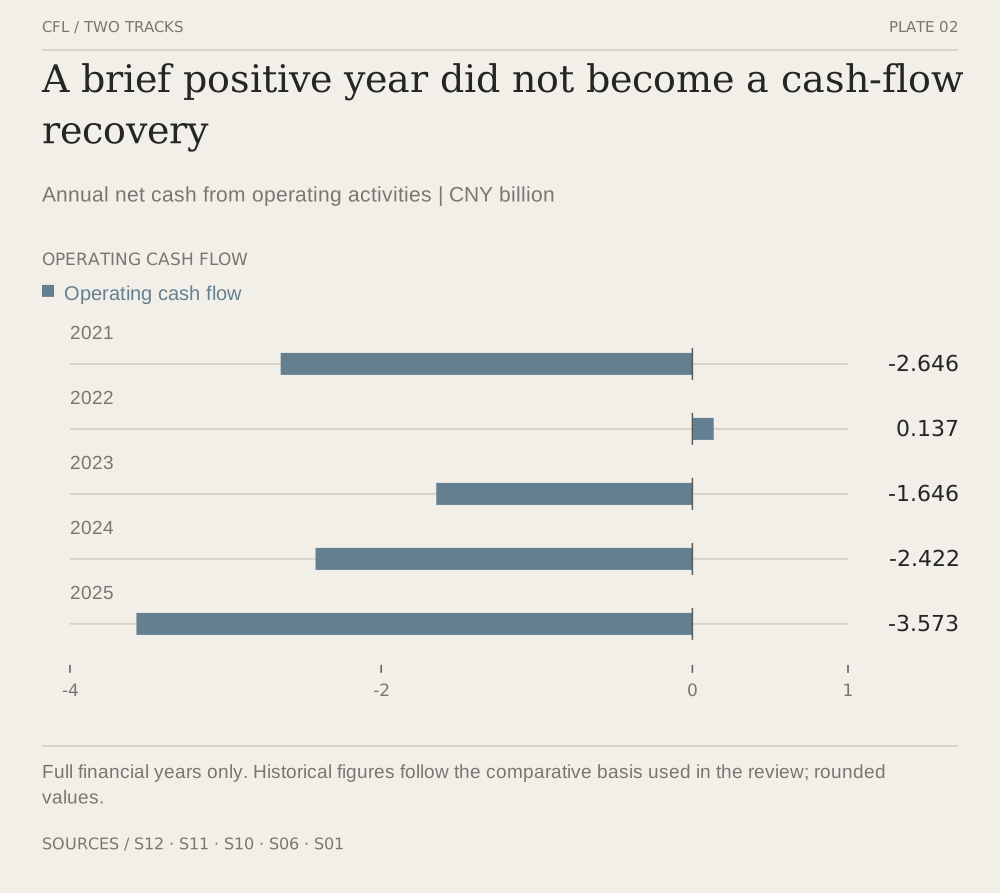
Revenue fell from CNY 43.181 billion in 2021 to CNY 8.603 billion in 2025 (S12, S01). Net profit attributable to shareholders was negative in 2021, positive in 2022, and negative again from 2023 through 2025 (S12, S11, S10, S06, S01). The 2022 positive result must be read alongside the company’s own disclosure that debt restructuring gains materially affected that year’s financial statements (S13). Operating cash flow was negative in 2021, barely positive in 2022, and negative again from 2023 through 2025 (S12, S11, S10, S06, S01). In the first quarter of 2026, operating cash flow remained negative (S04).
The balance sheet also changed in a way that should focus investor attention. At the end of 2025, equity attributable to shareholders was negative CNY 17.743 billion; by the end of 2026Q1 it was negative CNY 19.080 billion (S01, S04). Contract assets were CNY 100.916 billion at the end of 2025, equal to 39.52% of total assets (S01, S02). Inventory was CNY 61.168 billion, accounts receivable were CNY 24.582 billion, and other receivables were CNY 14.504 billion (S01). These items are not cash. Their value depends on recoverability, project completion, counterparty performance, disposal outcomes, impairment assumptions, and restructuring progress.
The 2025 audit report brings these issues into sharp focus. The auditor issued a qualified opinion on the financial statements. The qualified matters involved: going-concern disclosure; the impairment allowance for contract assets; and contingencies, including litigation and arbitration matters (S02). The company also received a standard unmodified internal control audit opinion for 2025 (S03). That distinction is important. The financial statement audit qualification should not be transformed into a broad statement that internal control failed. Even so, the qualified audit opinion makes the affected financial statement disclosures difficult for ordinary investors to treat as routine.
Public filings also show continuing uncertainty around the restructuring path. The court accepted the company’s pre-restructuring in November 2025, but the company stated that this did not amount to formal acceptance of a restructuring application and that success remained uncertain (S16). In June 2026, it identified a selected restructuring investor consortium, but the investment agreement had not yet been signed (S21). The filings reviewed through the information cutoff do not show court acceptance of formal restructuring (S16, S21).
Financial analysis
1. Debt restructuring gains are not operating cash flow
China Fortune Land’s 2022 financial statements provide a central caution. In 2022, the company reported positive net profit attributable to shareholders, while adjusted net profit after non-recurring items remained sharply negative (S11). The Shanghai Stock Exchange later focused on debt restructuring gains and related effects in the company’s 2022 annual report review process (S13). In its reply, the company disclosed that 2022 debt restructuring involved financial debt of CNY 136.540 billion and investment income of CNY 25.532 billion, along with other debt settlement effects (S13).
This matters because debt restructuring gains can improve reported profit without indicating that the core business is generating cash. That is not a criticism of the accounting treatment by itself. Debt restructuring can be real, economically meaningful, and necessary for a distressed company. But investors should not read restructuring gains in the same way they read recurring operating profit.
The operating cash flow trend is difficult to ignore. Operating cash flow was negative CNY 2.646 billion in 2021, positive CNY 137 million in 2022, negative CNY 1.646 billion in 2023, negative CNY 2.422 billion in 2024, negative CNY 3.573 billion in 2025, and negative CNY 778 million in 2026Q1 (S12, S11, S10, S06, S01, S04). The trajectory does not show a clear operating cash flow recovery, making debt restructuring, asset resolution, and restructuring-related developments important variables in the investor analysis.
The restructuring gains therefore need to be read separately from operating cash flow. They can improve reported earnings while collections, asset recovery, and contingent liabilities remain unresolved.
2. Contract asset recoverability is the core asset-quality issue
At the end of 2025, contract assets were CNY 100.916 billion, equal to 39.52% of total assets (S01, S02). That single line item is central to any investor assessment of China Fortune Land. In the reviewed 2025 balance sheet data, contract assets were larger than inventory, accounts receivable, other receivables, monetary funds, fixed assets, and construction in progress as separate line items (S01).
Contract assets are not inherently problematic. In project-based businesses, they may reflect rights arising from performance already completed but not yet unconditionally receivable. For a company with industry-city development and property-related activities, the economics can be complex. Recoverability may depend on government or platform counterparties, project completion, settlement arrangements, restructuring plans, and timing of cash flows.
The issue here is that the auditor qualified the 2025 financial statements partly because of contract asset impairment allowance. The audit report stated that management’s impairment calculation involved key assumptions including whether the restructuring plan could be approved, court rulings, and the probability of successful restructuring, and that the auditor was unable to obtain sufficient appropriate audit evidence to confirm the accuracy and sufficiency of the impairment allowance (S02).
With almost 40% of total assets in contract assets, the missing audit evidence concerns a large part of the balance sheet. Investors cannot assess recoverability from the aggregate balance alone.
The question investors should ask is not only “what is the balance?” It is also: who are the counterparties, what are the contractual settlement mechanisms, what cash has been collected after year-end, how are restructuring assumptions embedded in impairment estimates, and what happens to recoverability if formal restructuring is delayed or materially changed?
3. The qualified audit opinion is a disclosure event
The 2025 audit opinion is one of the strongest pieces of evidence in this case because it is part of the company’s audited public record (S02).
The auditor’s qualified opinion covered three areas: going-concern disclosure, contract asset impairment allowance, and contingencies (S02). Each area is directly connected to investor understanding.
The going-concern issue is tied to the company’s debt maturity and liquidity profile. The audit report disclosed that, at the end of 2025, the company had interest-bearing liabilities of CNY 138.068 billion, with CNY 30.944 billion due within the next 12 months, while monetary funds included restricted funds of CNY 4.073 billion (S02). The auditor also focused on uncertainty related to pre-restructuring and whether the company had sufficiently disclosed matters needed to eliminate the material uncertainty related to going concern (S02).
The contract asset issue is tied to asset recoverability and impairment. As discussed above, the auditor was unable to obtain sufficient appropriate audit evidence regarding impairment allowance accuracy and sufficiency (S02).
The contingency issue concerns litigation, arbitration, and related obligations. The auditor described numerous cases, some under trial or enforcement, with significant uncertainty around outcomes and compensation amounts. It could not obtain sufficient appropriate evidence to confirm the accuracy and completeness of the related liability provisions (S02).
The audit opinion should be read precisely. It is not a regulatory finding, and it does not by itself establish that assets are misstated. It does mean that investors should treat the affected disclosures as areas requiring close scrutiny.
4. Pre-restructuring progress is not the same as risk resolution
China Fortune Land’s pre-restructuring progress is important. It may provide a path toward a broader debt resolution. But it should not be described as if the restructuring risk has already been resolved.
In November 2025, the court decided to accept the company’s pre-restructuring. The company disclosed that creditors applied on the basis that the company had failed to repay matured debts on schedule and apparently lacked repayment capacity, while still having restructuring value (S16). The same announcement stated that pre-restructuring does not mean the court had formally accepted a restructuring application, and that success and entry into restructuring remained materially uncertain (S16).
In June 2026, the company disclosed that the temporary administrator had identified a consortium of 杭州骋风而来数字科技有限公司 and 南阳木兰花置业有限公司 as the selected restructuring investor. The company also disclosed that the restructuring investment agreement had not yet been signed and that uncertainty remained over whether the agreement could be signed and whether the company could enter formal restructuring (S21).
For investors, the distinction is fundamental. Pre-restructuring may be a constructive development. It may create a framework for creditor negotiation. It may help identify restructuring investors. But until formal restructuring steps are completed, it does not by itself resolve questions about debt maturity, asset recoverability, guarantee exposure, litigation, or going-concern disclosure.
5. Guarantees and contingencies add another layer of uncertainty
The company’s guarantee and contingent liability disclosures deepen the investor-protection concern.
In June 2026, China Fortune Land disclosed that, as of March 31, 2026, the company and its controlled subsidiaries had total external guarantees of CNY 117.036 billion, equal to 659.62% of the absolute value of the latest audited net assets attributable to shareholders; overdue guarantees were CNY 27.022 billion (S24). The same announcement involved an extension of a guarantee for a special “housing delivery” loan for a wholly owned subsidiary, with a maximum secured claim amount of CNY 108 million and no counter-guarantee arrangement. The announcement also identified the guaranteed party as a 失信被执行人, a PRC court enforcement status commonly translated as a judgment defaulter or dishonest judgment debtor (S24).
The use of the absolute value of net assets matters because the company’s equity attributable to shareholders was negative (S01, S24). The denominator requires care, but the scale of guarantees and overdue guarantees remains material.
The auditor’s contingency qualification adds further weight. The audit report’s qualified matters included contingencies, with uncertainty around litigation and arbitration outcomes and the completeness and accuracy of related provisions (S02). For a company already under debt stress, that disclosure and audit-evidence issue matters.
6. Controlling-shareholder risk is a governance issue, not a shortcut to allegations
The company’s June 2026 announcements provide a serious governance context.
The controlling shareholder held 520.09 million shares, or 13.36% of total share capital, and 413.14 million shares were frozen, equal to 79.44% of its holdings (S22). The company disclosed that the controlling shareholder had overdue financing principal of CNY 4.617 billion as of May 31, 2026 and faced multiple material lawsuits or arbitration proceedings (S22).
The actual controller share pledge announcement disclosed that the controlling shareholder and parties acting in concert had pledged 484.77 million shares, equal to 82.81% of their holdings, and that the controlling shareholder’s China Fortune Land shares were subject to forced liquidation risk (S25).
These facts are relevant to control stability, governance oversight, financing conditions, and market confidence. The company disclosed that the controlling shareholder and parties acting in concert did not harm the listed company’s interests through non-operating funds occupation, improper guarantees, or related-party transactions (S25). With that balancing point included, the investor question is how the controlling shareholder’s own debt stress, share freezes, pledges, and possible forced liquidation risk may affect governance stability during a restructuring-sensitive period.
Key Disclosure Issues
-
Qualified audit opinion on core investor issues. The 2025 qualified opinion involved going-concern disclosure, contract asset impairment allowance, and contingencies (S02).
-
Large contract assets with audit evidence limitations. Contract assets were CNY 100.916 billion, equal to 39.52% of total assets, and the auditor was unable to obtain sufficient appropriate audit evidence over impairment allowance accuracy and sufficiency (S01, S02).
-
Negative operating cash flow during debt restructuring. Operating cash flow was negative in 2023, 2024, 2025, and 2026Q1 (S10, S06, S01, S04).
-
Negative equity attributable to shareholders. Equity attributable to shareholders was negative CNY 17.743 billion at the end of 2025 and negative CNY 19.080 billion at the end of 2026Q1 (S01, S04).
-
Large interest-bearing liabilities and near-term maturities. The 2025 audit report disclosed CNY 138.068 billion of interest-bearing liabilities, including CNY 30.944 billion due within 12 months (S02).
-
Pre-restructuring remains uncertain. Court acceptance of pre-restructuring did not equal formal restructuring acceptance, and the June 2026 investor-selection progress still left the investment agreement unsigned (S16, S21).
-
High guarantee exposure and overdue guarantees. As of March 31, 2026, total external guarantees were CNY 117.036 billion and overdue guarantees were CNY 27.022 billion (S24).
-
Controlling-shareholder share freeze and pledge pressure. The controlling shareholder had 79.44% of its holdings frozen, while the controlling shareholder and parties acting in concert had 82.81% of their holdings pledged (S22, S25).
Possible benign explanations
A fair investor disclosure review should also consider reasonable explanations.
First, debt restructuring gains are not inherently suspect. In a distressed company, restructuring debt can be a legitimate and necessary way to preserve value, reduce near-term cash pressure, and create a path toward operational stabilization. The issue is not that the company had restructuring gains. The issue is that investors must separate restructuring effects from recurring operating performance (S13).
Second, contract assets are not inherently low-quality. The company’s historical industry-city development model may naturally generate contract assets tied to long-cycle projects and government or platform settlement arrangements. The problem is that the size of the balance, the dependence on recoverability assumptions, and the qualified audit opinion make the disclosure burden heavier (S01, S02).
Third, pre-restructuring progress may be meaningful. The court’s acceptance of pre-restructuring, the appointment of a temporary administrator, and identification of a selected restructuring investor are real procedural developments (S16, S18, S21). They may improve coordination among creditors and potential investors. The limitation is that they do not yet equal completed restructuring.
Fourth, guarantee arrangements may be connected to housing delivery, subsidiary financing, and legacy project resolution. The June 2026 guarantee extension involved a special housing-delivery loan for a wholly owned subsidiary (S24). In the property sector, such arrangements can be tied to project completion and public-policy objectives. That does not remove the need to analyze scale, overdue amounts, counter-guarantees, and contingent liability recognition.
Fifth, controlling-shareholder stress should be analyzed through control stability and transparency. The company disclosed that there was no non-operating funds occupation, improper guarantee, or related-party transaction harming listed company interests by the controlling shareholder and parties acting in concert (S25).
Questions investors should ask
-
What specific assumptions drive the contract asset impairment allowance, especially assumptions linked to restructuring approval, court rulings, and restructuring success probability (S02)?
-
What are the largest contract asset counterparties, project types, aging profiles, and post-year-end collection outcomes?
-
How much of reported profitability in recent years came from recurring operations versus debt restructuring gains or other non-recurring effects (S11, S13)?
-
What explains continuing negative operating cash flow in 2023, 2024, 2025, and 2026Q1 despite debt restructuring progress (S10, S06, S01, S04)?
-
What additional disclosure would help investors understand the link between pre-restructuring progress and the recoverability of contract assets, inventory, and receivables (S02, S16, S21)?
-
What is the expected timeline for signing the restructuring investment agreement, and what conditions remain before formal restructuring can be accepted by the court (S21)?
-
How should investors evaluate CNY 117.036 billion of total external guarantees and CNY 27.022 billion of overdue guarantees when equity attributable to shareholders is negative (S01, S24)?
-
What is the potential financial statement impact of litigation and arbitration outcomes that remain uncertain (S02, S23)?
-
How might the controlling shareholder’s share freezes, pledges, overdue financing debt, and possible forced liquidation risk affect governance stability during the pre-restructuring period (S22, S25)?
-
What subsequent events after June 28, 2026 might materially change the analysis, including court acceptance of formal restructuring, signing of a restructuring investment agreement, shareholder meeting results, or new debt restructuring disclosures?
Conclusion
China Fortune Land’s public filings tell a more complicated story than a simple debt-workout narrative. The company has made and disclosed substantial debt restructuring progress. It has entered pre-restructuring. A selected restructuring investor consortium has been identified. These are important developments (S16, S21, S23).
But public filings also show continuing operating cash flow pressure, negative equity attributable to shareholders, large contract assets, large guarantee exposure, overdue guarantees, controlling-shareholder share freezes and pledges, and a qualified audit opinion that directly addresses going-concern disclosure, contract asset impairment allowance, and contingencies (S01, S02, S04, S22, S24, S25).
The next milestones to watch are court acceptance of formal restructuring, a signed investment agreement, and evidence of collections from contract assets. Those developments would help investors assess whether the debt workout is improving cash available to meet obligations, as well as reported earnings.
Disclaimer
This report is based solely on public information available as of June 28, 2026, as reviewed in the project source table. It is prepared for educational and investor protection purposes only. It does not constitute investment advice, legal advice, accounting advice, tax advice, or a recommendation to buy, sell, hold, short, or avoid any security. The author does not claim that any company or individual has engaged in misconduct unless such finding has been made by a competent authority. Readers should conduct their own due diligence and consult qualified professional advisers where appropriate.
Selected source table
| Source number | Source | Date | Relevance | Link |
|---|---|---|---|---|
| S01 | 华夏幸福:2025年年度报告 | 2026-04-30 | 2025 revenue, loss, operating cash flow, negative equity, contract assets, inventory, receivables. | CNINFO |
| S02 | 华夏幸福:2025年度审计报告 | 2026-04-30 | Qualified audit opinion; going-concern disclosure; contract asset impairment; contingencies; debt and cash context. | CNINFO |
| S03 | 华夏幸福:2025年度内部控制审计报告 | 2026-04-30 | Standard unmodified internal control audit opinion, useful as balancing evidence. | CNINFO |
| S04 | 华夏幸福:2026年第一季度报告 | 2026-04-30 | Latest quarterly revenue, loss, operating cash flow, and negative equity. | CNINFO |
| S06 | 华夏幸福:2024年年度报告 | 2025-04-30 | 2024 revenue, losses, operating cash flow, and debt restructuring gains. | CNINFO |
| S10 | 华夏幸福:2023年年度报告 | 2024-04-30 | 2023 revenue, losses, operating cash flow, and contract asset balance. | CNINFO |
| S11 | 华夏幸福:2022年年度报告 | 2023-04-29 | 2022 positive net profit, adjusted loss, and operating cash flow. | CNINFO |
| S12 | 华夏幸福:2021年年度报告 | 2022-04-30 | Earlier liquidity-stress period and long-term trend baseline. | CNINFO |
| S13 | 华夏幸福关于上海证券交易所对公司2022年年度报告的信息披露监管工作函的回复公告 | 2023-07-11 | Debt restructuring gains and SSE review context. | CNINFO |
| S16 | 华夏幸福:关于法院决定受理公司预重整的公告 | 2025-11-17 | Pre-restructuring acceptance and uncertainty warning. | CNINFO |
| S18 | 华夏幸福:关于法院指定公司预重整临时管理人的公告 | 2025-11-18 | Appointment of temporary administrator in pre-restructuring. | CNINFO |
| S21 | *ST华幸:华夏幸福关于公司预重整事项的进展公告 | 2026-06-11 | Selected restructuring investor consortium and unsigned investment agreement. | CNINFO |
| S22 | *ST华幸:关于控股股东股份被司法冻结、轮候冻结的公告 | 2026-06-13 | Controlling-shareholder share freeze, overdue financing debt, and lawsuits/arbitrations. | CNINFO |
| S23 | 华夏幸福基业股份有限公司关于债务重组进展等事项的公告 | 2026-06-18 | Latest debt restructuring progress and overdue debt as of May 31, 2026. | CNINFO |
| S24 | 华夏幸福基业股份有限公司关于为全资子公司提供担保展期的公告 | 2026-06-18 | Total guarantees, overdue guarantees, and guarantee extension details. | CNINFO |
| S25 | 华夏幸福基业股份有限公司关于实际控制人股份质押的公告 | 2026-06-13 | Share pledge pressure, forced liquidation risk, and balancing disclosure on no funds occupation/improper guarantees/related-party harm. | CNINFO |
| S29 | 华夏幸福:关于债务逾期、债务重组进展等事项的公告 | 2024-02-20 | Historical debt overdue, restructuring progress, debt settlement and litigation background. | CNINFO |
| S30 | 华夏幸福:关于债务逾期、债务重组进展等事项的公告 | 2023-12-16 | Earlier historical debt overdue and restructuring progress background. | CNINFO |