Jilin Sino-Microelectronics: What Repayment Resolves
The occupied funds have been recovered. Investors still need to distinguish that cash inflow from operating performance and examine how the controls that failed have changed.
- Company
- Jilin Sino-Microelectronics Co., Ltd.
- Ticker
- 600360.SH
- Published
- August 10, 2026
- Information cutoff
- August 9, 2026
Why this matters
Repayment can restore cash and eliminate a receivable, but investors still need evidence showing how the control failure occurred, how it was tested and what prevents recurrence.
Evidence snapshot
The figures that frame the review
- Funds recovered
- CNY 1.567bn Principal and interest, S04
- 2025 revenue
- CNY 2.235bn Source S01
- 2025 net profit
- CNY 173m Attributable to shareholders, S01
- Operating cash flow
- CNY 233m 2025, S01
Executive summary
Jilin Sino-Microelectronics Co., Ltd. (吉林华微电子股份有限公司, 600360.SH; “JSMC” or “the company”) has reported full repayment after a serious funds-occupation case. Its formal English name appears in its articles of association (S07). The recovery addresses the outstanding balance; the later record must also be read for evidence that the controls which failed now work.
The 2024 audit record was unusually consequential. The company’s board stated that its auditor issued a disclaimer of opinion on the 2024 financial statements and an adverse opinion on financial-reporting internal control. The underlying matter was non-operating funds occupation by the then controlling shareholder and related parties. At the audit-report date, the disclosed outstanding balance was approximately CNY 1.491 billion. The auditor was unable to obtain sufficient evidence about the shareholder’s repayment capacity and therefore could not determine the recoverability of the occupied funds or the related credit-impairment charge (S02).
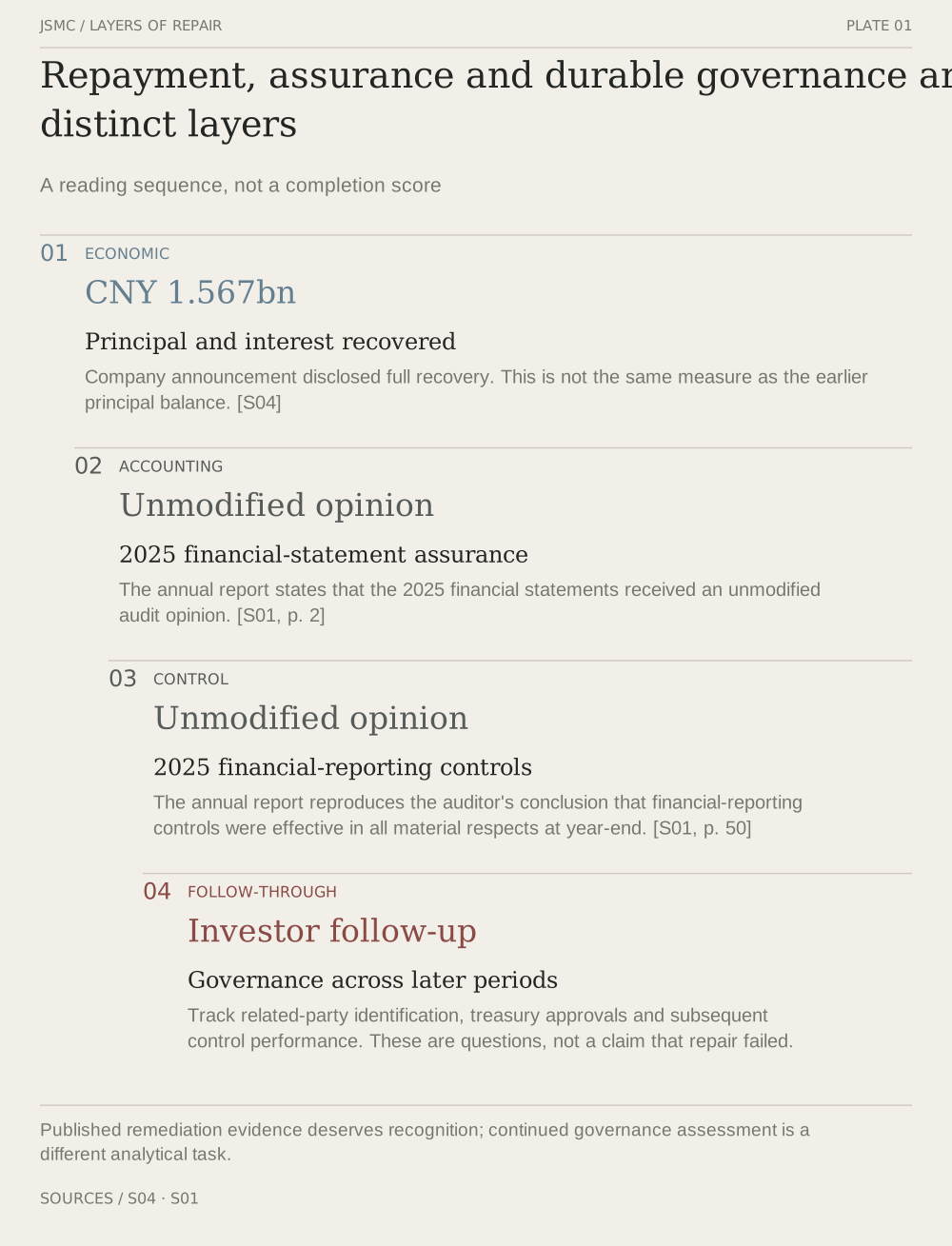
The subsequent progress was also consequential. In an April 2026 audit-progress announcement, the company stated that it had recovered all occupied funds and interest, totaling approximately CNY 1.567 billion, and that the exchange had removed the other risk warning associated with the funds-occupation matter (S04). The 2025 annual report then showed revenue of approximately CNY 2.235 billion, net profit attributable to shareholders of CNY 173 million, and operating cash flow of CNY 233 million (S01).
Repayment can eliminate a receivable and restore cash. A later unmodified audit provides assurance on the current financial statements under the applicable framework. To assess whether the problem is less likely to recur, investors also need to understand how the controls failed, which transaction channels were tested, how repayment was funded, and which safeguards have changed.
Why this matters
Funds occupation is not merely a balance-sheet classification issue. When a controlling shareholder or related party uses listed-company resources for non-operating purposes, ordinary investors face at least three separate risks: loss of liquidity, uncertainty over recoverability, and evidence that approval and monitoring controls did not function as intended. The 2024 audit and internal-control opinions brought all three questions into view (S02, S03).
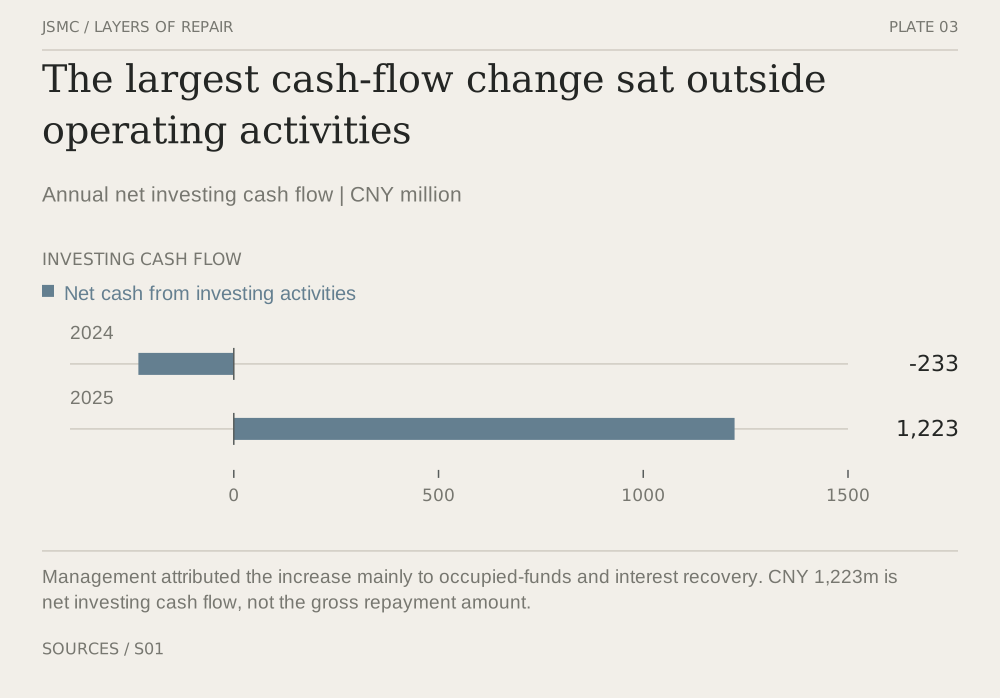
The case also shows why cash-flow labels matter. The 2025 annual report reported positive operating cash flow of CNY 233 million. It separately reported investing cash inflow that management said primarily reflected receipt of occupied funds and related interest; investing cash flow was positive CNY 1.223 billion (S01). Investors should therefore distinguish recurring operating cash generation from the recovery of a historical related-party balance. Both improve liquidity, but they describe different economic events.
Finally, the case has broader public-interest value. Disclosure systems are tested not only when a problem is discovered, but also when a company claims that the problem has been resolved. A credible post-remediation record should allow investors to trace the original failure, the amount recovered, the accounting treatment, the audit response, and the control changes that are intended to prevent recurrence.
Company background and market narrative
JSMC is listed on the Shanghai Stock Exchange. Its 2025 annual report describes a business focused principally on semiconductor discrete devices, integrated circuits, power electronics, automotive electronics, and related products (S01). The operating narrative is tied to power semiconductors, automotive applications, clean energy, industrial control, and the broader semiconductor cycle.
The disclosure narrative changed more sharply than the product narrative. In 2025, the company remained subject to risk-warning consequences connected to the disclaimer audit opinion, the adverse internal-control opinion, and the outstanding funds-occupation matter. A June 2025 announcement described those conditions and the company’s remediation efforts (S03). By April 2026, the company stated that the occupied funds and interest had been fully recovered (S04). The 2025 annual report then presented a profitable business with positive operating cash flow (S01).
The market-facing temptation is to compress that sequence into a single word: normalization. Public filings support a more precise reading. Liquidity improved. Profitability improved. The disclosed occupied balance was repaid. But the quality of governance repair should be judged through evidence about controls, verification procedures, board oversight, related-party identification, treasury authorization, and the transparency of subsequent dealings.
What the filings show
The first layer is the 2024 audit limitation. According to the board’s explanation, the company had transferred funds through intermediary parties in the form of advance payments for construction-in-progress procurement and other arrangements, resulting in non-operating funds occupation by the former controlling shareholder. At the audit-report date, the balance was CNY 1.491 billion. Because the auditor lacked sufficient evidence about repayment capacity, it could not determine recoverability or the adequacy of the related credit-impairment treatment (S02).
The second layer is internal control. The same board explanation stated that the company did not have effective collection controls to ensure timely repayment and had not implemented effective measures to compel repayment. The auditor therefore issued an adverse internal-control opinion (S02). That conclusion matters because it identifies a control failure, not merely an overdue account.
The third layer is remediation. The company later disclosed recovery of approximately CNY 1.567 billion of principal and interest and stated that the relevant other risk warning had been removed (S04). This is strong evidence that the reported balance was addressed. It is also balancing evidence that must accompany any discussion of the historical failure.
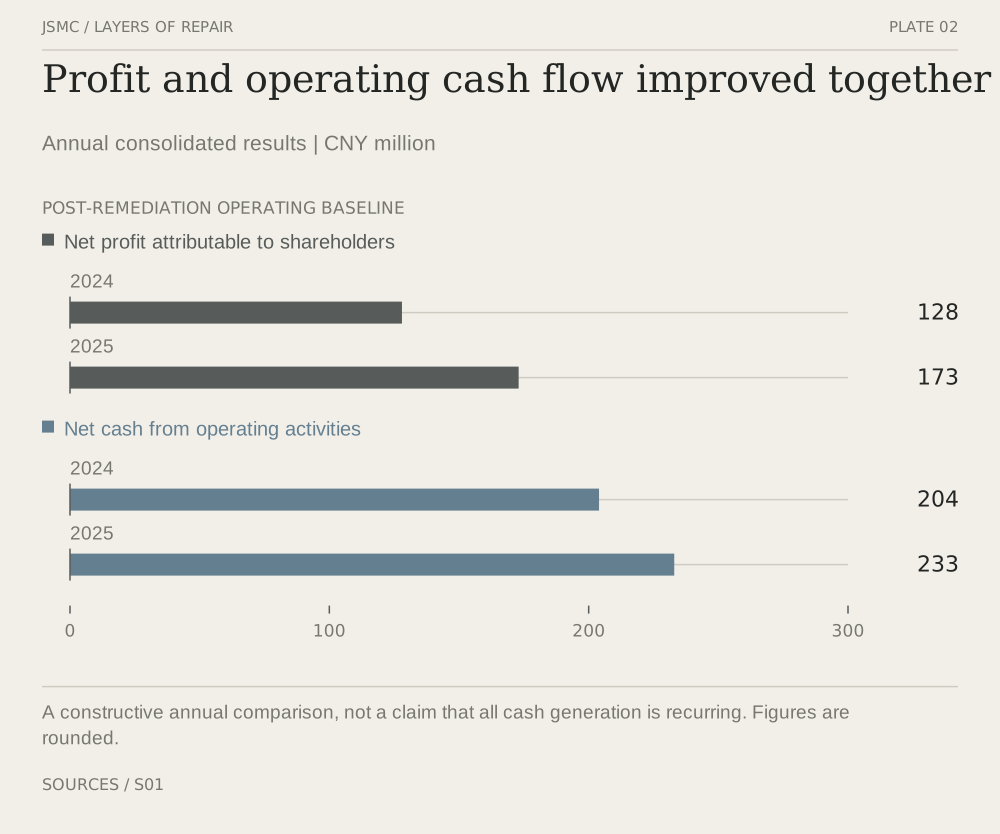
The fourth layer is post-remediation financial performance. In 2025, main-business revenue was approximately CNY 2.235 billion, up 9.19%, while the main-business gross margin was 24.59%, down 1.75 percentage points. Net profit attributable to shareholders was CNY 173 million and operating cash flow was CNY 233 million (S01). These figures support an operating-recovery narrative, although the margin movement and asset-impairment charge still deserve attention.
Financial analysis
Operating recovery appears real, but its components matter
The 2025 annual report shows that industrial revenue increased while gross margin narrowed. Main-business industrial revenue was approximately CNY 2.198 billion, up 10.24%, with a gross margin of 24.52%, down 1.90 percentage points (S01). This combination is consistent with higher volume, product-mix changes, pricing pressure, or cost inflation. It supports recovery in activity, but it does not by itself establish stronger unit economics.
The company reported net profit attributable to shareholders of CNY 173 million, compared with CNY 128 million in the prior year. Operating cash flow was CNY 233 million, compared with CNY 204 million (S01). Profit and operating cash flow moved in the same direction, which is a constructive signal. The central analytical question is not whether the operating cash flow is “real”; it is how much came from repeatable customer collections and operations, and how much reflected timing in receivables, inventory, payables, and other working-capital accounts.
The funds recovery belongs to a different cash-flow category
The annual report reported investing cash flow of CNY 1.223 billion, compared with negative CNY 233 million in the prior year. It explained that the change mainly resulted from receipt of related-party occupied funds and interest (S01). This classification is analytically important.
A recovered related-party receivable improves cash resources and eliminates exposure to the counterparty. But it is not equivalent to cash generated by selling semiconductor products. Investors assessing normalized cash generation should therefore consider operating cash flow separately from the investing inflow associated with remediation.
This distinction also prevents two opposite errors. The first is to dismiss the repayment as irrelevant: it was plainly important to liquidity and asset recovery. The second is to treat the resulting cash inflow as proof of durable operating strength. The filings support neither extreme.
Asset quality remains relevant after repayment
The historical audit issue centered on recoverability and credit impairment. Once the occupied balance was paid, that specific uncertainty changed materially. But asset-quality analysis remains important because the company operates in a capital-intensive and cyclical sector.
The 2025 annual report recorded asset-impairment losses of approximately CNY 55 million, compared with CNY 16 million in the prior year (S01). This does not indicate that impairment was inadequate or that assets were misstated. It does show that inventory and long-lived-asset assumptions can affect reported profitability. Investors need information about inventory ageing, product obsolescence, capacity utilization, construction-in-progress conversion, and the assumptions used in impairment testing.
What the change in audit opinion tells investors
The 2024 disclaimer and adverse internal-control opinion were strong signals that investors could not rely on ordinary audit assurance for the affected reporting period in the usual way (S02). Later disclosure of full repayment and the 2025 annual report provide evidence of progress (S01, S04).
The later opinion needs to be read alongside the remediation work. Which bank accounts were reviewed? How were intermediary counterparties identified? Were construction and procurement advances tested for commercial substance? How did related-party records and payment approvals change? Those procedures address the routes through which the historical transfers occurred.
Key Disclosure Issues
1. Repayment resolves a balance, not every governance question
The company’s disclosure of full principal-and-interest recovery is substantial positive evidence (S04). Yet the historical route through procurement or construction-related advances makes process remediation important. Investors need to know which controls now stop a commercially unsupported payment before funds leave the company.
2. The transition from disclaimer to later reporting needs an evidence bridge
The 2024 auditor could not determine recoverability or impairment for the occupied balance (S02). Once repayment occurred, that uncertainty may have been resolved. The public-interest question is whether investors can see the bridge: repayment evidence, audit procedures, control testing, responsibility changes, and board monitoring.
3. Operating cash flow and remediation cash flow should not be blended
The 2025 operating cash flow of CNY 233 million and investing cash flow of CNY 1.223 billion tell different stories (S01). The first is relevant to recurring operations; the second was heavily influenced by recovery of a historical balance. Clear investor communication should preserve that distinction.
4. Semiconductor recovery still requires ordinary accounting scrutiny
Revenue growth, lower gross margin, and higher asset-impairment losses create a conventional operating question separate from the governance case (S01). Investors should assess product mix, pricing, inventory ageing, capacity utilization, and capital expenditure rather than allowing the remediation story to dominate every aspect of financial analysis.
Reading the remediation evidence in layers
Economic remediation
The first layer is economic: did the listed company receive the money? The company’s announcement that it recovered all occupied funds and interest is the most direct positive fact in the post-2024 record (S04). If independently verified and unrestricted, that cash recovery changes the economic exposure materially. A receivable whose collectability was uncertain has been converted into cash, while interest provides compensation for the period in which funds were unavailable.
Even at this layer, disclosure detail matters. Investors benefit from knowing the payment dates, payment accounts, principal-interest split, and whether any recovered cash remained restricted or was immediately committed to debt repayment. They also benefit from understanding the payer’s funding source where that information is public. These questions are not accusations that the repayment lacked substance. They are ordinary procedures for understanding a transaction that was material enough to drive an earlier disclaimer opinion.
Accounting remediation
The second layer is accounting: how did recovery affect the receivable, impairment allowance, interest income, and cash-flow statement? The 2025 annual report says that investing cash flow increased mainly because of the recovery of occupied funds and interest (S01). That disclosure helps readers locate the principal cash effect, but a complete bridge would also identify any impairment allowance reversed, interest recognized, and prior-period presentation consequences.
This layer matters because accounting recovery can influence more than cash. If an allowance had previously been recognized, collection may create a reversal or reduce credit-loss expense. Interest can affect profit. Classification affects how investors calculate normalized free cash flow. None of those effects is improper merely because it is non-recurring. They simply need to be separated from semiconductor production and sales when assessing repeatable performance.
Control remediation
The third layer is control: what changed in the processes that allowed the transfers? The board’s 2024 explanation linked the historical occupation to payments routed through intermediary parties and described weaknesses in collection and enforcement (S02). A durable response would therefore extend beyond recovery. It would address vendor onboarding, beneficial-owner checks, related-party databases, contract approval, advance-payment limits, construction-progress verification, bank-payment authorization, exception reporting, and audit-committee review.
Public investors do not need every internal manual. They do need enough information to understand whether the redesign targets the actual failure mode. A generic statement that controls were strengthened is less informative than a statement that, for example, non-routine advances now require independent commercial-substance testing and are monitored against construction milestones. The report does not claim that such controls are absent. It identifies the evidence that would allow investors to evaluate their effectiveness.
Governance remediation
The fourth layer is governance: who was accountable, who now monitors the controls, and how are exceptions escalated? Funds occupation involving a controlling shareholder creates a conflict that ordinary operational controls may not fully address. Board independence, audit-committee access to bank and counterparty information, whistleblowing channels, and authority to halt related payments become especially relevant.
This is why repayment and governance repair should not be treated as synonyms. Repayment addresses the economic consequence. Governance repair addresses the power structure and oversight failure that made the consequence possible. The available filings provide strong evidence on the former and important but less granular public evidence on the latter (S02, S04).
What the 2025 numbers can and cannot demonstrate
The 2025 results provide a useful post-remediation baseline. Revenue increased, profit rose, and operating cash flow remained positive (S01). Those figures weaken any suggestion that the company’s entire operating business should be viewed only through the funds-occupation event. Semiconductor products continued to generate revenue, and ordinary operating analysis remains necessary.
At the same time, one year of improved results cannot by itself establish a durable earnings trajectory. Gross margin declined, and asset-impairment losses increased (S01). A cyclical semiconductor company can experience rapid changes in demand, selling prices, utilization, inventory values, and customer mix. Investors should therefore ask whether 2025 growth was broad-based, whether automotive and clean-energy sales carried margins comparable with the legacy portfolio, and whether inventory and capital assets are aligned with expected demand.
The relationship between attributable profit of CNY 173 million and operating cash flow of CNY 233 million is directionally constructive (S01). But the difference should still be reconciled. Depreciation, impairment, receivable collections, inventory changes, payables, taxes, and interest all affect conversion. The annual report provides the accounting totals; a public-facing explanation of the largest drivers would make the recovery narrative more durable and easier to assess.
The same discipline applies to the company’s cash position. The recovery of occupied funds was much larger than annual operating cash flow. Investors should distinguish the level of cash received from the amount available after debt reduction, capital expenditure, and other commitments. A large cash inflow can strengthen the balance sheet without becoming a recurring source of cash.
An investor-protection standard for post-correction disclosure
JSMC provides a broader lesson for companies emerging from serious disclosure or governance events. A strong remediation package should answer five questions in sequence.
First, what happened, over which periods, through which transaction channels, and in what amounts? Second, what was the financial-statement effect, including impairment, interest, classification, and any correction? Third, what economic recovery occurred, and how was it independently verified? Fourth, which controls and governance arrangements changed in response to the identified failure mode? Fifth, what subsequent evidence shows that the new controls operated effectively rather than existing only on paper?
The public record reviewed here answers the economic-recovery question more clearly than it answers the final operating-effectiveness question. That is not unusual: control evidence often develops over time. It is also why investors should avoid binary labels such as “resolved” or “unresolved.” Different components can sit at different stages of repair.
At the information cutoff, the materials reviewed support repayment and improved financial performance. They provide less detail on how the revised controls operated over time. Further disclosures of testing results could strengthen that part of the assessment.
The filings support recovery of a major receivable and a separate assessment of 2025 operating performance (S01, S02, S04). The longer-term question is whether the revised payment and oversight procedures remain effective through subsequent reporting periods.
Possible benign explanations
Several explanations may support a favorable interpretation of the later record.
First, full recovery of principal and interest may have removed the economic loss associated with the occupied balance. Second, positive operating cash flow and higher revenue may reflect genuine customer demand and stronger collection. Third, the lower gross margin may reflect competitive pricing, product mix, or temporary cost pressure rather than deterioration in product quality. Fourth, higher impairment expense may indicate more conservative recognition rather than worsening controls. Fifth, governance and ownership changes may have allowed the company to redesign treasury and related-party controls.
These possibilities deserve fair treatment. They also remain testable propositions. The strongest disclosure would connect each remediation claim to specific control owners, procedures, testing results, and subsequent-period evidence.
Questions investors should ask
- What were the ultimate sources of the funds used to repay the occupied balance and interest?
- Which independent procedures verified the repayment, and were all relevant bank accounts and intermediary counterparties covered?
- How were procurement advances, construction payments, and other non-routine disbursements redesigned after the control failure?
- What changes were made to related-party identification and approval?
- How did the 2025 auditor test whether the historical matter had no remaining material effect?
- How much of 2025 operating cash flow came from recurring collections rather than temporary working-capital movements?
- What explains the decline in main-business gross margin?
- What drove the increase in asset-impairment losses, and what are the key inventory-ageing and capacity-utilization assumptions?
Conclusion
JSMC’s public record supports two conclusions at once. The historical funds occupation, disclaimer opinion, and adverse internal-control opinion were serious investor-protection events. The later recovery of principal and interest, improved profitability, and positive operating cash flow are also meaningful evidence of remediation and operating progress (S01-S04).
The next evidence to follow is specific: repayment records, the accounting effects of collection, changes to payment authorization, and independent tests of those changes. The recovered historical balance should remain separate from recurring semiconductor cash generation. Both improved liquidity, but only the latter can recur through ordinary sales.
Disclaimer
This report is based solely on public information available as of the information cutoff date. It is prepared for educational and investor-protection purposes only. It does not constitute investment advice, legal advice, accounting advice, or a recommendation to buy, sell, or hold any security. The author does not claim that any company or individual has engaged in misconduct unless such a finding has been made by a competent authority. Readers should conduct their own due diligence.
Selected source table
| Source number | Source title | Date | Relevance | Public link |
|---|---|---|---|---|
| S01 | 吉林华微电子股份有限公司2025年年度报告 | 2026-04-21 | 2025 operations, cash flow, impairment and business profile | CNINFO |
| S02 | 关于2024年度非标意见审计报告和否定意见内控审计报告涉及事项的专项说明 | 2025-04-30 | Disclaimer opinion, adverse internal-control opinion and funds-occupation recoverability | CNINFO |
| S03 | 关于被实施退市风险警示并被继续实施其他风险警示的进展公告 | 2025-06-11 | Risk-warning and remediation timeline | CNINFO |
| S04 | 2025年度报告编制及审计进展公告 | 2026-04-04 | Full recovery of occupied funds and interest | CNINFO |
| S07 | 关于修订《公司章程》的公告及修订文本 | 2025-12-13 | Official English company name | CNINFO |
| S08 | 吉林华微电子股份有限公司2025年度审计报告 | 2026-04-21 | Independent audit opinion and audited financial statements | SSE |
| S09 | 吉林华微电子股份有限公司2025年度内部控制审计报告 | 2026-04-21 | Independent internal-control audit conclusion | SSE |
| S10 | 关于非经营性资金占用及其他关联资金往来情况汇总表的专项审计报告 | 2026-04-21 | Independent special audit of funds occupation and related fund transfers | SSE |
| S11 | 关于2024年度财务报表非标准审计意见涉及事项影响已消除的专项鉴证报告 | 2026-04-21 | Independent assurance on remediation of the modified-audit matter | SSE |
| S12 | 关于2024年度内部控制非标准审计意见涉及事项影响已消除的专项鉴证报告 | 2026-04-21 | Independent assurance on remediation of the internal-control matter | SSE |
| S13 | 关于控股股东资金占用偿还进展暨风险提示的公告 | 2025-08-13 | Disclosed repayment arrangement and source of funds | CNINFO |