Hepalink's CNY89.8 Million Advance: Who Keeps the Recovery?
An interest-free shareholder advance helped replace cash lost in an Italian subsidiary's telecommunications scam. A repayment condition in the related-party note changes how investors should understand that support.
- Company
- Hepalink
- Ticker
- 002399.SZ / 09989.HK
- Published
- September 3, 2026
- Information cutoff
- September 2, 2026
The detail
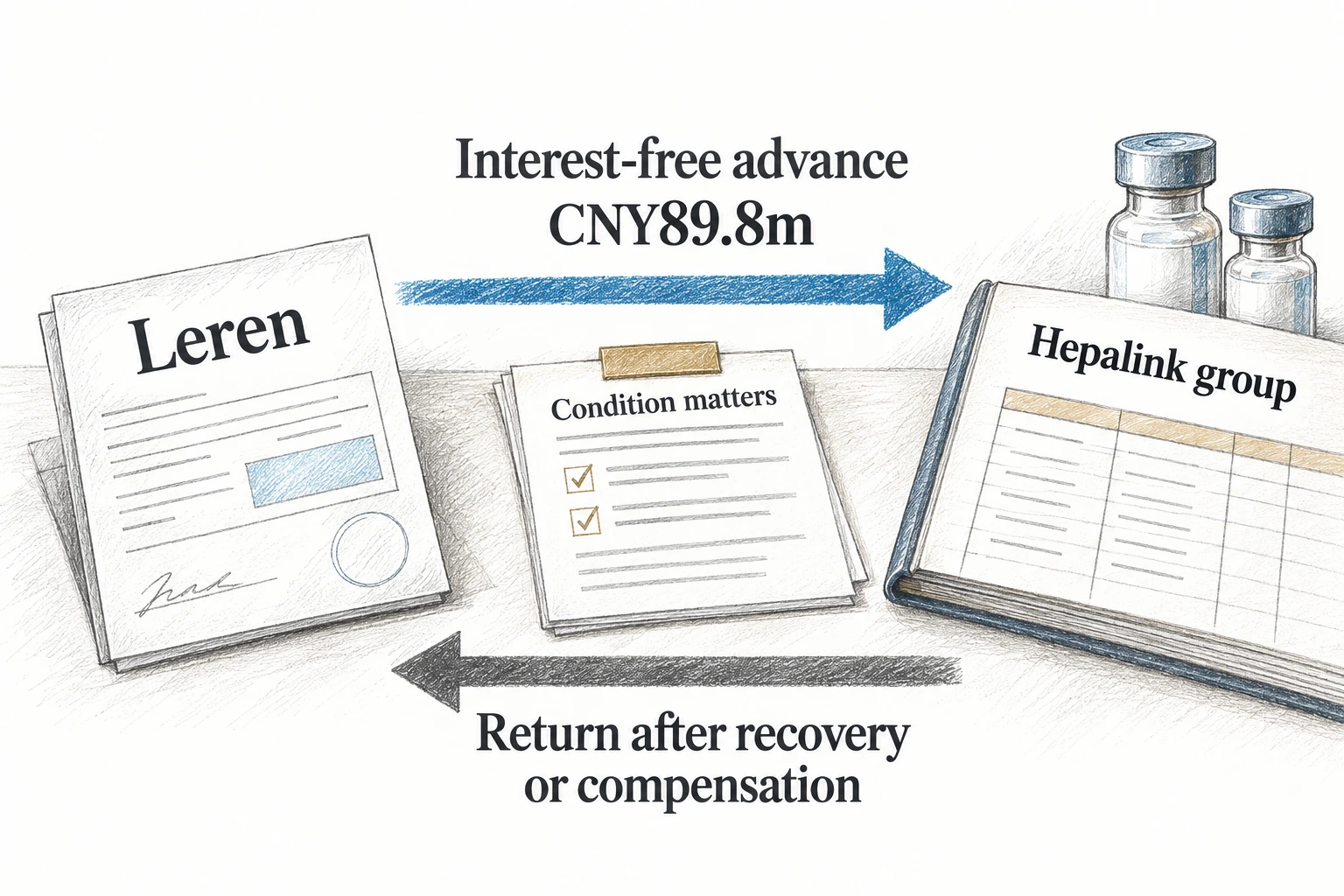
The 2025 annual report, p.195, and 2026 interim report, p.157, retain a CNY89,809,600 payable to Leren and state that the advance is to be returned after the relevant recovery or compensation is obtained.
Why this matters
A CNY89.8 million advance supplied cash after an Italian subsidiary's scam loss. The related-party note ties its return to recovery or compensation, while the cash-flow tables reveal how limited its contribution was to overall operating cash generation.
The detail
CNY89,809,600 appears twice in quite different parts of Hepalink’s 2025 annual report. On page 150, it is a significant other payable to Shenzhen Leren Technology Co., Ltd., inside a table covering important balances older than one year or overdue. The company’s reason for leaving it outstanding is that the payment milestone has not been reached. On page 195, the related-party note explains the milestone: after the relevant scam proceeds are recovered or compensation is obtained, the company is to return the advance to Leren. The advance carries no interest. [S02, pp.150, 195]
That final condition deserves as much attention as the initial support. The note describes cash supplied in advance of recovery, with an associated obligation that remains on the balance sheet. It does not describe an unconditional gift of CNY89.8 million. A reader who sees only that the controlling shareholder advanced an amount equivalent to the scam loss could miss the difference.
There is another small detail. The 2024 cash-flow note includes the CNY89.8 million shareholder advance within other cash received from operating activities. The same line in the 2025 report shows no new advance that year. Those two facts make this a useful case for reading financial statements across their captions: cash arrived, a liability remained, and the reported operating-cash-flow category contained something other than customer collections. [S01, p.181; S02, p.167]
The three notes raise a specific question: what did the advance resolve immediately, and how much of a future recovery would remain with the listed group after repayment?
Executive summary
Hepalink’s reviewed reports describe a telecommunications scam at its Italian subsidiary, Techdow Pharma Italy S.R.L., involving approximately EUR11.70 million. The company says its actual controller, Li Li, supplied an equivalent CNY89,809,600 advance through Leren to protect the company and its investors. The support was interest-free. Its disclosed repayment condition was tied to recovery of the scam amount or receipt of compensation. [S01, pp.180, 209; S02, p.195]
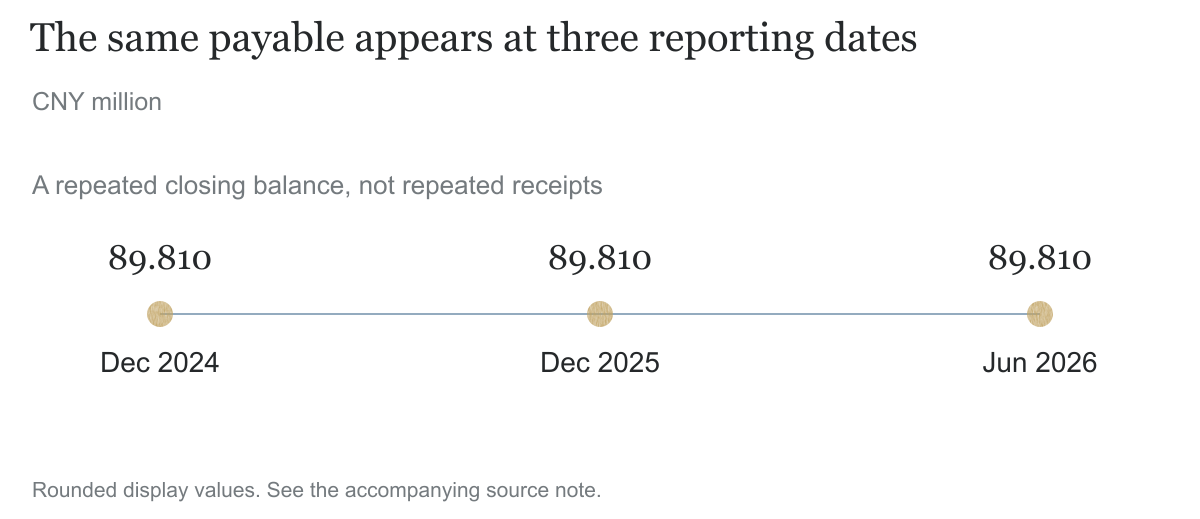
The advance remains a recorded related-party payable at the end of 2024, the end of 2025, and June 30, 2026. The 2026 interim report repeats both the amount and the recovery-linked repayment language. Its ageing note again describes the payment milestone as not yet reached. The continuing liability is a verified fact; the complete history of recovery receipts cannot be inferred from that closing balance alone. [S01, p.209; S02, pp.150, 195; S03, pp.115, 157]
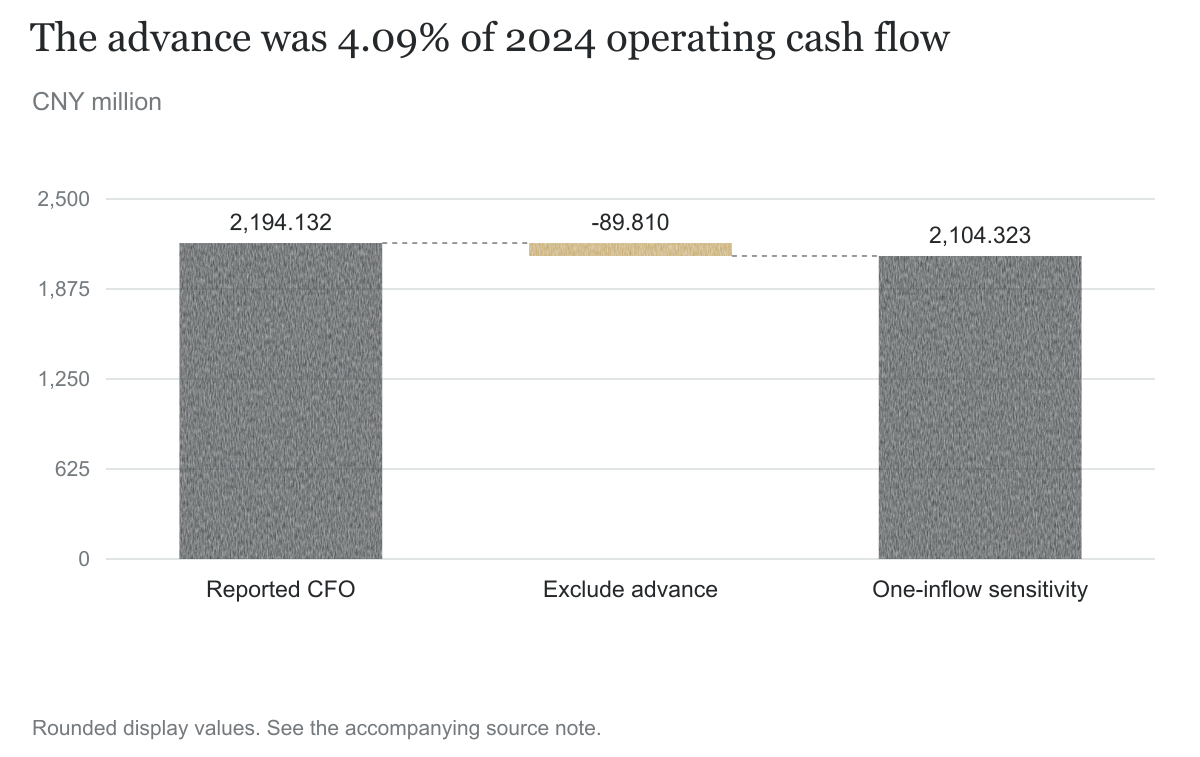
The financial significance needs proportion. CNY89.8 million represented approximately 4.09% of Hepalink’s CNY2,194.1 million reported operating cash flow in 2024. Excluding that single inflow as an analytical sensitivity leaves CNY2,104.3 million. This is not a restatement, and it does not demonstrate an error in the reported classification. It shows that the advance helped cash generation in the reported category without explaining most of it. [S01, p.181; S02, p.7; calculation]
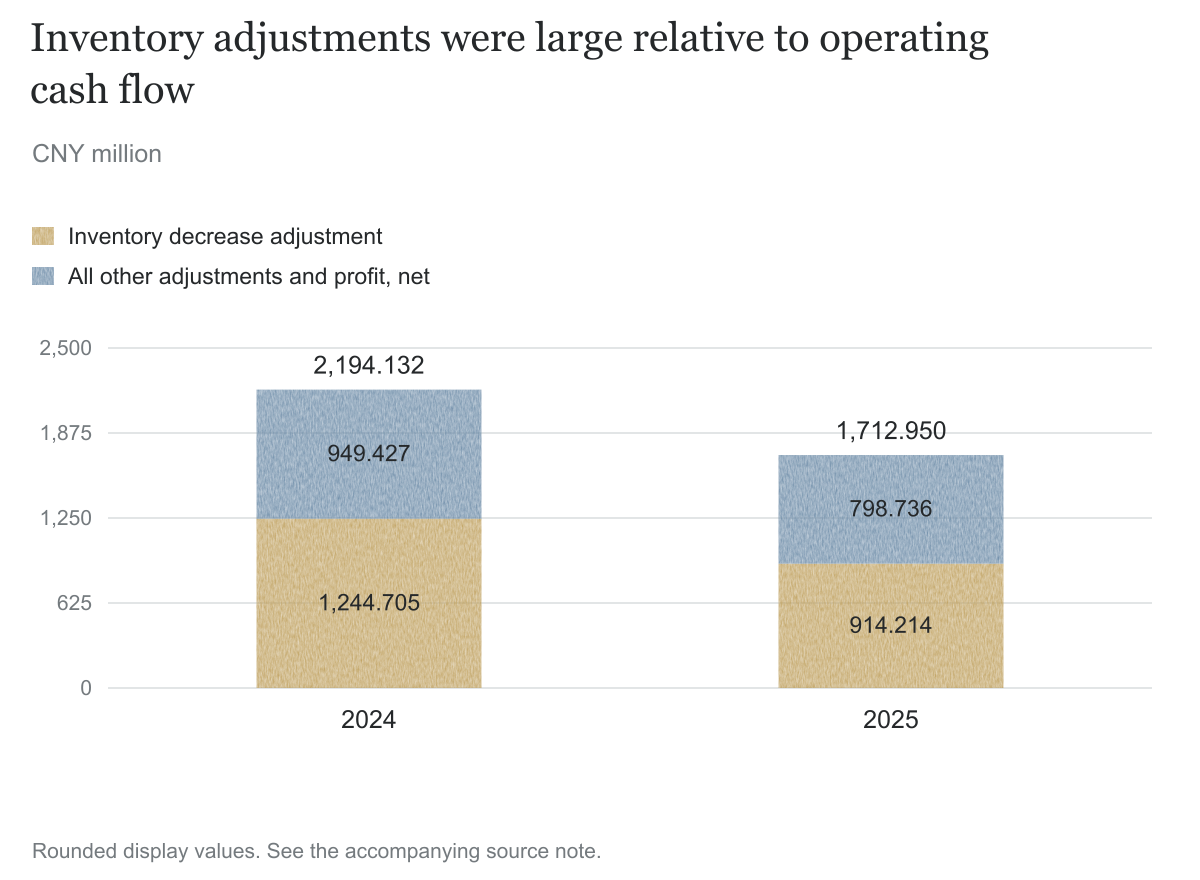
Inventory movements were much larger. The indirect cash-flow reconciliation includes a CNY1,244.7 million positive inventory adjustment for 2024 and CNY914.2 million for 2025. Operating cash flow remained strongly positive in 2025, when the advance line was zero, and in the first half of 2026. Any claim that shareholder support alone sustained operating cash flow would therefore be contradicted by the figures reviewed. [S02, pp.167, 169; S03, pp.132–133]
The unresolved issue concerns allocation, rather than whether the cash support had value. The short related-party note does not spell out all the terms for partial recoveries, pursuit costs, currency differences, or compensation from different parties. It also does not provide a recovery-to-repayment reconciliation. Investors need those details to distinguish a cash recovery announcement from the cash ultimately retained by the listed group.
A pharmaceutical business with several cash cycles
Shenzhen Hepalink Pharmaceutical Group Co., Ltd. is listed in Shenzhen under 002399 and in Hong Kong under 09989. Its annual report describes a business spanning heparin active pharmaceutical ingredients, finished enoxaparin products, large-molecule contract development and manufacturing services, and innovative-drug investment and development. The operating businesses and the investment activities have different cash demands. [S02, pp.6, 10–12]
The distinction matters before examining the advance. An active pharmaceutical ingredient is a substance used to manufacture a medicine. A finished product sits further along the production chain, with additional manufacturing, registration, packaging, and distribution requirements. Hepalink’s disclosed heparin-chain activities include both kinds of products. The annual report also describes overseas sales through combinations of its own teams, distributors, and cooperating commercial partners. This creates operating balances in several countries and currencies. [S02, pp.10–11]
CDMO means contract development and manufacturing organization. Instead of relying solely on selling a finished product under its own commercial arrangements, the provider performs development or manufacturing work for another drug developer. Hepalink describes work orders with milestones that can include process development, validation, analytical testing, and production. Customers generally pay a portion in advance, with remaining fees collected as milestones are completed under the relevant arrangements. [S02, pp.11–12]
A group with those activities can report profit before collecting every amount associated with it. It can also receive cash before recognizing all the revenue associated with a customer advance. Purchasing raw materials adds a third timing difference: cash can leave before the material is consumed in production or the resulting product is sold. A pharmaceutical company’s cash flow is therefore shaped by inventories, customer payments, supplier terms, and development commitments, as well as by its reported profit.
The Italian subsidiary belongs in this operating context. The reviewed note identifies a particular cash-loss event and a response to it. That event should not be used to explain every movement in a multinational group’s cash balances. Conversely, the size and complexity of the group do not make the repayment condition irrelevant. An investor can understand the broad business while still asking who has a claim on a specific future receipt.
Hepalink reported CNY5,479.0 million of revenue in 2025, compared with CNY5,280.7 million in 2024 and CNY5,445.6 million in 2023. Profit attributable to shareholders changed much more sharply, from a CNY783.3 million loss in 2023 to CNY646.7 million profit in 2024 and CNY349.5 million in 2025. The three-year comparison is drawn from one annual report’s comparative table; it is not a five-year study or a forecast. [S02, p.7]
These figures put the CNY89.8 million note in perspective. The amount is large enough to deserve a clear explanation, but the business generates and uses cash at a substantially larger scale. The reason to examine it is the combination of its conditions and its accounting location, rather than a claim that it dominates the company’s financial position.
Following the amount through three reports
The 2024 report supplies the starting point for this review. Its non-operating-expense note says the Italian subsidiary encountered a telecommunications scam involving approximately EUR11.70 million. The company describes payments made without approval by the subsidiary’s general manager in violation of internal procedures. That is the company’s description of a historical incident, not an independent finding here about the conduct of other managers or other subsidiaries. [S01, p.180]
The same note identifies approximately EUR1.99 million of scam transfers made in 2024, equivalent to CNY15,559,523.79, recorded in that year’s non-operating expenses. The relationship between the annual portion and the overall event is easy to mishandle. The 2024 amount is described as part of the scam event, not a second EUR11.70 million event to add to it. Adding the portion again would overstate the disclosed incident. [S01, p.180]
In the related-party section, the report records CNY89,809,600 payable to Leren. It says Li Li advanced the equivalent amount through that company for the benefit of Hepalink and its investors. The note then sets out the recovery-linked return condition and the absence of interest during the advance period. Reading the cash-loss note without reading the related-party note would leave the response only half explained. [S01, p.209]
The operating-cash-flow note provides an independent accounting location for the receipt. It includes CNY89,809,600 of shareholder advances in 2024, with zero in the comparative period. A balance-sheet liability and a cash-flow receipt are different views of the same kind of financing support: one describes an outstanding claim at a date, the other describes a flow during a period. They should not be added together as separate amounts of assistance. [S01, p.181]
The 2025 report then shows the payable unchanged at CNY89,809,600 at both the beginning and the end of the year. Its cash-flow note reports zero new shareholder advances in 2025. The recovery-linked condition remains in the related-party note. The important ageing table adds the company’s explanation that the payment milestone has not been reached. [S02, pp.150, 167, 195]
The 2026 interim report brings the record to June 30, 2026. The same payable appears at both the beginning and the end of the half-year, the same condition is repeated, and the ageing table gives the same reason for remaining unpaid. This establishes continuity of the disclosed balance and condition across three reporting dates. [S03, pp.115, 157]
| Reporting date | Leren advance outstanding | What the reviewed note says |
|---|---|---|
| December 31, 2024 | CNY89,809,600 | Interest-free; return after the relevant recovery or compensation |
| December 31, 2025 | CNY89,809,600 | Same condition; payment milestone not reached |
| June 30, 2026 | CNY89,809,600 | Same amount and condition; payment milestone not reached |
Sources: S01 p.209; S02 pp.150, 195; S03 pp.115, 157. These are period-end balances, not a complete transaction ledger.
A flat balance cannot answer every question about activity during the period. A payable can begin and end at the same amount even when related transactions occur between those dates. The reviewed disclosures therefore support saying the recorded outstanding amount has not changed. They do not, by themselves, support saying that no scam proceeds were ever recovered, that no compensation was received through any channel, or that the entire event remained legally unchanged.
That limitation is practical. A complete recovery analysis would reconcile receipts, expenses, amounts transferred back to the advance provider, and the closing liability. The small repeated note gives the condition and the balance, but not that full reconciliation. The difference between those two levels of disclosure is precisely what an ordinary investor might overlook.
What an advance changes in the accounts
Cash, profit, and equity are separate measures. Cash is an available financial resource. Profit measures recognized income less recognized expenses over a reporting period. Equity is the residual after liabilities are deducted from assets. One transaction can affect those measures differently, which is why describing a payment simply as support is not enough for financial analysis.
Consider an illustrative company that loses CNY100 to a scam and recognizes the loss as an expense. Subject to the appropriate accounting treatment of any recovery claim, the loss reduces profit and the resources available to the company. If a shareholder later advances CNY100, that receipt restores cash but can create a CNY100 payable. The receipt itself does not reverse the original loss merely because the cash balance has recovered.
In this simple example, the entries for the advance would increase cash and increase the liability by equal amounts. Equity would not increase merely from receiving the advance. A separate unconditional capital contribution or a recognized reimbursement could have different consequences. Those are different transactions; they should not be silently substituted for the one described in the filing.
Hepalink’s reports identify the CNY89.8 million amount as an other payable to a related party. That is the relevant recorded fact. The short note cannot be used to reconstruct every historical journal entry associated with the scam or to pronounce on accounting choices for all possible recovery outcomes. It does show why a cash replacement and a final allocation of the economic loss are different questions. [S01, p.209; S02, p.195]
The timing benefit is real. A business that has lost cash may need to keep paying employees, suppliers, and ordinary operating expenses while recovery efforts take time. An interest-free advance can reduce the need to borrow elsewhere and can avoid an interest charge on that support. If repayment waits for a specified recovery event, the arrangement can also avoid an immediate scheduled repayment burden.
Those benefits do not require the advance to be a gift. They arise from receiving cash earlier, from the cost of using it, and from the conditions governing its return. An analytical description that calls the support worthless because it is repayable would be as incomplete as one that calls it unconditional compensation because cash arrived.
The balance-sheet classification also helps explain why the provider’s role matters. Leren is a related party identified in the company’s disclosures, not an unrelated customer buying medicines. A receipt from it may be valuable, but its existence says little about how much cash customers paid for current-period sales. Reading the liability note and the cash-flow note together prevents that connection from being assumed.
At December 31, 2025, the advance represented approximately 17.37% of the CNY517.0 million total other-payables balance. At June 30, 2026, it represented approximately 18.54% of CNY484.5 million. The increase in the percentage does not mean the advance increased; its numerator stayed the same while the total caption became smaller. [S02, pp.149–150; S03, p.115; calculation]
The return condition, examined carefully
The disclosed trigger is a recovery or compensation event. The wording makes a link between obtaining money associated with the scam and returning the shareholder advance. It does not disclose a fixed calendar maturity. Those facts make the condition more informative than an investor’s generic assumption that every old payable is immediately due. [S02, p.195; S03, p.157]
They also make the recovery announcement an incomplete stopping point. If the group eventually receives compensation, the reader needs to know whether a corresponding obligation to Leren becomes payable, in what amount, and on what schedule. A recovered amount could improve gross cash receipts while leaving much less cash with the group after the advance is returned.
Take an explicitly illustrative full-recovery scenario. Assume CNY89,809,600 is received, the entire advance must then be returned, and there are no costs, taxes, exchange differences, or other relevant obligations. The group would first receive CNY89,809,600 and then pay CNY89,809,600. Its net cash increment from those two steps would be zero. It would also eliminate the payable to Leren.
That example does not mean recovery would have no benefit. Repayment would extinguish a liability, the group would have had the use of interest-free cash in the intervening period, and successful recovery could resolve uncertainty about the incident. It means that describing the receipt as an additional permanent CNY89.8 million cash benefit would ignore the assumed return step. The example is a mechanism, not a report that this sequence has happened.
Partial recovery is harder to analyze. Suppose only a portion is received. The abbreviated disclosure does not set out a detailed allocation formula: whether each receipt produces an immediate return of the same amount, whether costs are deducted first, or whether repayment waits for another milestone. Readers should not choose the harshest interpretation and treat it as a contractual fact. They should not choose the most favorable one either.
Currency introduces another question. The event is described in euros and the advance in renminbi. If recovery occurs in euros at a different exchange rate, the number of renminbi received may differ from the recorded advance. The note does not settle who bears or benefits from that difference in every possible outcome. Without the relevant agreement and accounting detail, a model of recovery should show its assumed currency treatment rather than hide it in a single number.
Costs of pursuing recovery create a similar need for clarity. Legal work, administrative procedures, and other pursuit costs can make a gross receipt different from the amount ultimately available. These are general mechanisms, not an assertion that Hepalink has incurred a particular unreported bill. The disclosure question is whether any future reconciliation would show gross recovery, related costs, repayment, and retained cash separately.
There may also be different sources of compensation. Recovery from a recipient, an insurance payment, a settlement, or another compensation arrangement need not have identical timing or conditions. The reviewed note refers broadly to recovery or compensation but does not itemize every route. A source-by-source account would allow investors to see which event satisfied the return condition and which outstanding claims remained.
The short note therefore establishes a useful boundary. The advance carries a return obligation linked to recovery. The complete allocation mechanics are not established by the wording reviewed. Both statements can be made directly without converting a disclosure question into an allegation about the provider’s motives.
Why an old payable is not necessarily an overdue payable
The table on page 150 of the 2025 report covers important other payables older than one year or overdue. That combined title is easy to read too quickly. A row can qualify because it is old, because it is overdue, or because both descriptions apply. The title alone does not determine which applies to Leren. [S02, p.150]
The company supplies a reason beside the balance: the payment milestone has not been reached. The 2026 interim report repeats the same reason. That is more specific evidence than the table’s combined heading. The careful reading is that an important amount has remained outstanding and the company says the condition for payment has not arrived. [S03, p.115]
This matters to a liquidity analysis. A payable due tomorrow and a payable triggered by a future recovery can have different implications for the next month’s cash requirements. Both belong in understanding obligations, but they cannot automatically be assigned the same maturity profile. Here the reviewed note does not support describing the advance as a missed scheduled debt payment or evidence that Leren has demanded immediate cash.
The age still has informational value. A balance persisting across reporting dates merits follow-up about what would clear it, what would activate repayment, and how the process is being monitored. That follow-up can remain specific. Asking whether the return condition has been met is more useful than calling the balance a delinquent loan solely because it appears in an ageing table.
Nor does the absence of a fixed date erase the liability. The related-party note states that such payables are interest-free, unsecured, and without a fixed repayment term, while also explaining the particular recovery-linked return condition. Those descriptions should be read together. An obligation can exist even when its settlement depends on an event rather than a date. [S02, p.195; S03, p.157]
The distinction will matter if a later report changes the reason for remaining unpaid. A move from milestone not reached to an identified overdue amount, a new maturity agreement, a waiver, or an actual repayment would each change the analysis. The useful disclosure would identify the change, rather than leave investors to infer it from a repeated balance.
The cash-flow arithmetic: useful support, limited scale
The CNY89.8 million receipt is included in 2024 other operating cash receipts. The reported classification is a fact from the filing. This review does not establish that the classification was improper under the applicable accounting requirements; it asks what an investor should understand when reading operating cash flow as evidence of business cash generation. [S01, p.181]
| 2024 operating-cash-flow sensitivity | CNY million |
|---|---|
| Reported net operating cash flow | 2,194.132 |
| Shareholder advance included in the note | 89.810 |
| Reported figure less that one inflow | 2,104.323 |
| Advance as a share of reported operating cash flow | 4.09% |
Sources: S01 p.181 and S02 p.7. The subtraction is an analytical sensitivity, not a replacement financial statement or a proposed restatement.
The calculation is deliberately narrow. CNY2,194,132,237.51 minus CNY89,809,600 equals CNY2,104,322,637.51. It does not adjust every non-recurring operating receipt, working-capital movement, or classification choice. Calling the result normalized cash flow would claim more work than has been done. Calling it operating cash flow before this particular advance describes it accurately.
There is a double-counting trap in the indirect cash-flow reconciliation. That reconciliation starts with profit and adjusts for non-cash items and operating balance changes. If the advance has affected a reconciliation component, removing it from direct cash receipts and then removing it again from the associated payable movement would subtract one economic receipt twice. A full reconstruction should trace the transaction through both presentations before making further adjustments.
The scale is equally important. Even after the single subtraction, the figure remains above CNY2.1 billion. The advance was meaningful cash assistance, but it cannot explain most of the reported operating cash flow. This result disciplines the thesis: the overlooked condition matters to understanding support and recovery, while the larger cash-flow story needs working-capital analysis.
The following year provides a useful check. The 2025 note shows zero shareholder advances and CNY1,713.0 million of net operating cash flow. Cash flow declined from 2024, but remained strongly positive without a new receipt on that line. The first half of 2026 then reported CNY814.5 million of net operating cash flow. Those facts undermine an explanation that makes the continuing CNY89.8 million payable responsible for recurring annual cash generation. [S02, pp.7, 167; S03, p.7]
An outstanding liability does not create the original receipt again each year. Repeating the payable in an annual report is a disclosure of an existing balance. It is not evidence of a new cash contribution. Confusing a stock with a flow could turn a single advance into several years of imagined support.
Inventory explains more of the cash bridge
Hepalink’s cash-flow reconciliation begins with consolidated net profit of CNY624.9 million in 2024 and CNY342.6 million in 2025. Those are the group-wide profit figures used in the reconciliation. They differ from profit attributable to shareholders, which excludes the relevant minority interests. A ratio pairing consolidated operating cash flow with attributable profit can be informative for some purposes, but it is not the same reconciliation. [S02, p.169]
Using the matched consolidated figures, operating cash flow was approximately 3.51 times consolidated net profit in 2024 and 5.00 times in 2025. A large ratio can look reassuring because cash exceeded profit. It needs decomposition before becoming a view about repeatability. Non-cash expenses and changes in inventories, receivables, and payables can produce the difference without cash collections matching current-year sales line by line.
| Selected indirect cash-flow bridge items | 2024, CNY million | 2025, CNY million |
|---|---|---|
| Consolidated net profit | 624.918 | 342.636 |
| Inventory decrease adjustment | 1,244.705 | 914.214 |
| Operating receivable adjustment | -25.383 | -132.511 |
| Operating payable adjustment | -63.431 | -143.670 |
| Net operating cash flow | 2,194.132 | 1,712.950 |
Source: S02 p.169. This is a selection, not a full bridge; depreciation, impairment, financing costs, tax-related adjustments, and other items also appear in the original reconciliation.
The positive inventory adjustment is approximately 56.73% of reported operating cash flow in 2024 and 53.37% in 2025. These percentages describe the arithmetic size of one reconciliation item relative to the total. They are not the percentage of sales collected in cash and they do not identify the proceeds from selling particular batches of inventory.
Inventory can release working capital when a company sells or consumes items already purchased while spending less on replacement stock. That can be an effective use of resources. It can also be temporary: the company cannot indefinitely draw down the same pool of stock. Whether the release reflects improved planning, changes in demand, raw-material purchases, or other operating developments requires the inventory composition and business explanation.
The annual report describes production based on sales while maintaining reasonable inventory. It also describes purchasing plans adjusted for production, stock levels, delivery times, and supplier preparation. Those mechanisms offer legitimate reasons for inventory movements; they do not prove that every decrease is a warning sign. They also do not eliminate the need to distinguish a year’s release of working capital from the cash available once inventories settle at a different level. [S02, p.11]
The balance-sheet inventory figures reinforce the importance of scale. Net inventory fell from CNY5,393.9 million at the end of 2024 to CNY4,446.6 million at the end of 2025. The same table shows gross balances and impairment provisions separately. Its net decline is about CNY947.3 million, which is not exactly the CNY914.2 million inventory adjustment in the cash-flow reconciliation. [S02, p.126; calculation]
That difference should not be filled with a convenient story. Foreign-exchange effects, provisions, changes in scope, and other non-cash movements can affect a balance-sheet comparison. An exact reconciliation would identify the actual components. Subtracting two inventory balances and calling every renminbi of the difference cash received would skip that work.
The first half of 2026 supplies another observation, rather than a full-year forecast. The reconciliation records a CNY524.1 million positive inventory adjustment against CNY814.5 million of operating cash flow, approximately 64.35%. It also includes CNY61.7 million of positive operating-receivable adjustment and CNY155.8 million of negative operating-payable adjustment. The latter reduces the bridge rather than providing support from increasing operating payables. [S03, pp.132–133; calculation]
The half-year figures make working capital central to the next reading exercise. They do not demonstrate that inventory liquidation will continue indefinitely, or that a positive inventory adjustment is economically bad. They show that the next report should be read for what replaces the release if it slows: recurring operating profitability, customer collections, purchasing discipline, or another source of liquidity.
Cash on hand is another, separate number
The year-end cash balance is not the same as operating cash flow during the year. Operating cash flow measures a period’s net operating receipts and payments. The closing cash balance also reflects investing activity, borrowing and debt repayment, dividends, foreign-exchange effects, and the opening balance. A company can have positive operating cash flow and a lower closing cash balance without either figure being contradictory.
Hepalink’s cash and cash equivalents fell from CNY1,421.8 million at the end of 2024 to CNY1,188.5 million at the end of 2025. In the first half of 2026 they increased by CNY163.3 million to CNY1,351.8 million. These are useful positive and negative observations to carry alongside the operating-cash-flow figures. [S02, pp.169–170; S03, pp.133–134]
The cash note also distinguishes cash equivalents from other monetary funds. At the end of 2025, it excludes CNY150.6 million of deposits longer than three months, CNY4.1 million of guarantee deposits, and CNY2.9 million of funds frozen in litigation. The total excluded amount was CNY157.6 million. Those categories should not all be described as legally frozen cash. A term deposit excluded by its maturity is different from a litigation freeze. [S02, p.170]
The CNY89.8 million advance was approximately 7.56% of the end-2025 cash-and-cash-equivalents balance. This is a scale comparison, not a tracing of the original bank receipt into a special account. Nothing in the cited short note identifies that much cash as ring-fenced for Leren or says the advance is segregated from the group’s other resources. [S02, pp.170, 195; calculation]
For obligations, the 2025 financing-liability reconciliation identifies CNY1,770.5 million of short-term borrowings and CNY1,132.7 million of long-term borrowings including their current portion. The related-party advance is a different liability with a different disclosed trigger. These numbers can inform a liquidity review, but adding every obligation into an assumed immediate cash demand would ignore maturity and conditions. [S02, p.168]
The first-half 2026 cash note introduces yet another distinct arrangement: supplier financing under which CNY27.2 million of payables was derecognized and short-term borrowings recognized. The company describes suppliers’ ability to receive financing and says its payment terms did not change under that arrangement. This is not the Leren advance and should not be presented as additional shareholder rescue. [S03, p.134]
Reading all these items together produces a more useful cash question than asking whether one support payment was large. What obligations are scheduled, what obligations depend on an event, what monetary funds are available on the required timetable, and how much operating cash is likely to recur? The CNY89.8 million condition belongs in that assessment, but it cannot substitute for it.
The company’s explanation and the strongest counterarguments
The company frames the advance as protecting Hepalink and its investors after the Italian scam. The disclosed structure is consistent with a meaningful immediate benefit: the group received cash, the advance was interest-free, and the repayment milestone was linked to recovery rather than a disclosed fixed date. An analysis that omits those terms would leave readers with an unnecessarily negative account. [S01, p.209; S02, pp.150, 195]
One reasonable interpretation is that the arrangement was designed to bridge the recovery period. Under that interpretation, the advance provider supplies cash while the company pursues recovery, and is repaid when the relevant receipt arrives. That can be a commercially understandable allocation of timing risk. The note alone does not establish every term of the arrangement, but it plainly supports describing a bridge function.
Another counterargument concerns materiality. The advance was only 4.09% of 2024 operating cash flow, and positive cash flow continued when no new advance was reported in 2025. The numbers do not support making this item the principal explanation for the group’s liquidity. That counterargument is strong and should constrain the article, not be relegated to a generic possible-explanations paragraph.
The condition still changes how a recovery is understood. A small share of annual cash flow can remain a meaningful claim on a specific future receipt. Materiality in the group’s entire financial position and significance in explaining one transaction are different questions. The article’s central judgment concerns the latter: a description of recovery that omits the return obligation would leave its economics incomplete.
A further counterargument is that a short related-party note is not meant to reproduce an entire contract. That is true. Investors should not expect every financial-statement note to provide all litigation strategy, confidential settlement terms, or operational detail. A concise reconciliation of the amount recovered, amounts returned, and the outstanding liability would nevertheless explain the financial consequences without requiring a full contract to be published.
The observed improvement in cash and cash equivalents during the first half of 2026 is also relevant. It weakens any suggestion that the continued liability necessarily means cash resources are deteriorating in every period. At the same time, first-half revenue, profit attributable to shareholders, and operating cash flow all declined from their corresponding first-half 2025 figures. Both developments belong in the comparison. [S03, pp.7, 133]
| First-half comparison | 2025 H1, CNY million | 2026 H1, CNY million | Reported change |
|---|---|---|---|
| Revenue | 2,817.347 | 2,579.522 | -8.44% |
| Profit attributable to shareholders | 421.850 | 275.285 | -34.74% |
| Net operating cash flow | 1,048.808 | 814.539 | -22.34% |
Source: S03 p.7. Half-year figures are compared with the same half-year period, not with full-year totals.
The reviewed evidence therefore supports neither an uncomplicated rescue narrative nor a claim that the support was illusory. It supports a narrower conclusion with financial substance: the interest-free cash mattered, the related liability persisted, and the final retained benefit of a recovery depends on terms that a short repeated note does not completely quantify.
What remains unresolved, and what would change the reading
The most direct missing document is the complete advance agreement or an authoritative disclosure summarizing its relevant settlement terms. It would clarify partial receipts, timing of repayment, currency treatment, pursuit costs, and any later amendments or waivers. The reviewed notes cannot be treated as evidence that these details do not exist; they only show that those details are not set out there.
A recovery reconciliation would be equally useful. It could begin with cumulative amounts recovered or compensated, identify the source and receipt date of each material amount, show costs where relevant, show amounts returned to Leren, and reconcile the closing payable. That would replace the temptation to infer the entire history from three identical closing balances.
Different evidence would lead to different conclusions. An unconditional waiver of repayment would change the economic description of the remaining advance. Documented partial repayment would change the balance and reveal how receipts activate the condition. A settlement that sends compensation directly to the advance provider would require its own explanation of how the listed group’s liability is extinguished. Each is a possible mechanism to test, not an event established in the reviewed record.
The historical payment-control failure described in the 2024 expense note calls for a separate follow-up. Later evidence about approval, bank communication, payment verification, and subsidiary oversight would help show whether remediation addressed the original failure. The advance itself supplies cash, not evidence of how those procedures now operate. [S01, p.180]
The April investor-relations record provides another company explanation worth retaining. In answering a cash-flow question, management said operating cash flow had been positive for ten consecutive quarters and described budgeting, cash allocation, expense control, and financial-risk monitoring. This is a dated statement about group cash management, not a transaction-specific record of scam recoveries. It supports taking the broader cash improvement seriously, while leaving the advance’s settlement mechanism to its own evidence. [S04, p.4]
That distinction also prevents an optimistic cash-management statement from becoming a substitute for the missing recovery ledger. Strong cash generation can coexist with an unchanged conditional payable. Conversely, the first-half decline in operating cash flow does not establish that the scam recovery process deteriorated. Neither connection follows without receipts, settlement terms, and repayment records.
Follow-up searches covered CNINFO announcement titles and investor-relations records dated March 1 through September 2, 2026. Selected documents were reviewed in full; the search did not cover the full text of every announcement or every platform. The reviewed materials do not reconcile scam recoveries with repayment of the advance. They cannot rule out further recovery disclosed elsewhere.
Questions investors should ask
- What exact event activates the return obligation, and does a partial recovery require an immediate partial repayment?
- What amount has been recovered or compensated cumulatively, how much has been returned to Leren, and how does that history reconcile with the outstanding payable?
- Are pursuit costs, currency differences, taxes, or other deductions relevant to the amount the listed group ultimately retains?
- Has the advance agreement changed, or has any portion been waived, since the terms described in the reviewed reports?
- Can management distinguish customer-related operating cash generation from exceptional receipts and explain how inventory releases affect the persistence of cash flow?
- What verifiable procedures now govern overseas payments and communications with banks after the historical incident described by the company?
Conclusion
The most consequential words in this note are the words connecting recovery to return of the advance. Hepalink received useful interest-free support, yet continued to report the associated CNY89,809,600 liability. The cash-flow arithmetic shows that the support was only one part of a much larger operating-cash story, with inventory movements doing considerably more work in the reviewed reconciliations.
The next useful disclosure is a sequence of amounts: recovered, compensated, spent in pursuit, returned, and retained. Until those amounts and the relevant conditions can be connected, a recovery figure alone will not tell readers who ultimately keeps the cash.
Sources
| ID | Original document | English description | Date and location |
|---|---|---|---|
| S01 | Hepalink 2024 Annual Report | 2024 Annual Report | Company website lists March 28, 2025. pp.180–181: scam-related expense and operating receipts; p.209: related-party advance and return condition. |
| S02 | Hepalink 2025 Annual Report | 2025 Annual Report | March 31, 2026. p.7: three-year figures; pp.10–12: business; p.126: inventory; pp.149–150: other payables; pp.167–170: cash-flow notes and cash; p.195: advance condition. |
| S03 | Hepalink 2026 Interim Report | 2026 Interim Report | Company website lists August 28, 2026. p.7: half-year figures; p.115: other payables; pp.132–134: cash-flow reconciliation and cash; p.157: related-party advance. |
| S04 | Investor Relations Activity Record | April 2026 Investor Record | April 20, 2026. p.4, question 14: management’s cash-flow and cash-management explanation. |
Page references use PDF page numbers, which match the printed page numbers on the cited pages. Calculations use the reports’ unrounded CNY amounts; display tables round to millions. Hypothetical examples are identified as illustrative and are not company transactions. This review is based on public filings, not interviews, bank records, or the complete advance contract.
Disclaimer
This report is based on the cited public information available by the stated cutoff and is prepared for educational and investor-protection purposes. It is not investment, legal, or accounting advice, or a recommendation to buy, sell, or hold any security. Financial patterns and unresolved disclosure questions do not, by themselves, establish wrongdoing. No misconduct is alleged unless a competent authority has made such a finding. Readers should conduct their own due diligence.