Kylinsec's Accepted Sales Can Still Have a Provisional Price
The gap between project acceptance, final pricing, and cash collection.
- Company
- Kylinsec
- Ticker
- 688152.SH
- Published
- September 8, 2026
- Information cutoff
- September 7, 2026
The detail
The 2025 annual report, p.47, describes provisional-price recognition and subsequent approved-price adjustments. The same report, p.222, marks significant contract changes or significant transaction-price adjustments as not applicable; the reviewed tables do not quantify revenue or receivables awaiting price approval.
Why this matters
Kylinsec describes revenue recognized at provisional prices once recognition conditions are met, with later approved-price differences adjusting revenue. The annual report does not quantify that cohort and marks significant price adjustments as not applicable. Receivable and cash-flow bridges show why pricing uncertainty must remain distinct from credit loss.
The detail
On page 47 of its 2025 annual report, Hunan Kylinsec Technology describes a pricing mechanism with an important sequence. For products whose price review is unfinished, the company can recognize revenue and a receivable at a provisional price once the revenue-recognition conditions are met. After the review is completed, the difference between the approved price and the provisional price adjusts revenue in the period of the adjustment. The company also says further price review could affect products already reviewed. [S02, p.47]
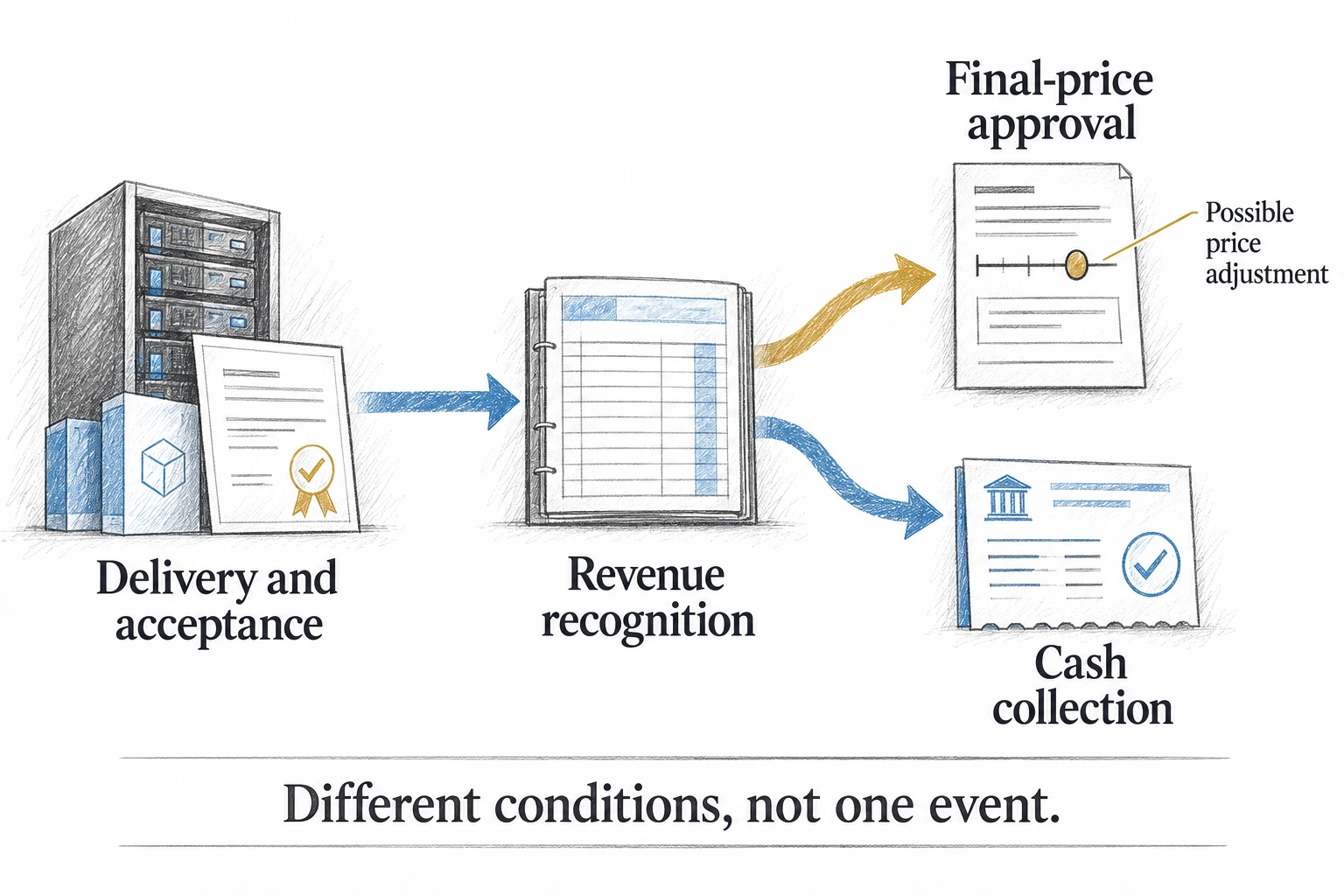
This means product acceptance, revenue recognition, final pricing, and cash collection need not be the same event. A reader who sees an accepted project and a recorded receivable may assume that only the payment remains outstanding. For the products covered by this mechanism, the amount of consideration may also remain subject to a later decision.
The size of that exposure is not established by the reviewed tables. They do not provide a quantified cohort of provisional-price revenue or receivables. The same report marks the item for significant contract changes or significant transaction-price adjustments as not applicable. That is important counterevidence against treating the risk paragraph as proof that a major downward adjustment occurred in 2025. [S02, p.222]
The detail is worth examining because it changes the questions asked of the accounts. How much revenue has completed delivery but not final pricing? How much of an old receivable reflects a payment delay, and how much remains exposed to a price decision? How would a later adjustment affect the period in which it is reported? Those questions are different from a general allegation that revenue was recorded too early.
Review scope: Public disclosures available through September 7, 2026. The principal evidence is the 2024 and 2025 annual reports and the full 2026 interim report. Follow-up selection uses CNINFO announcement titles dated within this boundary. These documents establish the mechanism but do not quantify the population awaiting final price review.
Executive summary
Kylinsec is a provider of operating-system, information-security, and cloud-computing products and services. Its customers include power-sector and special-industry users. The 2025 annual report says some products can be recognized at provisional prices, subject to later review. It warns that downward revisions could affect revenue, profit, and receivables. This is management’s disclosed risk mechanism, not an auditor’s finding that the accounts are misstated. [S02, pp.15,47]
Revenue recognition still has conditions. The accounting-policy note describes customer acceptance for the relevant product and service deliveries and sets out the constraint applied to variable consideration. The provisional-price paragraph does not give management unlimited permission to book any estimate it chooses. Reading it without the general revenue policy would overstate what the filing says. [S02, pp.175-176,221]
The financial context makes careful grouping useful. Revenue increased by 8.36% to CNY310.329 million in 2025, but attributable profit moved from a positive CNY7.936 million in 2024 to a loss of CNY58.074 million. Operating cash flow remained negative, although it improved from negative CNY7.463 million to negative CNY4.953 million. None of these changes, by itself, identifies a price-review adjustment. [S02, pp.8-9]
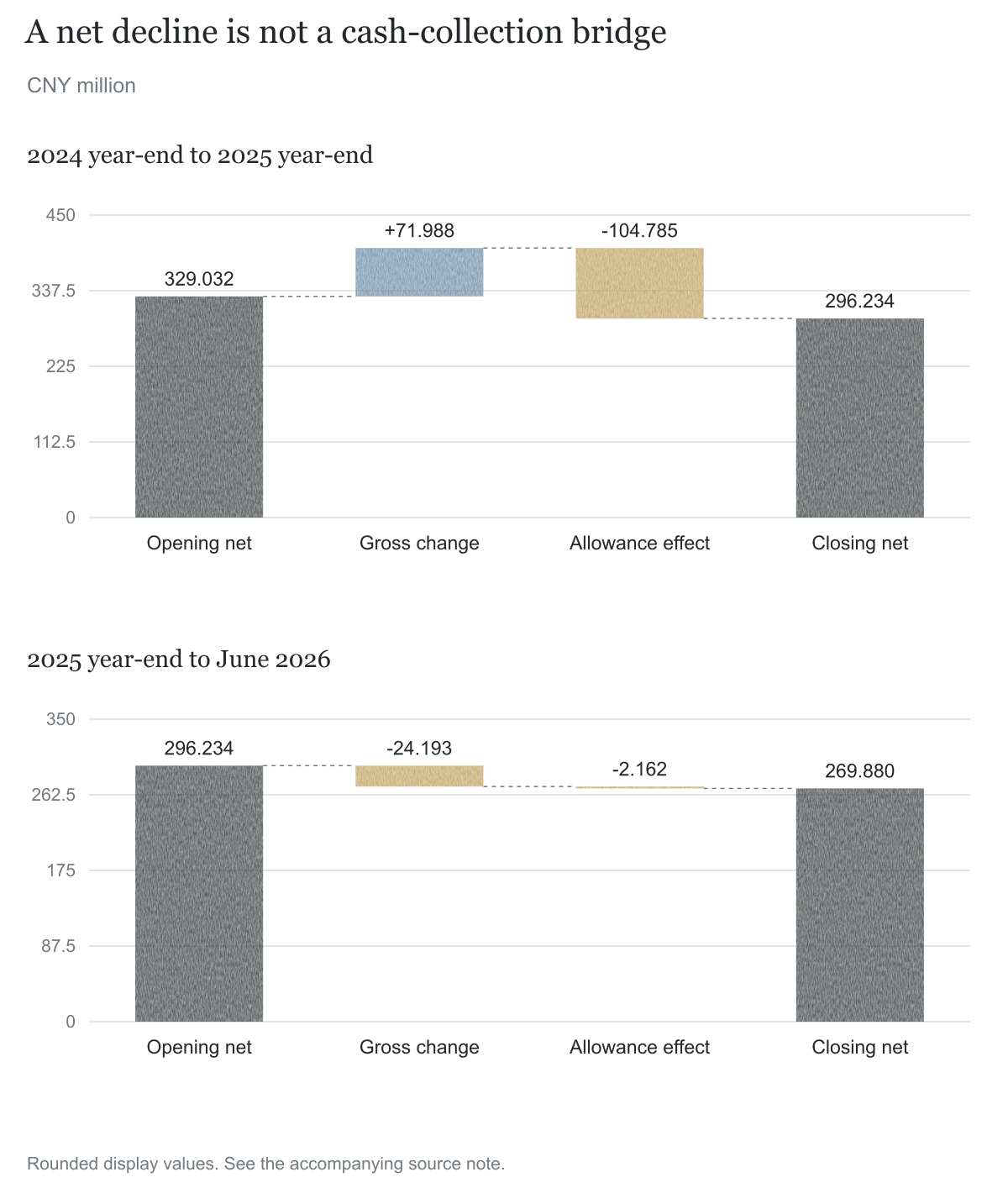
The receivable figures illustrate a separate source of confusion. Net accounts receivable fell by CNY32.798 million, while gross receivables increased by CNY71.988 million. The allowance increased by CNY104.785 million. The decline in the net balance therefore cannot be presented as evidence that the company collected CNY32.798 million of old receivables. It is the arithmetic result of a larger gross balance and a still larger increase in the allowance. [S02, pp.184-186]
Price revision and credit impairment must remain distinct. A price revision changes the amount of consideration for the product. A credit allowance estimates losses associated with collection. The reviewed sources do not establish that the larger allowance resulted from provisional pricing, or identify a relationship between the specific overdue balances and products awaiting price review.
The practical disclosure question is a cohort question: separate products awaiting price approval, products with approved prices but unpaid balances, and accepted projects with warranty retentions. Follow each group from delivery through pricing and payment. Until those amounts are known, a sensitivity can explain how the mechanism works, but it cannot be offered as an estimate of Kylinsec’s actual potential loss.
What the company sells, and why the contract sequence matters
Kylinsec’s business starts with operating systems and extends into information security and cloud computing. The annual report describes products and solutions serving power, government, and special-industry applications, among other fields. Its business is not a single standardized item sold across a counter for an immediately fixed cash price. The report includes software, integrated solutions, and technical services, with different delivery and acceptance processes. [S02, p.15]
The industry table reports CNY123.982 million of special-industry revenue in 2025, with CNY64.397 million of associated cost and a gross margin of 48.06%. Special-industry revenue was approximately 39.95% of total revenue. This provides a scale reference for that business category. It does not show that 39.95% of revenue was provisionally priced. The pricing-risk paragraph says the downstream customer base includes special-industry users; it does not assign the entire category to the provisional-price mechanism. [S02, p.49; author’s calculation]
This distinction prevents a tempting but unsupported calculation. Multiplying all special-industry revenue by an assumed price reduction would produce a number, but the reviewed disclosure does not identify that whole amount as the relevant exposure. Some products may have completed review; others may not be subject to the same process. The warning about further review of approved products also means that a simple current-year category is not necessarily the complete historical population affected by any future decision.
Ordinary investors may be familiar with an invoice, but less familiar with the sequence preceding it. A contract can set specifications and commercial terms. Delivery demonstrates that the supplier has provided the product or service. Acceptance records that the customer has accepted the relevant performance. Pricing procedures determine the amount payable where that amount is not yet final. Payment terms then determine when settlement is due, and actual collection determines when cash arrives.
Those stages can be close together, but their closeness must be established rather than assumed. A completed technical acceptance may remove a delivery question while leaving a pricing question open. A final price may remove a measurement uncertainty while leaving a collection delay. A cash payment may settle an amount while a separate warranty retention remains outstanding. Combining all these situations into “the receivable” loses information that matters to both accounting interpretation and liquidity.
Kylinsec explicitly describes recognizing revenue and receivables at provisional prices once the recognition conditions are satisfied. To assess the exposure, investors need the amounts awaiting final pricing and the process by which those prices are settled.
Recognition is not the same as final measurement
Revenue accounting has at least two questions: when should revenue be recognized, and how much should be recognized? They are related, but they are not interchangeable. A company can satisfy a delivery or acceptance condition while still needing to estimate an element of consideration. Conversely, a price can be written into a contract before the supplier has performed enough to recognize revenue.
Kylinsec’s accounting policy says it recognizes revenue when the customer obtains control of the goods. It describes the relevant product and service deliveries as recognized after contractual delivery and customer acceptance, with installation and commissioning where required. Services meeting the conditions for performance over time use an appropriate progress-based approach. These are the timing conditions; the price-risk disclosure does not displace them. [S02, pp.175-176]
For measurement, the policy describes considering variable consideration and limiting the amount included in the transaction price so that a significant reversal is highly unlikely when the uncertainty is resolved. This is an important qualification to the provisional-price mechanism. The reviewed filing does not say that the full amount of any optimistic provisional quote can automatically enter revenue regardless of the likelihood of a later reduction. [S02, p.176]
There are therefore two incomplete readings to avoid. One says that because a price is provisional, all related revenue recognition must be improper. That conclusion does not follow. The other says that because acceptance has occurred, the recognized amount must be completely fixed. The pricing paragraph directly cautions against that assumption for the products covered by the mechanism.
The more useful review asks how the provisional amount was estimated, which evidence supports it, how prior price-review outcomes compare with estimates, and what portion remains awaiting a decision. Those are questions about measurement support and remaining uncertainty. A finding that a particular estimate was inappropriate would require evidence about that estimate, not just the existence of a policy allowing provisional prices.
The distinction is visible in a simplified example. Suppose a supplier has completed and obtained acceptance for a product, and the accounting conditions support CNY100 of revenue using the best supported provisional price. It records revenue and a receivable of CNY100. The customer has received the product, but the amount is still subject to the agreed price process. A later approved price of CNY95 could require a CNY5 adjustment. Delivery did not disappear; the amount of consideration changed.
This is an illustration, not a description of an identified Kylinsec sale. Actual accounting would also need the contract, tax treatment, previous estimates, and other relevant conditions. The example’s purpose is narrower: an accepted transaction can remain exposed to measurement uncertainty without being a nonexistent transaction.
What changed between the reports?
The 2024 annual report already said that some special-industry product prices are determined through review by the relevant user units. It discussed pricing policy as one factor that could affect gross margin, alongside product mix, demand, labor costs, and raw materials. The mechanism should therefore not be described as having first appeared in 2025 simply because the later paragraph is more detailed. [S01, p.45]
The 2025 report sets out the provisional-price sequence more explicitly. It distinguishes products whose prices have already been reviewed from products whose review is unfinished, describes recognition at provisional prices where the recognition conditions are met, and describes later adjustments for the approved-versus-provisional difference. It also warns that changes in review policy or requirements could lead to further review and changes to previously reviewed prices. [S02, p.47]
The later report gives more detail about the mechanism, without saying when it began or how much revenue it affects. A fuller explanation is therefore not evidence that the exposure first arose that year.
The revenue note supplies an important counterpoint. Its item for significant contract changes or significant transaction-price adjustments is marked not applicable. A balanced reading must preserve this. The risk paragraph describes what could happen; the revenue note does not report a significant adjustment under that item for 2025. [S02, p.222]
The word “significant” sets the scope of that disclosure. It rules out a reported significant adjustment, but leaves open smaller adjustments and amounts still provisionally priced at year-end. Quantifying those two items would complete the picture.
The reports thus answer different questions. The risk section explains the potential mechanism. The revenue policy explains recognition and measurement principles. The revenue note reports whether a specified significant event category applies. The receivable note records balances and allowances. Reading these sections together provides a stronger basis than selecting whichever paragraph seems most alarming.
Revenue growth does not settle the price question
Kylinsec’s annual revenue series is uneven. Revenue was CNY400.356 million in 2022, CNY163.421 million in 2023, CNY286.379 million in 2024, and CNY310.329 million in 2025. The latest annual increase is real, but it follows a substantial earlier decline and recovery. It should not be described as four consecutive years of growth. [S01, p.8; S02, p.8]
| Year | Revenue, CNY million | Attributable profit or loss, CNY million | Operating cash flow, CNY million |
|---|---|---|---|
| 2022 | 400.356 | 128.857 | -46.456 |
| 2023 | 163.421 | -30.118 | -41.339 |
| 2024 | 286.379 | 7.936 | -7.463 |
| 2025 | 310.329 | -58.074 | -4.953 |
Sources: S01, pp.8-9; S02, pp.8-9. This table covers four annual periods, not a completed five-year financial review.
Growth can come from additional products, more projects, a changed product mix, a changed price, or adjustments associated with older deliveries. The reviewed totals do not identify a price-review contribution. A statement that revenue rose by 8.36% does not tell the reader how much of the recognized amount was finally priced. It also does not prove that adjustments reduced the year.
Product economics vary substantially. The 2025 table shows operating-system revenue of CNY155.350 million with a 95.79% gross margin, information-security revenue of CNY42.308 million with a 49.84% margin, and cloud-computing revenue of CNY108.378 million with a 37.33% margin. The overall gross margin was 68.42%, down 2.42 percentage points. [S02, p.49]
Such differences matter when evaluating any later price decision. The profit effect depends on which products are affected, the costs attached to those products, and whether procurement prices also change. A uniform percentage applied to consolidated revenue or consolidated gross margin would ignore those distinctions. The report’s pricing-risk paragraph itself says that relevant end-product selling prices and major-component purchase prices are subject to review.
The decline in overall gross margin does not establish that price review caused it. Mix can change the consolidated margin even when each product’s price remains unchanged. Costs can rise. Different types of cloud solutions can have different hardware content. The company identifies multiple drivers in its margin-risk discussion, so attributing the full decline to the provisional-price mechanism would require evidence not supplied by the selected tables. [S02, pp.47,49]
The company attributes its 2025 loss to increased credit impairment, marketing and research investment, personnel costs, new-subsidiary spending, and share-based payment charges. Those items explain a different part of the accounts; they do not identify an adverse final-pricing decision. [S02, p.2]
A lower net receivable can conceal a larger gross balance
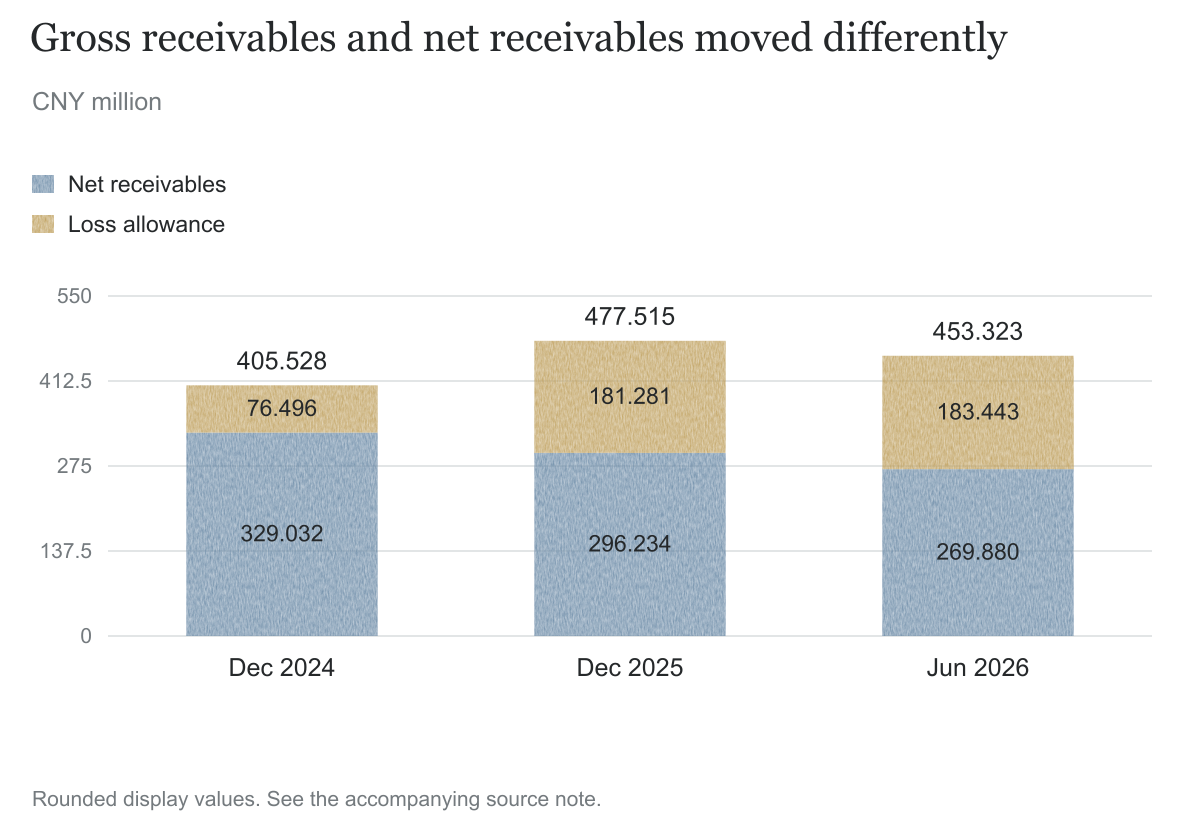
The receivable note gives a concrete calculation that readers can reproduce. At the end of 2024, gross accounts receivable were CNY405.528 million, the allowance was CNY76.496 million, and the net carrying amount was CNY329.032 million. At the end of 2025, the corresponding figures were CNY477.515 million, CNY181.281 million, and CNY296.234 million. [S02, pp.184-186]
| Accounts receivable measure | End of 2024, CNY million | End of 2025, CNY million | Change, CNY million |
|---|---|---|---|
| Gross balance | 405.528 | 477.515 | 71.988 |
| Allowance | 76.496 | 181.281 | 104.785 |
| Net carrying amount | 329.032 | 296.234 | -32.798 |
The exact identity is straightforward: net receivables equal gross receivables minus the allowance. The change in net receivables is therefore the change in gross receivables minus the change in the allowance. Here, positive CNY71,987,845.43 minus positive CNY104,785,352.57 equals negative CNY32,797,507.14.
Gross receivables increased by approximately 17.75%, faster than the 8.36% increase in annual revenue. Net receivables fell by approximately 9.97%. Both statements can be true. The allowance as a proportion of gross receivables rose from approximately 18.86% to approximately 37.96%. These ratios describe reported balances; they do not forecast the final loss rate on every customer. [S02, pp.184-186; author’s calculations]
The practical consequence is that the net decline cannot be used as a cash-collection bridge. Some customers may have paid during the year, and new sales may have added receivables. The endpoint balances do not quantify those gross flows. What they do establish is that the larger allowance more than offset the increase in the gross balance.
The allowance movement table adds another distinction. It records CNY104.848 million of new accounts-receivable allowance charges and CNY62,530.89 in the combined recovery-or-reversal column, producing the CNY104.785 million net allowance increase. The item for actual receivable write-offs is marked not applicable. The combined recovery-or-reversal amount should not be described entirely as cash collected, and an allowance charge should not be described as an actual write-off. [S02, p.186]
A credit allowance reduces the carrying value used in the accounts while the gross claim can remain outstanding. That is different from adjusting the sale price itself. If a final price decision reduces the consideration, the gross amount due may change. If the price remains fixed but expected collection worsens, an allowance can change without the same reduction in the contractual claim. Contract-specific facts determine the treatment; the aggregate table does not identify the source of each movement.
The receivable note shows a larger gross balance and allowance, without identifying which balances await price review or linking the allowance to provisional prices. A price adjustment and a credit loss could affect the same receivable. Adding estimates of both risks would require identifying the overlap to avoid double counting.
The accounting-estimate change is smaller than the full charge
The annual report also discloses a change in receivable loss assumptions, applicable from October 1, 2025. The explanation refers to aging, historical collection, forward-looking industry information, and differences in credit-risk characteristics. The table reports impacts on credit impairment and asset impairment in units of CNY10,000. [S02, p.111]
The reported impacts are negative CNY1.0272 million for credit impairment and negative CNY420,700 for asset impairment. These are the amounts attributed to the disclosed estimate change in that table. They are not the entire year’s impairment charges. Reading “102.72” as CNY102.72 million would introduce a hundredfold unit error.
The distinction also matters analytically. The cash-flow reconciliation adds back CNY104.237 million of total credit impairment for 2025. The receivable allowance table has its own scope and movement figures. The estimate-change table reports the effect of changing specified assumptions. Those three numbers answer different questions and should not be forced into a single explanation. [S02, pp.111,186,229]
This review does not conclude that the estimate change accounts for the whole deterioration in reported profit. Nor does it infer that the unchanged portion of a loss estimate must be reliable or unreliable. The necessary question is how each balance’s collection evidence and assumptions support its carrying amount. For the provisional-price topic, the further question is whether price uncertainty and credit uncertainty have been separated in that assessment.
Acceptance, warranty retention, and pricing are different conditions
Kylinsec’s contract-asset note supplies another useful boundary. It identifies the balance as warranty retentions on accepted projects. At the end of 2025, the gross balance was CNY8.417 million, the allowance was CNY3.517 million, and the net carrying amount was CNY4.900 million. [S02, p.187]
A warranty retention can remain unpaid after acceptance because another contractual condition must be satisfied. That is not automatically a provisional-price balance. The company has given this category a specific description, and a reader should preserve it. Reclassifying all contract assets conceptually as “unapproved sales” would ignore what the note says.
Likewise, contract liabilities have the opposite direction from receivables: they generally represent consideration received before the related performance has been completed. The consolidated balance was CNY38.984 million at the end of 2025, up from CNY26.907 million a year earlier. That is another source of timing in customer cash flows, not a quantified measure of final-price uncertainty. [S02, p.140]
Inventory also includes project-related costs. The 2025 inventory note shows a net balance of CNY80.835 million, of which CNY69.751 million is contract-fulfillment cost. Describing all inventory as unsold boxed software or unwanted hardware would miss this composition. Costs can sit in projects at different stages and later move into expense with the associated accounting recognition. [S02, p.196]
Before completion, qualifying fulfillment costs may be carried as assets and a customer’s advance may create a contract liability. On performance and acceptance, revenue and the associated cost are recognized under the relevant policy. A receivable or warranty retention may remain. For the sales described on page 47, final pricing is a further step in that sequence.
The reviewed report does not connect every category to a common contract-level schedule. That is the missing analytical bridge. Adding inventory, receivables, and contract assets and calling the sum “unsettled provisional revenue” would mix cost assets with sales claims and include different conditions. The categories are useful precisely because they should not be collapsed.
How fourth-quarter acceptance affects the year-end picture
The 2025 quarterly table reports CNY151.313 million of fourth-quarter revenue. Dividing by the annual total gives approximately 48.76%. The 2024 annual report reported a fourth-quarter share of 47.64%. The company explains that its customer and end-user base tends to plan budgets around year-end or the beginning of the following year, with project acceptance concentrated in the third and fourth quarters. [S01, p.44; S02, pp.10,46]
The company’s explanation links seasonality to acceptance timing. Assessing individual sales would still require contract and acceptance records. For the aggregate figures, the immediate implication is that year-end receivables may reflect a concentration of recently accepted work.
A year-end receivable balance can contain a substantial amount of recently accepted work. Dividing that endpoint balance by the whole year’s revenue and multiplying by 365 does not produce an exact collection period for a highly seasonal company. It mixes a point-in-time numerator with an annual flow and may also mix tax bases or net and gross measures. An aging schedule and due-date analysis are more informative.
For provisionally priced sales, one more clock is needed. How long after acceptance does price review occur? If acceptance is concentrated late in the year, pricing decisions might fall in a later reporting period. That is a possibility arising from the sequence, not an observed timing result established for Kylinsec’s contracts. The reviewed tables do not provide the required cohort dates.
A useful follow-up would take projects accepted in a specified quarter and show the provisional amount, approved amount, date of approval, payment due date, and cash received. That would reveal whether a receivable’s age reflects ordinary payment terms, review timing, overdue collection, or a combination. Each case can have a different explanation and financial implication.
The late-year concentration also makes interim comparisons sensitive to timing. A weak first quarter or stronger fourth quarter cannot be interpreted without the company’s project cycle. The 2026 interim report repeats the seasonality and provisional-pricing discussion. Its first-half results should be compared with the corresponding first half, not used to predict the full-year delivery pattern. [S04, pp.7,35]
The interim report leaves the amount awaiting final pricing open
For the first half of 2026, revenue was CNY96.587 million, up 2.69% from CNY94.060 million a year earlier. The attributable loss narrowed to CNY2.427 million from CNY10.384 million, while the loss excluding non-recurring items was CNY24.307 million compared with CNY29.260 million. Operating cash flow improved from negative CNY16.182 million to negative CNY4.425 million. Improvement and a continuing negative balance belong in the same description. None of those headline comparisons identifies an approved-versus-provisional price difference. [S04, p.7]
The June-end receivable note allows a new, different bridge. Amounts below are CNY million, rounded for display. [S04, p.129]
| Receivable measure | December 31, 2025 | June 30, 2026 | Change |
|---|---|---|---|
| Gross accounts receivable | 477.515 | 453.323 | -24.193 |
| Loss allowance | 181.281 | 183.443 | +2.162 |
| Net accounts receivable | 296.234 | 269.880 | -26.355 |
Gross receivables declined by CNY24,192,670.65 and the allowance increased by CNY2,161,972.35, producing the CNY26,354,643.00 net decline. Unlike 2025, the gross balance also fell. To determine how much of that fall came from collections, readers would need to separate cash receipts from new sales, price changes, write-offs, and other movements. The closing balances do not allocate those components. [S04, p.129; calculation]
The interim report retains the provisional-price risk mechanism, but the cited passage does not quantify the cohort awaiting approval. It therefore brings the balance-sheet analysis forward without supplying the exposure base needed for a company-specific price sensitivity. The annual report’s not-applicable designation for significant transaction-price adjustments remains evidence about that annual reporting period; it should not be silently extended into a statement about all first-half price adjustments. The two periods require their own evidence. [S04, p.35; S02, p.222]
The cash-flow bridge: a provision is not a payment
The 2025 cash-flow reconciliation starts from a consolidated loss of CNY58.089 million, rather than the CNY58.074 million loss attributable to shareholders. It adds back CNY104.237 million of credit impairment, along with other noncash and classification adjustments, before including working-capital movements. The starting figures have different scopes and should not be substituted for each other. [S02, p.229]
The major working-capital rows include a negative CNY75.552 million movement for operating receivable items, a negative CNY19.757 million movement for inventory, and a positive CNY52.347 million movement for operating payable items. The full reconciliation reaches negative operating cash flow of CNY4.953 million. These selected rows are not a complete reconstruction of every adjustment; they show why a large impairment add-back does not mean cash was collected. [S02, pp.229-230]
When an impairment charge reduces accounting profit without an immediate cash payment, the indirect cash-flow reconciliation reverses that noncash charge. That reversal is an accounting bridge, not an incoming bank transfer. Customer receipts, supplier payments, payroll, taxes, and other cash movements still determine the cash outcome.
The operating-receivable row is also broader than accounts receivable alone. It should not be forced to equal the difference between two net receivable balances. The balance-sheet change includes allowance movements, while the cash-flow reconciliation uses adjustments suited to the statement’s scope. Taxes, other receivable categories, and other differences can matter; an exact account-level bridge needs more detail than the two endpoints.
Kylinsec’s operating cash flow improved in 2025, and the company attributes the improvement principally to increased cash received from selling goods and providing services. The improvement should be acknowledged. It remained negative, as it had in the other annual periods shown, but a negative value becoming less negative is not a deterioration merely because profit fell. [S02, pp.9,49]
The cash evidence neither proves nor disproves the provisional-price exposure. A customer can pay a provisional amount before final review, settle only after review, or make staged payments, depending on the contract. The reports reviewed do not establish which pattern applies to the unquantified cohort. A complete analysis needs the payment arrangement rather than an assumption that all unreviewed amounts are unpaid.
A price sensitivity, clearly separated from an estimate
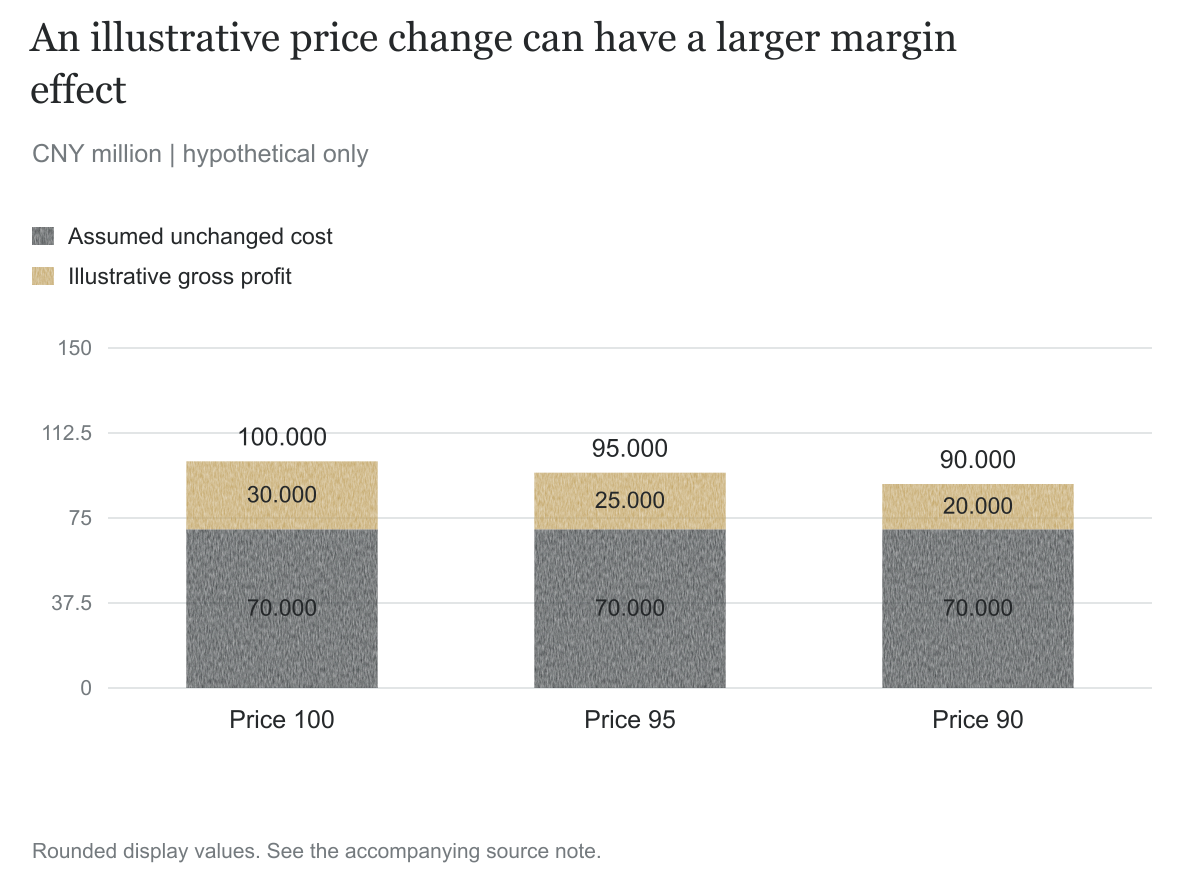
The following illustration uses assumed numbers. It is not a calculation of Kylinsec’s exposure, a prediction of an approved price, or a restatement of its profit. Assume a supported provisional selling amount of CNY100 million and associated cost of CNY70 million. Assume the cost is unchanged when the selling price is finalized, and ignore taxes, credit allowances, financing effects, and other expenses.
| Hypothetical outcome | Selling amount, CNY million | Cost, CNY million | Gross profit, CNY million | Gross margin |
|---|---|---|---|---|
| Provisional amount retained | 100 | 70 | 30 | 30.00% |
| Final selling amount 5% lower | 95 | 70 | 25 | 26.32% |
| Final selling amount 10% lower | 90 | 70 | 20 | 22.22% |
A 5% reduction in the selling amount reduces gross profit by one-sixth in this example; a 10% reduction reduces it by one-third. The effect on gross profit is proportionately larger than the selling-price change because the assumed cost stays fixed. That is the reason a modest percentage adjustment can deserve attention even without changing the volume delivered.
The fixed-cost assumption is not automatically appropriate for the company’s contracts. The price-risk paragraph says major-component purchase prices are also reviewed. If a lower selling price were accompanied by lower procurement cost, the profit effect could be partly offset. The timing, contractual linkage, and amount of such an offset would need evidence. It should neither be assumed absent nor assumed complete.
A price increase would work in the opposite direction, subject to the actual accounting and contract facts. The filing warns about downward outcomes but does not establish that every review must be adverse. Historical approved-versus-provisional differences would help assess the range and direction of outcomes.
The example also shows why tax and attribution matter. A gross-profit sensitivity is not a one-for-one estimate of attributable net profit. Tax treatment, other cost changes, and the relevant subsidiary interests can alter the result. No particular tax rate is applied here because the actual exposure and entity are unidentified.
For a company-specific sensitivity, the missing input is the exposure base. It might include current-year provisional revenue, older deliveries awaiting approval, and products subject to further review, with different pricing and cost conditions. Until those populations are established, selecting a large public balance and applying an arbitrary percentage would create false precision.
Why a later adjustment can affect a later period
The company’s disclosed sequence places the difference between approved and provisional prices into revenue when the review is completed. A later period can therefore contain an adjustment associated with an earlier delivery. The filing describes this mechanism; the reviewed notes do not identify the amount of such adjustments in 2025. [S02, p.47]
Suppose, purely hypothetically, CNY100 of supported provisional revenue is recognized on a completed and accepted delivery in Year One. In Year Two, the approved amount becomes CNY95. Under the stated mechanism, the CNY5 difference would affect the relevant current-period revenue treatment. Year Two’s revenue comparison would then contain a price outcome for an earlier cohort, alongside its own new deliveries.
That makes a delivery-year bridge useful. Current reported revenue can be separated analytically into new-period delivery revenue and adjustments associated with prior deliveries, where the actual disclosures support those categories. The bridge would let readers distinguish a change in demand from the completion of an old pricing process.
A later difference does not, by itself, prove that the earlier estimate was wrong when made. Assessing the earlier estimate requires the evidence available at that earlier date and the policy applied to it. New information, the resolution of uncertainty, and an accounting error are different concepts. This article does not classify an unidentified future adjustment as a prior-period error.
The same discipline applies to payment. If cash has already been received at the provisional amount, a later lower price might require a different settlement path from a case in which the full amount remains unpaid. Any refund, offset, or revised receivable depends on the contract and actual payment history. The filing’s general risk paragraph is not a substitute for those documents.
The balance sheet offers a counterweight
A review of pricing uncertainty should not turn into an unsupported liquidity-crisis story. At the end of 2025, Kylinsec reported CNY158.152 million of monetary funds and CNY621.433 million of trading financial assets. The latter consisted of wealth-management products and structured deposits. The balance sheet did not show short-term or long-term borrowing balances, although lease obligations and other liabilities remained. [S02, pp.139-140,181-182]
These observations matter because operating cash flow and liquidity resources are not the same measure. A company can have negative operating cash flow while holding substantial financial assets. Ignoring those assets would exaggerate a funding inference. Counting every financial asset as immediately accessible cash would exaggerate available liquidity in the other direction.
The cash-and-cash-equivalent note reports CNY113.319 million, less than monetary funds. It explains that the difference includes restricted funds and term deposits intended to be held to maturity that do not meet the cash-equivalent definition. The monetary-funds note separately identifies CNY362,814.01 of restricted balances at year-end. The whole difference must not be called restricted. [S02, pp.181,230]
Liquidity resources do not make price uncertainty disappear. They can reduce the immediate funding consequences of a collection delay while a change in consideration still affects revenue or profit. Conversely, a sizable receivable allowance does not establish that the company lacks resources to meet its obligations. The pricing, credit, and liquidity analyses answer related but separate questions.
Company explanations and the remaining disclosure question
The strongest benign interpretation is that price review is an ordinary feature of the relevant customer procurement arrangements. Provisional estimates may be well supported, final outcomes may be close to those estimates, and settlements may proceed normally. The report’s measurement policy supplies an important discipline, and the significant-price-adjustment item does not report a significant 2025 event.
The business also has plausible timing explanations. Customer budgets and project acceptance create seasonality. Product mix creates different margins. Increased credit allowances have already reduced reported carrying values. The company describes efforts to strengthen credit management and collection. These points should be part of the analysis, not relegated to a generic final sentence. [S02, pp.46-47,49]
The unresolved issue is quantification. A risk description tells the reader a mechanism exists but not how much of the accounts it affects. The reviewed tables do not identify the provisional-price cohort, its age, its approval progress, or the range of historical adjustments. That limits the ability to distinguish a small routine process from a financially meaningful exposure.
The amount and age of the affected sales would change the assessment. Small balances, immaterial past adjustments, and prompt approvals followed by payment would ease the concern. A large backlog of older sales or repeated material price differences would call for more detail. The reviewed filings do not establish which situation applies.
The full interim report was reviewed, with follow-up documents selected from CNINFO announcement titles dated March 1 through September 7, 2026. This does not cover the full text of every announcement or every platform. The remaining question calls for the value and age of sales awaiting final pricing, together with past provisional-to-final price differences. Favorable results would be just as relevant as adverse ones.
Questions investors should ask
- What amount of current-period revenue and year-end gross receivables relates to products awaiting final price review?
- How much of that population comes from earlier delivery years, and what is its approval timeline?
- What were the approved-versus-provisional differences in each period, including adjustments not described as significant?
- How does the company support provisional amounts under its variable-consideration policy?
- Which balances have approved prices but remain unpaid, and which instead depend on pricing or warranty conditions?
- Do procurement-price adjustments offset selling-price adjustments, and in which period would each be recognized?
- What subsequent disclosure resolves or narrows the unanswered questions in the annual report?
Conclusion
Kylinsec’s filing describes a sequence that ordinary readers can easily compress into a single event. An accepted product can support revenue recognition while its final price remains subject to review. That is a measurement question, distinct from whether the product was delivered and distinct from whether the customer will pay.
The 2025 accounts also show why net receivables need careful reading: the net balance fell while the gross balance increased, because the allowance increased more. Neither that decline nor the larger impairment charge establishes an adverse pricing outcome. The report’s significant-price-adjustment item provides a further limit on the current evidence.
The useful next disclosure is a quantified bridge from provisional revenue to approved prices and then to cash, grouped by delivery period and contractual condition. Until that bridge is available, the evidence supports explaining the mechanism and asking about its scale. It does not support a claim that Kylinsec overstated revenue, suffered a particular price haircut, or faces a liquidity crisis.
Sources
References use physical PDF pages. Monetary tables are rounded to CNY million; the receivable reconciliation uses exact source amounts. The early prospectus is not evidence of how much revenue currently awaits final pricing.
| ID | Original title and English description | Publication date | Principal locations | Link |
|---|---|---|---|---|
| S01 | Hunan Kylinsec Technology Co., Ltd. 2024 Annual Report | April 30, 2025 | pp.8-9: 2022-2024 results; p.44: seasonality; p.45: product price-review risk | Issuer filing PDF |
| S02 | Hunan Kylinsec Technology Co., Ltd. 2025 Annual Report | April 30, 2026 | p.2: company loss explanation; pp.8-10: results; pp.46-49: seasonality, price risk, margins; p.111: estimate change; pp.139-140: consolidated balance sheet; pp.175-176: revenue policy; pp.181-182: cash and financial assets; pp.184-187: receivables and warranty retentions; p.196: inventory; pp.221-222: revenue note; pp.229-230: cash-flow reconciliation | Issuer filing PDF |
| S04 | Hunan Kylinsec Technology Co., Ltd. 2026 Interim Report | August 27, 2026 | p.7: first-half results; p.35: pricing and seasonality; p.129: gross receivables and allowance | Issuer filing PDF |
Disclaimer
This report is based on the cited public information available by the stated cutoff and is prepared for educational and investor-protection purposes. It is not investment, legal, or accounting advice, or a recommendation to buy, sell, or hold any security. Hypothetical examples do not estimate Kylinsec’s actual exposure or future prices. The amount awaiting final pricing and the complete contract terms remain unquantified in the materials reviewed. No misconduct is alleged unless a competent authority has made such a finding. Readers should conduct their own due diligence.