Mindray's 75% Acquisition Leaves a Future Cash Obligation
The price-floor clause behind a long-dated obligation to purchase a seller's remaining interest.
- Company
- Mindray
- Ticker
- 300760.SZ
- Published
- September 17, 2026
- Information cutoff
- September 16, 2026
The detail
The 2025 annual report, p.283, records CNY415.5 million for a future purchase of Gorka's then-held DiaSys interest. The 2026 interim bridge, p.216, shows its CNY23.6 million decrease was entirely non-cash, not repayment.
Why this matters
A price-floor clause disclosed in the original DiaSys acquisition leaves a conditional future equity purchase obligation. Its accounting balance changes without cash settlement, while strong group cash generation and the contract's unresolved pricing inputs keep the analysis focused on capital commitments rather than an immediate liquidity alarm.
Review scope
Information cutoff: September 16, 2026. The review uses the public disclosures cited below and dated index entries within this boundary; later disclosures are outside its scope.
The detail
On page 283 of Mindray’s 2025 annual report, an explanatory paragraph under other non-current liabilities describes a future share transfer. From the ninth year after completion of the DiaSys acquisition, specified events can allow either party to require the purchase or sale of all the seller’s then-held interest. The price is a fair price, but cannot be lower than an agreed floor. Both parties have committed to accept the relevant request. The report carries a financial liability of CNY415.5 million for this arrangement. [S01, p.283]
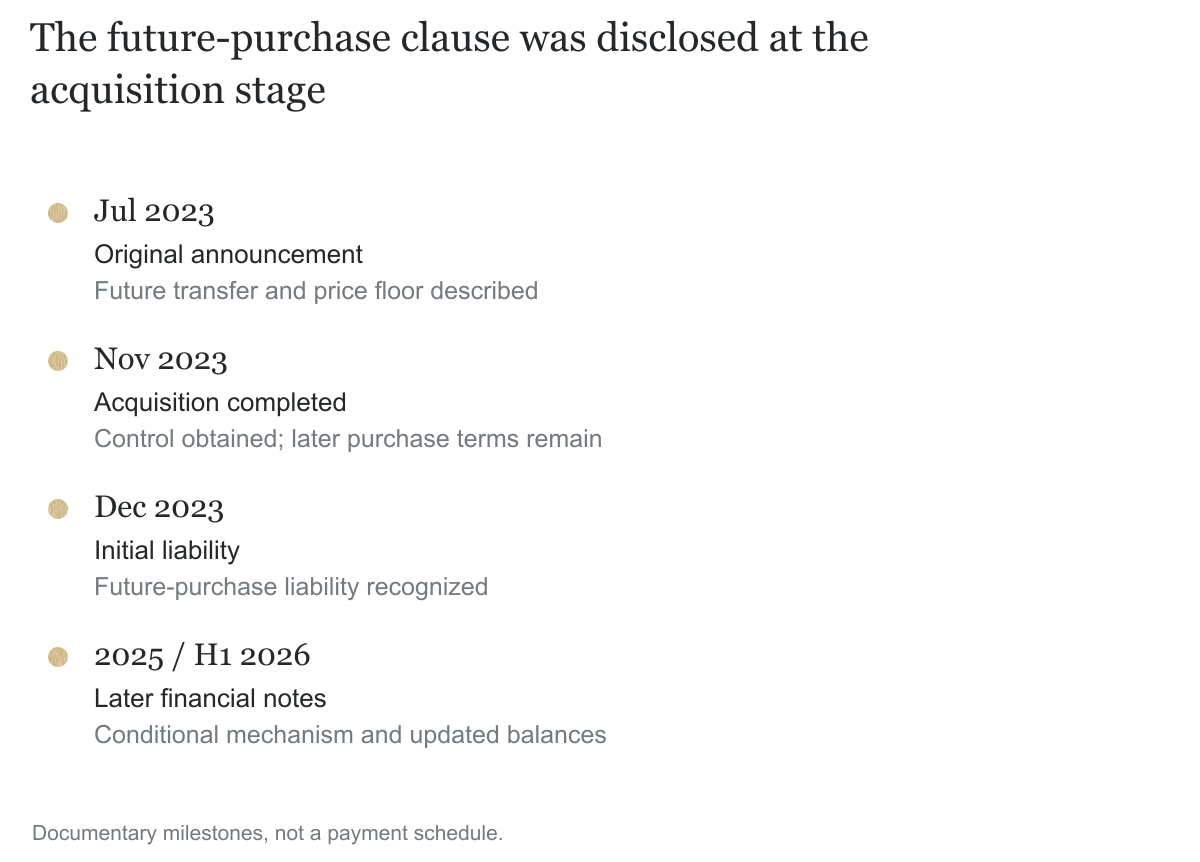
This provision was not a new revelation in the annual report. Mindray’s original acquisition announcement, published on 31 July 2023, already described the future transfer and the floor. What is easily missed is how that contractual sentence connects to the consolidated accounts several years later. A headline saying that Mindray acquired 75% of a business describes the acquisition of control. It does not, by itself, describe every future cash commitment attached to the ownership structure. [S09, pp.5-6]
The distinction matters even when the buyer has substantial resources and the acquired business offers genuine strategic benefits. The remaining interest is equity in a subsidiary, but a contractual obligation to purchase it can appear as a financial liability in the buyer’s group accounts. Its initial recognition can reduce equity without appearing as an acquisition expense in the income statement. Its reported balance can subsequently fall without any money having been paid. Reading only profit, bank loans, or the first acquisition price will miss part of the arrangement.
Mindray’s first-half 2026 report makes the last point particularly clear. The liability fell to CNY391.8 million, but the financing-liability reconciliation identifies the entire CNY23.6 million reduction as non-cash. The relevant line reports no cash increase or cash decrease. That is evidence of a lower accounting balance, not evidence that Mindray paid the seller and extinguished the obligation. [S02, pp.200,216]
Executive summary
The central question is how investors should incorporate a conditional, long-dated equity purchase into their understanding of an acquisition. The public record establishes the existence of the arrangement, its relative starting period, the presence of a price floor, and its recognition as a liability. It does not supply the floor amount, a complete list of triggering events, or enough valuation detail to independently reconstruct the liability.
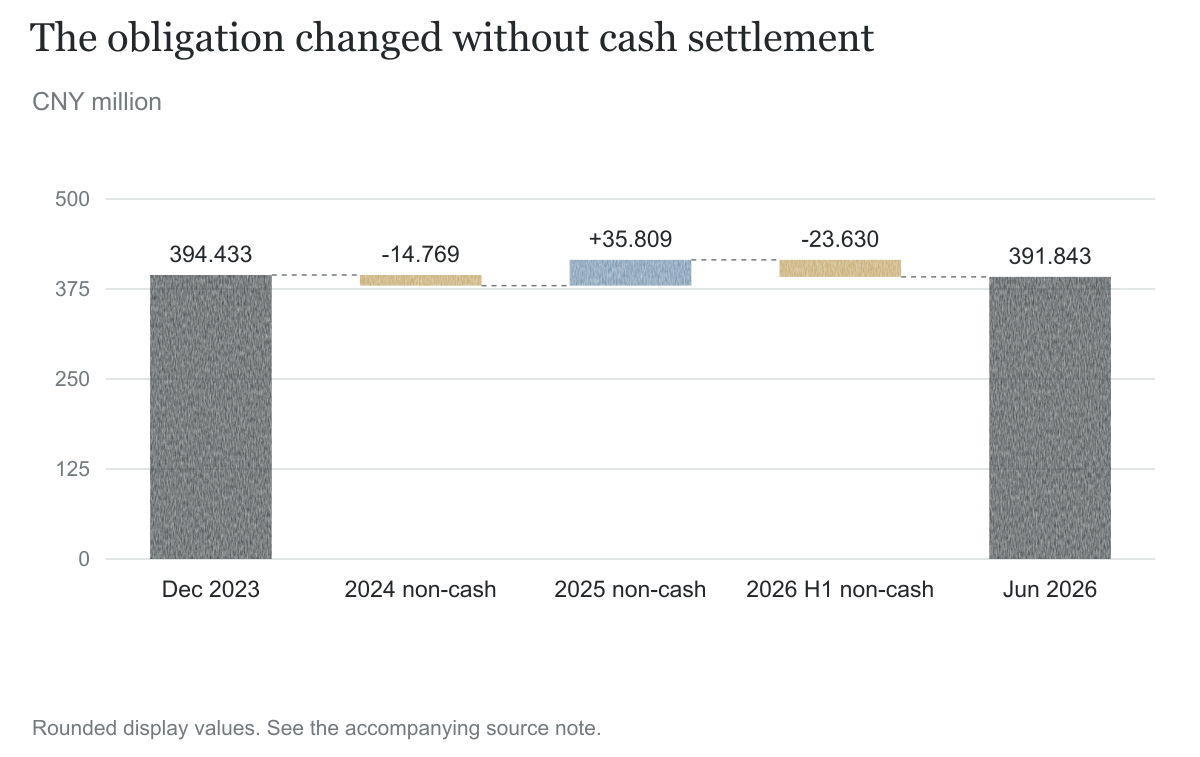
The recorded amount moved from CNY394.4 million at the end of 2023 to CNY379.7 million in 2024, CNY415.5 million in 2025, and CNY391.8 million in June 2026. The three subsequent reporting-period movements were all non-cash in the disclosed reconciliations. There is no monotonic increase and no demonstrated repayment in those lines. [S04, p.86; S03, p.277; S01, p.301; S02, p.216]
The scale also limits the interpretation. The December 2025 carrying amount was approximately 2.35% of reported monetary funds, 0.70% of total assets, and 4.10% of that year’s consolidated operating cash flow. Those comparisons do not establish a dedicated reserve for payment, but they argue against presenting this one item as evidence of an immediate group liquidity crisis. Mindray generated substantial operating cash across the five years reviewed. [S01, pp.20,252; S02, p.16; calculations below]
There are two substantive disclosure questions. First, what determines the ultimate cash requirement once the future transfer conditions are met? Second, why does the liquidity-risk table reproduce the liability’s carrying amount under a heading describing undiscounted contractual cash flows, when the accounting explanation refers to present value? The reviewed documents do not resolve the assumptions behind that presentation. The matching numbers warrant an explanation, not an allegation that the table is wrong. [S01, pp.283,315; S02, pp.200,229]
Background: what Mindray bought
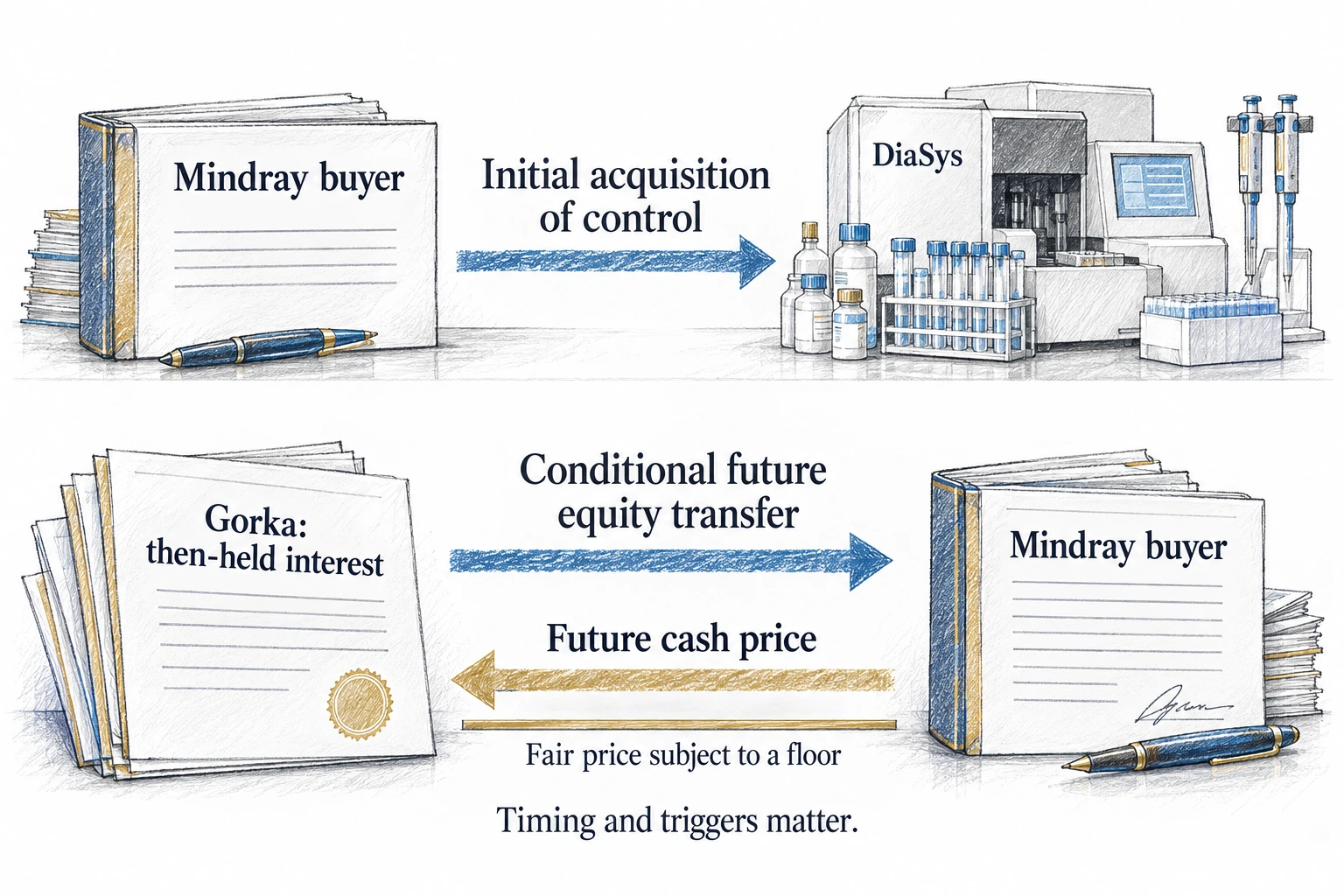
Mindray develops and supplies medical equipment and diagnostic products. The DiaSys transaction concerned its in-vitro diagnostics business, commonly abbreviated IVD. In this context, the company’s acquisition rationale emphasized an overseas supply platform, international personnel, and products that complement its diagnostic offering. These are business reasons for buying a company, rather than reasons to view every acquisition-related obligation as suspect. [S09, p.6]
In-vitro diagnostics involves examining samples outside the patient’s body. A diagnostic business may need more than a machine: reagents, controls, calibrators, manufacturing capability, logistics, and support can all form part of the operating system. Mindray said that DiaSys would help strengthen its overseas supply chain and support access to medium- and large-volume customers. That rationale explains why an acquisition can be economically valuable beyond the acquired company’s immediately reported standalone profit. It does not, however, quantify the value of the remaining stake years later. [S09, p.6]
The original transaction was for 75% of DiaSys Diagnostic Systems GmbH, purchased from Gorka Holding GmbH through Mindray’s Netherlands subsidiary. The announcement described an initial purchase price of approximately EUR115 million, subject to closing-account adjustments. It separately described a EUR40 million capital contribution after closing: EUR30 million from the Mindray buyer and EUR10 million from Gorka. A payment for shares to a seller and a contribution into the operating business are different uses of money. [S09, pp.4-6]
The distinction is practical. Money paid to a seller changes ownership but does not automatically become cash available inside the acquired company. Money subscribed as new capital supports that company’s balance sheet. A later purchase of the seller’s remaining interest is a third transaction, even if all three belong to the same strategic acquisition. Combining them into one loosely described acquisition cost can obscure who receives cash and when the obligation arises.
The completion announcement, dated 1 December 2023, confirmed that closing occurred on 30 November. It said the preliminary EUR115 million consideration had been paid, while the closing-account mechanism still required final adjustment. The audited 2023 financial statements subsequently recorded an acquisition cost of CNY947.1 million and CNY894.7 million paid by year-end. These disclosures concern different stages and measurement descriptions. Their numerical difference is not, without a reconciliation, evidence of an undisclosed payment problem. [S10, p.1; S04, p.108]
Acquiring 75% gave Mindray control, which is the basis for consolidating DiaSys and its subsidiaries. Consolidation means that the group reports the controlled business’s assets, liabilities, revenues, and expenses within its own financial statements, with the relevant ownership distinctions also presented. It does not mean that Mindray owns every economic interest in that business. The seller’s remaining interest and a commitment to buy it therefore remain relevant after the initial transaction has closed.
An ordinary reader can reasonably regard completion as the end of an acquisition story. For accounting and capital allocation, completion can instead be the beginning of a second story: integration, continuing minority ownership, and a later exit arrangement. The Fine Print question starts at that boundary. It asks what remains committed after control has already been obtained, rather than relitigating whether the original acquisition should have happened.
The documentary trail
The documents allow the contractual and accounting history to be followed without treating the most recent note as a standalone warning. The July 2023 announcement described both the purchase agreement and the shareholders’ agreement. Its summary of the latter included the future transfer from the ninth year after completion and a fair-price mechanism with a floor. The announcement also identified German law and arbitration in London under International Chamber of Commerce rules for disputes under the shareholders’ agreement. [S09, pp.5-6]
The public summary is informative but is not the complete signed contract. It explains that specified events matter without enumerating them in the reviewed clause. It identifies a floor without stating its amount there. It provides a dispute forum, but not a complete explanation of the valuation process. Those differences determine what an analyst can calculate. A known arbitration framework does not provide the missing pricing inputs.
After closing, the 2023 financial statements recorded CNY394.4 million for the future equity purchase arrangement. The subsequent annual reports repeated the mechanism and supplied later balances. The 2026 interim report retained the same conditional description and a financial liability of CNY391.8 million. The existence of a later accounting balance is therefore consistent with an arrangement disclosed at the transaction stage, rather than evidence that a new bank borrowing arose in 2025. [S04, p.86; S03, p.266; S01, p.283; S02, p.200]
The company’s business updates also belong in the record. In its 31 March 2026 investor relations document, Mindray said DiaSys product introductions, capacity expansion, and regional logistics integration were progressing. Its 31 August record reported growth in the broader IVD business. These statements provide an important competing perspective: the acquisition is being described as an operating platform under development, not simply a financial claim waiting to be settled. They are company explanations, not an independent valuation of the residual equity obligation. [S07, p.3; S08, p.3]
The review covers the 2025 and 2026 interim financial notes, the original acquisition and completion announcements, and the two investor-relations records. Follow-ups were selected through an official announcement-title search. A complete signed agreement was not obtained, and the investor records examined do not supply the price floor or full trigger schedule. Other contractual developments may fall outside the materials reviewed.
How the mechanism works
A minority interest can become a purchase commitment
The object of the future transfer is the seller’s then-held interest in DiaSys, not Mindray’s publicly traded A shares. This is important because the word repurchase in a financial note can otherwise sound like a listed-company share buyback. The economic transaction described here is a buyer taking the remaining ownership interest of an acquired subsidiary from its seller, subject to the contractual conditions. [S09, p.6; S01, p.283]
The two parties’ rights do not imply two unrelated directions of investment. In the disclosed mechanism, one party can request the relevant purchase or sale of the seller’s remaining interest, and the counterpart commits to accept it. The result contemplated is a transfer of that interest to the buyer. The filing does not describe Gorka being required to purchase Mindray stock or Mindray being required to sell its own controlling stake.
Nor does the existence of such a commitment establish that the initial arrangement was unfair. Retaining a seller as a minority shareholder can support continuing cooperation, and providing a later exit can make the ownership structure workable. The appropriate investor question is what was promised in exchange for those benefits. A company can have a commercially sensible acquisition and still carry a future commitment that deserves clearer quantification.
The relative starting period is one of several conditions. A calendar reaching the ninth year is not the same as all transfer conditions being satisfied. Without the full agreement, this review cannot identify an exact payment date or treat a particular year as an unconditional maturity. The article preserves the company’s relative wording because the contractual counting convention and the triggering events have not been reconstructed.
A price floor changes the distribution of outcomes
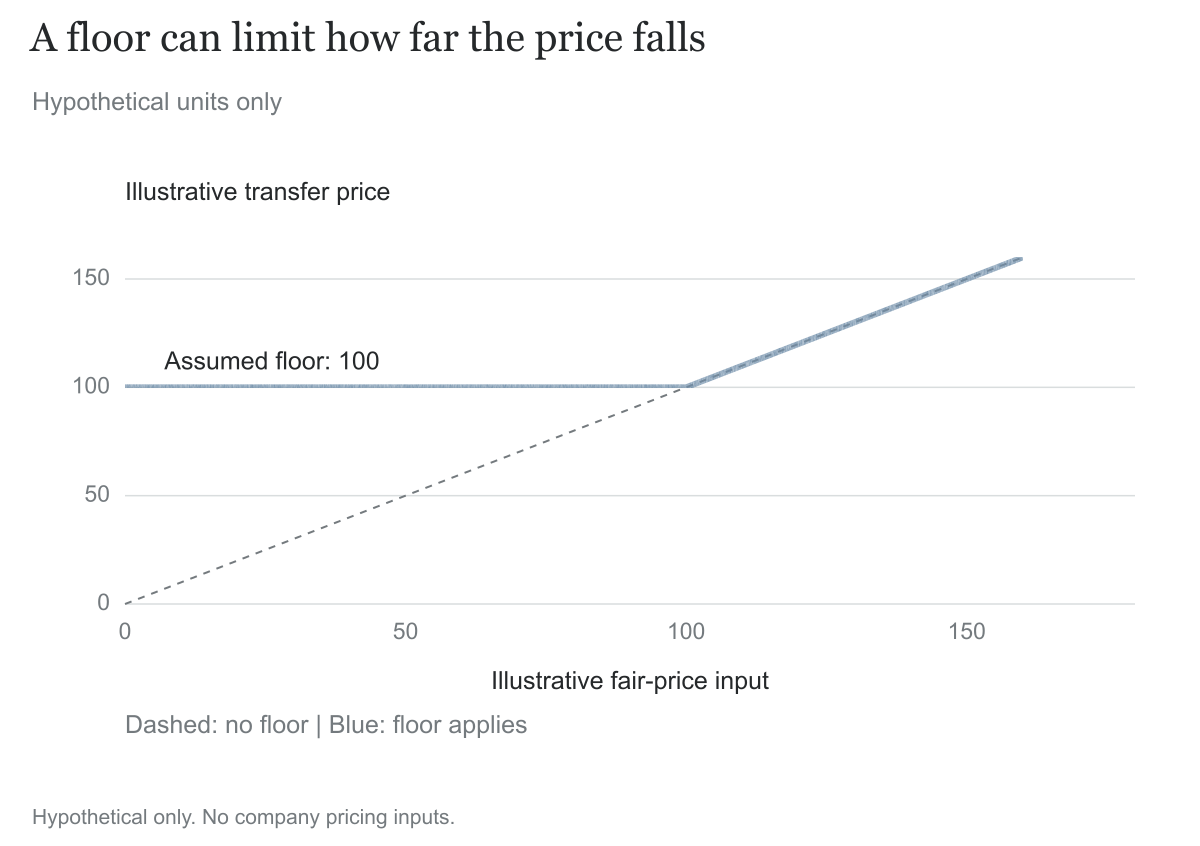
A floor matters because it can prevent a lower equity valuation from producing an equally lower purchase price. Consider a purely hypothetical agreement with a floor of 100 units. If the agreed fair-price process produces 140 units, the price can be 140. If it produces 80, the floor can keep the transfer price at 100. This example is not Mindray’s floor, currency, valuation, or actual contract calculation. It illustrates the economic effect of the stated lower bound.
For a buyer, the consequence is that future cash requirements need not move proportionately with the acquired business’s value. A weaker business could mean less value received without an equally reduced payment. A stronger business could mean a higher fair price and a more valuable ownership interest acquired. The first outcome describes downside asymmetry in a mechanism; it does not demonstrate that DiaSys is weakening or that the floor is currently binding.
The identity of the price input also matters. Fair value is not simply a percentage of today’s consolidated revenue, nor is the floor automatically the initial acquisition price multiplied by the unpurchased percentage. The agreement may define an equity valuation process differently from an accounting carrying value. Without the floor and valuation terms, such shortcuts would manufacture precision from incomplete information.
The public description supplies enough information to ask whether the floor has economic importance, but not enough to calculate how far current expectations stand above it. An informative additional disclosure would explain the floor’s currency, any adjustments, the valuation approach, and the events that can activate transfer. A commercial confidentiality concern might affect the level of detail provided; it does not change the distinction between knowing that a lower bound exists and knowing its size.
The paying entity matters
The original announcement identifies Mindray Netherlands as the buyer. It also says that the Hong Kong holding subsidiary will guarantee that buyer’s payment obligations under the transaction documents, with the specific arrangements subject to the signed documents and actual implementation. That is a disclosed support arrangement within the group. The summary does not establish every condition or the final scope of that guarantee, so this review does not treat it as an independently quantified additional obligation. [S09, p.4]
For an investor, this adds a useful distinction between consolidated capacity and transaction-level funding. A group can report substantial monetary funds while a particular subsidiary needs financing, a capital contribution, or a transfer from another entity to meet its payment. The existence of such steps does not establish that they are difficult or prohibited. It explains why a comparison with consolidated cash is a scale check rather than a complete settlement plan.
The ownership description also uses the seller’s interest at the future transfer date. The original deal left a minority stake, but the wording is not a promise that the final transferred percentage will remain numerically unchanged through every intervening capital event. To calculate a future price, readers would need the relevant ownership record and the agreement’s treatment of later contributions or changes. Multiplying a current group valuation by an assumed permanent 25% would bypass those inputs.
These entity and ownership boundaries help define a better follow-up request. The company could explain which buyer funds the settlement, how any group support operates, and which equity interest the valuation covers. That would connect an already recognized consolidated obligation to its actual contractual pathway without implying that cash is trapped or that ownership has changed in ways the public record does not show.
Present value is not a cash reserve
Mindray says the financial liability was initially recognized at the present value of future cash to be paid for the equity purchase, with a corresponding deduction from capital reserve. Present value expresses a future obligation in a current measurement. It is not an amount segregated in a bank account and is not, by itself, the contractual price that will eventually be paid. [S01, p.283; S04, p.86]
For a numerical illustration wholly unrelated to Mindray’s assumptions, suppose a fixed payment of CNY700 million were due in six years and discounted at 5% annually. Dividing CNY700 million by 1.05 to the sixth power gives approximately CNY522.4 million. Both amounts can describe the same hypothetical obligation at different points in time. Neither the six-year period nor the 5% rate should be applied to Mindray’s reported liability to infer its floor.
If the expected amount, timing, currency translation, or measurement basis changes, the reported balance can change even before settlement. The exact cause depends on the accounting and contract. The reviewed reconciliation identifies movements as non-cash, but does not divide this item’s movements into those components. It would therefore be inaccurate to call the entire 2025 increase interest expense, or the entire 2026 decrease an exchange-rate gain.
Investors also need to distinguish measurement uncertainty from absence of obligation. An accounting estimate can be uncertain and still represent a real commitment. Conversely, a recorded liability can be lower than an earlier balance without the underlying contract having disappeared. The useful evidence is the movement schedule and any revised terms, not an assumption drawn from the direction of one closing number.
Why the initial entry does not appear as an operating expense
The company’s explanation says that the initial liability reduced capital reserve. Capital reserve is within equity, rather than the income statement’s current-period operating expenses. That placement helps explain why an investor focused on the acquired business’s first-year profit might not notice the commitment. The obligation affected the financial position through the disclosed equity entry, not through an ordinary acquisition expense line. [S04, p.86; S01, p.283]
This does not make the entry unimportant or concealed. Equity, profit, and cash measure different aspects of a transaction. An equity reduction can matter to the shareholders’ residual position without reducing operating cash flow in that period. A later cash payment can matter to capital allocation even if purchasing a further interest in an already controlled business is not presented as an operating cost.
The original purchase of control also produced goodwill: CNY947.1 million of cost less CNY494.2 million of the acquired identifiable net assets’ fair-value share left CNY452.9 million of goodwill. That calculation belongs to the initial acquisition accounting. The separately recognized future purchase liability, with its stated capital-reserve treatment, should not casually be relabelled additional goodwill. The figures answer different accounting questions. [S04, p.108]
What the numbers show
The liability bridge, rather than the closing balance alone
The following table uses the financial liability specifically connected to the future equity transfer. It does not use the entire other non-current liabilities balance. Amounts are CNY million, rounded; the underlying reconciliations use CNY units.
| Period | Opening amount | Cash increases | Cash decreases | Non-cash movement | Closing amount |
|---|---|---|---|---|---|
| 2023 year-end, initial reported balance | Not used | Not used | Not used | Initial recognition discussed above | 394.433 |
| 2024 | 394.433 | 0 | 0 | -14.769 | 379.664 |
| 2025 | 379.664 | 0 | 0 | +35.809 | 415.473 |
| First half 2026 | 415.473 | 0 | 0 | -23.630 | 391.843 |
Sources: S04 p.86; S03 p.277; S01 p.301; S02 p.216. The first row is a starting balance, not a reconstructed 2023 cash-flow schedule.
The exact 2025 arithmetic is CNY379,664,485 plus CNY35,808,742 equals CNY415,473,227. The subsequent interim arithmetic is CNY415,473,227 less CNY23,630,339 equals CNY391,842,888. The first movement increased the liability by approximately 9.43%; the second reduced it by approximately 5.69%. These are changes in the accounting balance, not percentages of equity acquired or payments made.
A closing-balance comparison alone could generate two opposite but equally unsupported stories. Someone looking at 2025 might conclude that Mindray borrowed another CNY35.8 million. Someone looking at June 2026 might conclude that it repaid CNY23.6 million. The disclosed columns reject both readings for this item: cash movements are zero. The missing question is the composition of the non-cash changes.
That composition would improve comparability across years. Currency effects can differ from revisions of expected consideration, and an adjustment associated with the passage of time can differ from a change in contractual terms. This review does not assign the amounts among those possibilities. A separate reconciliation from the opening estimate to the closing estimate would allow readers to understand whether the economic expectation changed or merely its reporting measurement.
The later decline is meaningful counterevidence to a simple ever-growing-obligation narrative. By June 2026, the balance was below both December 2025 and December 2023. But a lower measurement does not explain whether the floor has changed, whether a trigger is more or less likely, or whether a transfer is closer. Those questions require contractual and valuation information that the amount itself cannot provide.
The larger caption moves in the opposite direction
The balance-sheet caption includes more than the equity purchase obligation. In December 2025, other non-current liabilities totalled CNY712.2 million, comprising the CNY415.5 million equity obligation and CNY296.7 million of contract liabilities. In June 2026, the total was CNY774.4 million, comprising CNY391.8 million and CNY382.6 million respectively. [S01, p.283; S02, p.200]
| Component, CNY million | December 2025 | June 2026 | Change |
|---|---|---|---|
| Future equity purchase obligation | 415.473 | 391.843 | -23.630 |
| Contract liabilities within this caption | 296.744 | 382.566 | +85.821 |
| Other non-current liabilities, total | 712.217 | 774.408 | +62.191 |
The total rose while the equity obligation fell. A reader using the caption’s growth as a proxy for the purchase arrangement would get the direction wrong. A contract liability also has a different economic origin: it generally concerns consideration associated with future performance for a customer, rather than buying a shareholder’s interest. The accounting label places these items together by classification, not because they have identical triggers or settlement mechanisms.
This is a useful reason to read the detail underneath a balance-sheet number. Grouping is necessary for a readable set of accounts, but it can make unlike commitments look like a common trend. Here, the reconciliation is not a sophisticated estimate. It is a direct addition of two separately disclosed components. Its value is that it prevents a claim about one liability from being supported by movements in another.
Scale against the group’s resources
The December 2025 obligation can be compared with several measures to judge its scale, provided those measures are not treated as interchangeable cash available for this payment. The annual report shows monetary funds of CNY17.690 billion, including CNY60.1 million of restricted funds and other components identified in the note. It reports consolidated operating cash flow of CNY10.145 billion for the year. Total assets at that date were CNY59.267 billion. [S01, pp.20,252; S02, p.16, comparative balance]
| Comparison at December 2025 | Denominator, CNY billion | CNY415.473 million as a percentage |
|---|---|---|
| Reported monetary funds | 17.690 | 2.35% |
| Total assets | 59.267 | 0.70% |
| 2025 consolidated operating cash flow | 10.145 | 4.10% |
Each percentage divides CNY415,473,227 by the corresponding unrounded figure. Assets are not money, operating cash flow is a period’s generation rather than a protected reserve, and monetary funds are not necessarily all immediately usable by the entity that must pay. The table gives a sense of relative size. It neither proves guaranteed funding nor demonstrates a shortfall.
For this particular company, those qualifications should not obscure the counterevidence. The recorded obligation is relatively small against the disclosed group measures. An analysis that concentrated on a large percentage of some much smaller borrowing category would magnify the appearance of danger while ignoring the more relevant operating capacity. The reason to investigate the clause is its conditional structure and interpretability, not a demonstrated inability to meet a near-term demand.
The future also matters in both directions. A business can generate cash before a distant transfer occurs, but it can also commit that cash to other purposes. Current resources do not settle a future capital-allocation choice. An investor can therefore ask for the obligation’s expected settlement profile while acknowledging that the present record does not show an immediate funding problem.
Five years of cash generation do not fit a distress shortcut
The reviewed reports provide a five-year context. The following series uses consolidated revenue, profit attributable to the parent’s shareholders, and consolidated net operating cash flow. Amounts are CNY billion, rounded. Acquisitions can change the consolidation scope; these are reported group figures, not a constant-business or same-store series. [S05, pp.18-19; S03, p.21; S01, p.20]
| Year | Revenue | Profit attributable to parent shareholders | Consolidated operating cash flow |
|---|---|---|---|
| 2021 | 25.270 | 8.002 | 8.999 |
| 2022 | 30.366 | 9.607 | 12.141 |
| 2023 | 34.932 | 11.582 | 11.062 |
| 2024 | 36.726 | 11.668 | 12.432 |
| 2025 | 33.282 | 8.136 | 10.145 |
The 2025 decline is substantial, especially in profit, but follows several years of growth. It is not evidence of a five-year deterioration. Operating cash flow exceeds the attributable-profit figure in four of the five years. That comparison is indicative rather than an exact cash-conversion ratio, because consolidated cash flow and profit attributable to parent shareholders have different ownership scopes.
For the first half of 2026, Mindray reported revenue of CNY17.747 billion, attributable profit of CNY4.797 billion, and operating cash flow of CNY4.877 billion. Compared with the prior first half, revenue increased 6.00%, attributable profit declined 5.37%, and operating cash flow increased 24.35%. No annualization is required to describe those reported changes. The cash-flow improvement weakens any attempt to use the DiaSys note as shorthand for worsening group cash generation. [S02, p.16]
The August investor record adds a business-level explanation: the company reported first-half IVD revenue of approximately CNY6.865 billion, up 9.58%. That is a broader product-line measure, not DiaSys standalone revenue and not a valuation of Gorka’s remaining interest. It belongs in the competing interpretation because it describes progress in the business the acquisition was intended to support. It cannot determine whether the undisclosed floor will be attractive when the transfer becomes possible. [S08, p.3]
Actual minority purchases are not automatically this payment
Mindray also undertook other minority-interest transactions. The 2025 cash-flow disclosures show CNY790.6 million paid for purchases of minority interests. Elsewhere, the equity note describes capital-reserve deductions associated with additional interests in Huatai, transactions involving DiaSys lower-level subsidiaries DSLAB and DSUS, and another subsidiary interest. The listed deductions total CNY610.5 million. [S01, pp.285,300]
These disclosures do not overturn the zero-cash movement in the specific Gorka obligation. The subsidiary-level DiaSys transactions are not identical to purchasing Gorka’s remaining interest in the top-level DiaSys group. Shared names do not make the seller, legal entity, ownership layer, or accounting entry identical. Allocating the group’s entire minority-purchase cash outflow to the obligation would contradict the item-specific bridge.
A cash payment, a reduction in capital reserve, and a movement in a recognized liability can differ because they measure different parts of ownership transactions. To reconcile them, an analyst needs the legal entity purchased, the stake, the consideration, the existing carrying interest, and any liability settled. Without that mapping, adding numbers from separate notes can create a transaction that did not occur.
This point also prevents a misleading all-in acquisition price. CNY947.1 million for the original controlling acquisition and CNY394.4 million for the initial future liability cannot simply be added and presented as a fixed price for 100% of DiaSys. One is a historical acquisition cost; the other is a present-value measurement of a conditional future arrangement. Subsequent capital contributions and ownership changes add further distinctions. A definitive total would require the contracts and actual settlement history.
The undiscounted table needs a reconciliation
The 2025 liquidity-risk disclosure describes a schedule of undiscounted contractual cash flows. It places CNY415,473,227 for the equity purchase obligation in the more-than-five-years bucket, matching the carrying amount in the liability note. The June 2026 schedule similarly places CNY391,842,888 in that bucket, again matching the carrying value. [S01, p.315; S02, p.229]
The accounting note’s explanation and the table’s heading invite a precise question. If initial measurement is based on the present value of future cash payments, what assumptions lead to the same amount being presented as undiscounted in the maturity analysis? The hypothetical fixed-payment example earlier shows why discounted and future amounts can differ. It does not prove that this company’s contingent, variable-price arrangement must be represented by that simple model.
Several aspects could matter: how the conditional payment is estimated, how a variable price is reflected, what the table convention is, and whether the relevant timing assumptions differ from an ordinary fixed debt maturity. The reviewed excerpts do not establish which explanation applies. It would be premature to choose one, infer a discount rate, or declare a reporting error from equality alone.
The more-than-five-years placement also should not be converted into a promised payment at the end of year five. It is a broad maturity category in a disclosure table. The contract summary uses a relative starting period and additional conditions. A range in a table and a contractual activation mechanism serve different purposes. Reading them together identifies the question; it does not supply a precise settlement calendar.
Company explanations and competing interpretations
The arrangement has a clear commercial interpretation: Mindray obtained control, the seller retained a stake, and the parties agreed a route for a later transfer. The clause was disclosed in 2023 and the obligation was recognized in the financial statements, consistent with its being part of the negotiated acquisition structure. [S09, pp.5-6; S04, p.86]
The company’s reported integration progress gives that interpretation substance. The March 2026 investor record specifically refers to DiaSys product introduction, capacity expansion, and logistics work. A future acquisition of the remaining stake could provide more complete participation in the economics of an integrated business. Cash paid in return for a valuable interest is not synonymous with a loss. [S07, p.3]
A more demanding capital-allocation interpretation focuses on asymmetry. If the floor becomes binding, the buyer may not fully benefit from a lower market valuation when acquiring the remaining stake. If fair value rises, the buyer may need more cash than the current liability suggests. Both questions are compatible with strategic benefits. They concern the price and conditions of obtaining those benefits, not whether management’s stated business rationale is inherently implausible.
The financial interpretation is narrower still. This is an already recorded financial liability whose measurement and cash consequences are not fully reconstructible from the summaries reviewed. It is possible to accept the accounting balance and still ask for more explanatory detail. Investors do not need to allege an omitted obligation to seek a bridge between an estimate, a contractual floor, and an undiscounted maturity presentation.
None of the reviewed group trends demonstrates that DiaSys has failed or that Gorka will exercise a right on a specific date. The 2025 group profit decline cannot be attributed to this acquisition without a business-specific bridge. The first-half 2026 IVD improvement cannot be used to prove the floor will never matter. Each would substitute a broad operating indicator for a contract-specific valuation.
What remains unresolved
The most important missing information is not another headline ratio. It is the contractual and measurement detail: the specified events, the floor and its adjustment mechanism, the procedure for setting fair price, and the settlement process. The original announcement’s German-law and London-arbitration provisions address dispute handling at a general level. They do not tell readers how an equity valuation is calculated before a dispute arises. [S09, p.6]
The non-cash movements also require explanation. A useful note would identify how much of each change came from translation, changes in estimated cash flows, the passage of time, or another factor relevant to the arrangement. The current bridges establish that movements were non-cash. They do not establish whether the expected economic payment rose or fell by the same amount in the contractual currency.
Another question is how investors should read the liquidity schedule. A reconciliation between the carrying liability and the undiscounted table would clarify whether the matching amounts reflect a particular estimation convention, a variable obligation, or something else. The current record supports requesting that explanation. It does not support assigning a numerical undiscounted cash requirement greater than the published amount using an invented rate.
Evidence could change the interpretation substantially. A modest disclosed floor relative to expected business value would weaken the downside concern. A significant binding floor combined with deteriorating target-specific performance would strengthen it. A revised agreement eliminating or reducing the commitment would change the central thesis. Actual settlement accompanied by an ownership and cash reconciliation would replace estimated future exposure with an observed transaction.
Questions investors should ask
What are the specified events that permit either party to activate the transfer, and how is the ninth-year starting period counted? These determine when the obligation becomes actionable. An answer need not disclose every private negotiation to distinguish an unconditional date from a date that merely opens a conditional right.
What is the price floor, in what currency is it expressed, and can it be adjusted? How is the fair price determined, and which interest will be valued at the transfer date? Those details would allow investors to distinguish a contractual lower bound from the currently reported accounting estimate.
What explains the non-cash movement in each reporting period? Does the change mainly concern translation, valuation, timing, or another component? A quantified reconciliation would prevent readers from mistaking a declining balance for repayment or an increasing balance for fresh borrowing.
How should the carrying amount be reconciled with the liquidity table’s undiscounted amount? Which assumptions determine the more-than-five-years presentation? A clear answer would improve the use of the disclosure without requiring investors to reconstruct a contract from an accounting caption.
Finally, how is the potential transfer considered alongside other acquisitions, capital contributions, and shareholder distributions? This is a capital-allocation question, not a request for a prediction of Mindray’s share price. The group may have ample capacity, but the uses of that capacity still deserve separate identification.
Conclusion
The DiaSys arrangement illustrates why acquiring control and completing the economic purchase are not always the same event. Mindray obtained 75%, disclosed a conditional future transfer mechanism, and recognized a financial liability for it. The liability did not sit outside the accounts, and its later decline did not represent a cash repayment in the reported bridge.
The recorded scale and Mindray’s substantial operating cash generation do not support an immediate liquidity alarm. The unresolved issue is the translation from a disclosed price-floor clause to an understandable future cash requirement. The missing inputs are specific: activation conditions, pricing parameters, movement components, and the relation between present-value accounting and the maturity table.
An ordinary investor does not need to decide that the acquisition was bad to ask those questions. The useful reading is more precise: a successful business combination can leave a long-dated capital commitment, and a balance-sheet amount is not the complete description of that commitment. Understanding the remaining obligation requires following the contract, ownership, accounting, and cash disclosures together.
Sources
PDF pages below are physical file pages, not necessarily printed note-page numbers. Amounts in the financial analysis are CNY; the historical transaction announcement separately uses EUR.
| ID | Primary document | Date | Relevant location |
|---|---|---|---|
| S01 | Mindray 2025 Annual Report | 31 March 2026 | pp.20,61,252,283,285,300-301,315: financial context, purchase obligation, ownership transactions, movement and maturity tables |
| S02 | Mindray 2026 Interim Report | 29 August 2026 | pp.16,200,215-216,229: latest results, liability components, cash/non-cash bridge and maturity table |
| S03 | Mindray 2024 Annual Report | SZSE file path 28 April 2025; CNINFO index 29 April 2025 | pp.21,266,277: comparative financial results and the 2024 obligation bridge |
| S04 | Mindray 2023 Audited Financial Statements | 27 April 2024 | Physical pp.86,108, printed pp.78,100: initial obligation, acquisition cost, payment and goodwill |
| S05 | Mindray 2022 Annual Report | 28 April 2023 | pp.18-19: 2021-2022 reported revenue, attributable profit and operating cash flow |
| S07 | Investor Relations Record, 31 March 2026 | 31 March 2026 | p.3: company explanation of DiaSys integration progress |
| S08 | Investor Relations Record, 31 August 2026 | 31 August 2026 | p.3: company-reported first-half IVD growth; broader than DiaSys standalone performance |
| S09 | Announcement on Acquisition of Equity in an Overseas Company, 2023-042 | 31 July 2023 | pp.4-6: preliminary consideration, separate capital contribution, future transfer, applicable law and arbitration |
| S10 | Announcement on Completion of the Overseas Equity Acquisition, 2023-063 | 1 December 2023 | p.1: 30 November closing, preliminary payment and remaining closing-account adjustment |
Disclaimer
This report is based on the cited public information available by the stated cutoff and is prepared for educational and investor-protection purposes. It is not investment, legal, or accounting advice, or a recommendation to buy, sell, or hold any security. Hypothetical examples illustrate the mechanism; they do not estimate Mindray’s actual terms, payments, valuation, or default probability. The complete contracts and liability valuation inputs have not been obtained. No misconduct is alleged unless a competent authority has made such a finding. Readers should conduct their own due diligence.