Weekly Brief / Issue 01
China Capital Markets Weekly: Inside Information and Asset Credit
A revised criminal-law interpretation and new ABS guidelines sharpen the focus on information timing and underlying assets
- Reporting period
- 20 to 24 July 2026
- IPO data cutoff
- 2026-07-24 20:03 Beijing time
- Legal materials checked
- 3 October 2026, 16:21 Beijing time
Weekly dashboard
Review activity at a glance
- 0
- New acceptances
- 3
- Published responses
- 2
- Committee passes
- 2
- Registration results
Three confirmed response disclosures; the ten newly issued inquiries are a separate event count. Results for two scheduled BSE meetings remained pending at the cutoff.
Executive summary
This week in focus
A July 24 judicial interpretation brought the timing of inside information and the evidence for trading defenses into sharper focus. Shanghai and Shenzhen also revised their ABS guidelines. The IPO pipeline continued to move through inquiries, committee reviews and registration without new acceptances.
Contents
Key takeaways
- The Shanghai Stock Exchange issued a formal revision to its guidance on major categories of underlying assets for asset-backed securities. The new framework adds chapters for real estate assets and inter-institutional REITs while tightening scrutiny of factoring receivables, cash-flow independence and related-party transactions.
- The official Shenzhen ABS notification and full text have been verified in the supplementary legal review.
- The Shanghai, Shenzhen and Beijing exchanges recorded no newly accepted IPO applications during the review period. Ten projects newly entered the inquiry stage, two Beijing Stock Exchange projects submitted for registration, and two issuers obtained registration effectiveness or approval.
- Shenzhen Dobot Corp Ltd and Changzhou Huaneng Turbine Power Co Ltd passed listing committee review. Two additional Beijing Stock Exchange meetings were scheduled for 24 July, but no official result had been captured by the cut-off.
- Local CSRC bureaus used administrative regulatory measures in cases involving investor suitability tests, investment advisory marketing, late bond annual reporting, a material contract amount error and private fund disclosure obligations.
New ABS rules combine product development with stricter asset scrutiny
On 24 July, the Shanghai Stock Exchange published the Guidance No. 2 on the Application of the Rules for Confirmation of Listing Conditions for Asset-Backed Securities — Major Categories of Underlying Assets (2026 Revision), Shanghai Stock Exchange Issuance [2026] No. 81. The guidance took effect on publication and replaced the 2022 version.
The revision has two distinct policy directions.
First, it gives a clearer institutional basis to real estate securitisation. The guidance introduces a chapter for real estate underlying assets and a separate set of provisions for inter-institutional REITs, the term now used for real estate ABS products with equity-like characteristics. The rules address asset types, project control, asset restructuring, state-owned asset transfer procedures and disclosure requirements.
Second, the guidance strengthens admission and diligence standards for debt-type assets. For factoring receivables, the factor’s payment of the purchase price must not be funded by the debtor, and the factor is expected to investigate the authenticity of the receivables and the legality of the underlying contracts. The exchange also emphasises the independence of asset cash flows, the fairness of related-party transactions and controls against cash commingling. Additional provisions address the eligibility and disposability of leased assets, limits relevant to online consumer lending and operating-cost coverage for future-revenue projects.
The regulatory logic is therefore not simply one of product expansion. It supports the use of genuine real estate assets and equity-like structures while seeking to prevent channel structures, circular funding, weak asset segregation and overreliance on the credit of a related financing party.
For counsel and other intermediaries, the practical consequence is a more demanding evidence chain. Legal work on receivables ABS should cover the underlying transaction, funding source, formation and transfer of the claim, and any connection between the debtor, originator and cash-flow participants. Real estate transactions require coordinated analysis of title, encumbrances, construction and operating compliance, valuation assumptions, state-owned asset procedures, related-party arrangements and cash-flow segregation. Material inconsistencies among the legal opinion, asset manager’s due diligence, valuation report and cash-flow forecast will be difficult to treat as presentational issues.
The Shenzhen official notification, revised guideline and explanation are now available and have been verified. No clause-by-clause equivalence between the two exchanges is assumed.
Inside information can arise before a formal decision
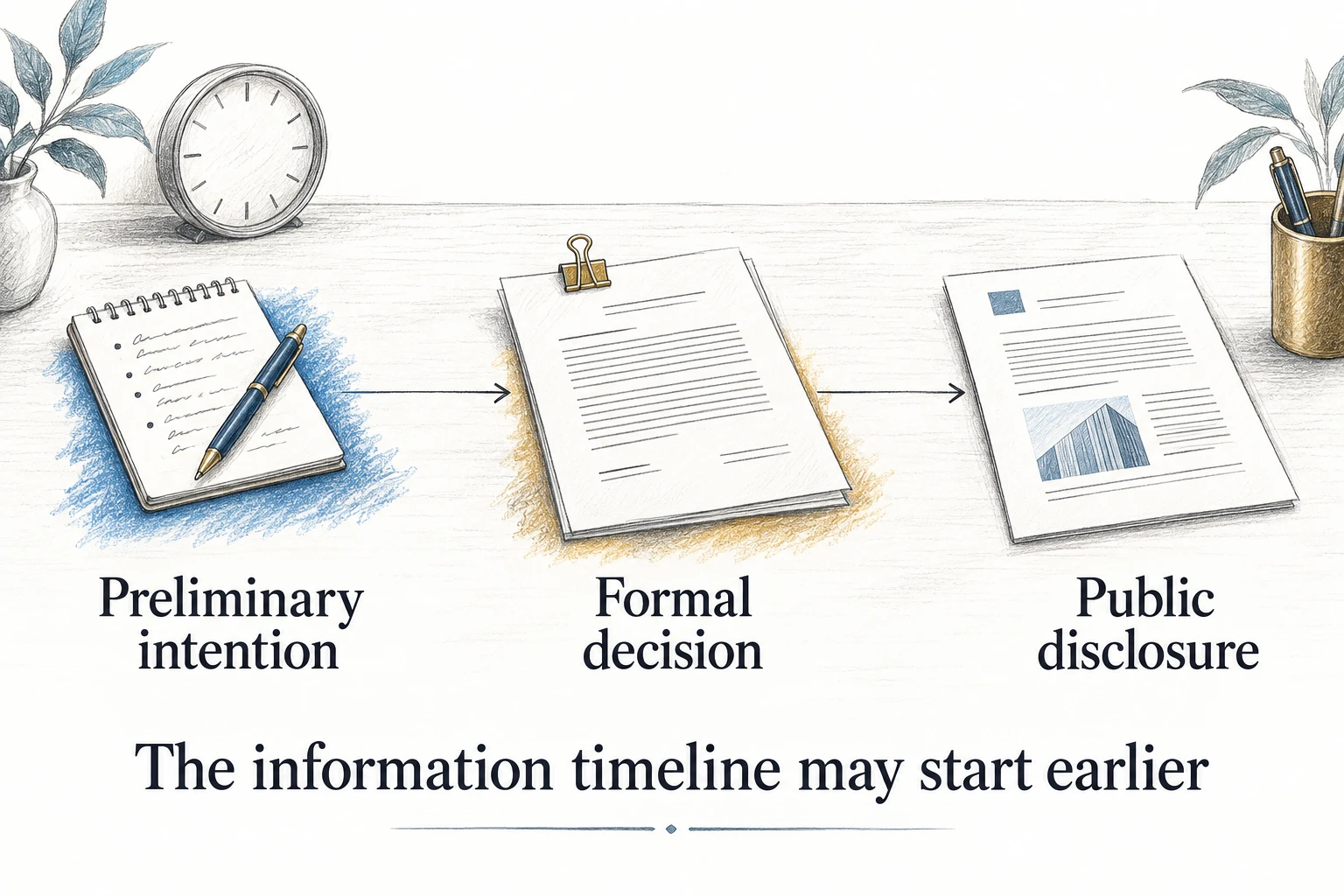
The Supreme People’s Court and Supreme People’s Procuratorate published a revised insider-trading interpretation on July 24, effective July 27. Article 6 of the consolidated interpretation addresses when a controlling shareholder, actual controller or relevant decision-maker communicates a preliminary intention to close contacts or trades on that intention. The information timeline may therefore begin before a board resolution.
Article 9 also clarifies defenses based on an acquisition, a pre-existing written trading arrangement or publicly disclosed information. A genuine, lawful arrangement and its contemporaneous evidence matter. Monetary thresholds are not the sole test of criminal liability. For issuers and advisers, contact records and the chronology of planning, decisions and disclosure deserve close attention.
IPO review advanced, but there were no new acceptances
No newly accepted IPO applications were identified at the Shanghai, Shenzhen or Beijing exchanges during the week. That fact should not be read as evidence of a new industry restriction or a systemic tightening of acceptance policy. A single week is too small a sample, and acceptance timing may reflect filing preparation, financial statement updates and exchange processing.
Ten projects newly entered the inquiry stage:
- STAR Market: Shanghai NewMed Medical Co Ltd, Chongqing Wuqi Microelectronics Co Ltd, China Electronics Defence Technology Co Ltd, Nanjing Geneseeq Technology Co Ltd, Zhejiang Jinlianjie Technology Co Ltd, Beijing Shiweitong Technology Co Ltd and Suzhou Vega Technology Co Ltd;
- ChiNext: Shenzhen Jinming Aviation Technology Co Ltd and Suzhou Great Wall Precision Technology Co Ltd; and
- Beijing Stock Exchange: Suzhou Weiheng Technology Co Ltd.
The daily project pages also showed updates for Huayi Taikang Pharmaceutical, Transmec New Materials and Shining 3D. Their initial inquiries pre-dated the review period, so those records were not counted as new inquiry letters.
Two Beijing Stock Exchange applicants, Jiangsu Yute Optical Technology Co Ltd and Huainan Wenfeng Optical Technology Co Ltd, submitted for registration on 20 July. Jiangsu Gaokai Precision Fluid Technology Co Ltd’s STAR Market registration became effective on the same date. On 23 July, the CSRC published its approval of the STAR Market registration of Suzhou Evopoint Biosciences Co Ltd.
Shenzhen Dobot passed the ChiNext listing committee on 22 July. The committee focused on the prudence of the company’s expectation that it would reach break-even in 2028. It asked the issuer to connect competitive conditions, market position, commercialisation, backlog, operating expenses, peer performance, core technology, mass-production obstacles and customer types to that forecast, and required the sponsor and reporting accountant to provide clear opinions.
The question illustrates a recurring disclosure issue for loss-making technology issuers: technical capability and a favourable market narrative do not by themselves establish a credible path to profitability. The evidentiary chain must extend from technology to production, customer validation, order conversion, revenue scale and operating leverage. Forward-looking disclosure should make the assumptions and downside risk visible rather than presenting a management target as a likely outcome.
Changzhou Huaneng Turbine Power passed the Beijing Stock Exchange listing committee on 22 July. The company manufactures turbocharger components and assemblies and derives more than 90% of revenue from overseas markets. Revenue increased from approximately RMB352 million in 2023 to RMB560 million in 2025, while adjusted net profit increased from approximately RMB112 million to RMB167 million. In the first quarter of 2026, however, reported net profit declined materially year on year.
The committee focused on earnings stability, foreign-exchange exposure and the risk of a substantial performance decline. Earlier review materials had addressed terminal sales through distributors and traders, overseas market capacity and the necessity of the proposed expansion. The case shows why overseas revenue verification should combine customer interviews, logistics, customs records, cash collection and evidence of terminal use. Where access is limited, the scope of the limitation and the alternative procedures matter as much as the headline coverage ratio.
Two additional Beijing Stock Exchange meetings were scheduled for 24 July: Inner Mongolia Xuyang New Materials Co Ltd and Jiangsu Fangyi Friction Materials Co Ltd. No official result was captured by 8:03 p.m. CST. They are therefore recorded as meetings with results pending, not as approvals or rejections.
Selected projects under review
Because the week had no newly accepted applications, the following are continuing projects rather than “new filings.”
Xuyang New Materials manufactures spherical aluminium powder, aluminium pigments and other functional metal powders. Its reported revenue increased from approximately RMB999 million in 2023 to RMB1.31 billion in 2025, while net profit moved from approximately RMB89.6 million to RMB102.9 million. Matters attracting attention included pressure on product margins, cash conversion, government grants, historical controller-related arrangements and production safety. These are diligence and disclosure questions, not findings of misconduct.
Fangyi Friction Materials manufactures automotive braking friction products and has substantial overseas exposure. Reported revenue increased from approximately RMB205 million in 2023 to RMB277 million in 2025, while adjusted net profit remained in a range of approximately RMB41.7 million to RMB46.1 million. Review themes included overseas ODM sales, customer stability, gross margins relative to peers, capacity expansion, R&D accounting and concentrated family control.
Evopoint Biosciences applies the STAR Market’s fifth listing standard for pre-commercial biotech issuers. Its registration prospectus reported first-quarter 2026 revenue of approximately RMB3.9 million and a net loss of approximately RMB147 million. Registration approval demonstrates the institutional accommodation available to qualifying pre-profit biotech issuers. It does not reduce the need to disclose rights to core products, clinical progress, commercialisation assumptions, continued funding requirements and the consequences of development failure.
Inquiry themes and response quality
The inquiry-stage projects and response documents reviewed this week point to three recurring groups of questions.
Legal and governance questions include the identification and stability of control, historical equity changes, employee platforms, special shareholder rights, related parties, independence, overseas subsidiaries, licences, environmental and production-safety compliance, export controls, sanctions and ownership of core intellectual property.
Financial questions cover whether sales occurred and were recorded in the correct period, verification of customers and distributors, overseas end-customer sales, customer concentration, and margins relative to peers. They also address receivables and inventory, cash conversion, government grants, related-party transactions, and R&D accounting.
Business questions include objective evidence of core technology, commercialisation, addressable market, customer acceptance, capacity absorption, the necessity of proposed fundraising and the assumptions behind profitability forecasts.
Confirmed response disclosures during the week included Huayi Taikang’s first-round response, Shining 3D’s second-round response and China Power Construction New Energy’s first-round response. The issues included control, related-party transactions, distributor revenue, overseas growth, gross margins, subsidiaries, spin-off listing matters and fundraising.
Dobot added detail on the assumptions behind its break-even timetable, giving readers more to test in a loss-making technology business. Huaneng Turbine reduced its proposed fundraising amount during review. The available record does not establish that a particular inquiry caused that reduction, or that either response introduced an unprecedented approach.
Enforcement focused on controls that should work in practice
The Ningbo CSRC Bureau published measures concerning a Guojin Securities branch and an employee who supplied customers with answers to knowledge tests for margin financing, the NEEQ and the STAR Market. The case concerns the substance of suitability controls: a test cannot protect investors if staff help customers bypass it.
The Hunan CSRC Bureau issued a warning letter to Guzhanggui Securities Investment Consulting over governance and internal-control deficiencies, unqualified personnel, misleading marketing, and promises or implications of returns. For investors using an advisory service, the relevant checks extend beyond its written policies to what its staff actually say, how they market the service, and whether they hold the required qualifications.
The Fujian CSRC Bureau ordered Fujian Yango Group to rectify its failure to publish its 2025 bond annual report on time and issued a warning letter to a responsible person. Bondholders depend on those reports to assess credit risk. A missed deadline leaves them without the expected update on the issuer’s finances, even before the reasons for the delay are known.
The Jilin CSRC Bureau issued warning letters after Jilin Gold Group Electric disclosed a contract award of approximately RMB252 million and corrected it the next day to approximately RMB157 million. The difference was approximately RMB95 million, or 37.76% of the originally disclosed amount. The measure does not amount to an administrative finding of fraud. It does, however, show the importance of reconciling source documents, tax treatment, consortium shares and announcement figures before publication.
The Beijing CSRC Bureau issued a warning letter to a compliance and risk officer in connection with a private fund manager’s failure to provide information required by the fund contract. Investors should read the contract’s reporting terms as well as the regulatory minimums: what information is promised, when it is due, and how it must be delivered.
These cases involved administrative regulatory measures such as orders to rectify and warning letters. They should not be described as administrative penalties, market bans or judicial findings. No new measure directly targeting a law firm or signing lawyer was identified in the reviewed official publications by the cut-off.
What to watch next
The immediate follow-up items are the official outcomes of the two Beijing Stock Exchange meetings held on 24 July; a clause-by-clause Shanghai–Shenzhen ABS comparison; the full inquiry letters for the ten projects that newly entered the inquiry stage; and subsequent filings for Dobot, Huaneng Turbine and Evopoint Biosciences.
More broadly, one week of zero IPO acceptances does not establish a regulatory trend. A defensible assessment should compare at least four to eight weeks of acceptances, listing standards, industries, inquiry rounds, committee outcomes and terminations.
Methodology and disclaimer
This review distinguishes an event date, the date on which an authority or exchange published the information, and the retrieval cut-off. Formal rules, policy statements, project status changes, inquiry letters, responses and enforcement measures are classified separately. Primary public materials are preferred; secondary sources are used to identify leads or where an official page is temporarily unavailable, and that limitation is disclosed.
This article is based solely on public information available by 24 July 2026 at 8:03 p.m. China Standard Time, with regulatory legal materials supplemented and checked on October 3, 2026. It is intended as a review of regulatory and disclosure developments and does not constitute investment advice, legal advice, accounting advice or a finding of fact concerning any issuer, intermediary or individual. Public materials may later be supplemented, corrected or updated.
Selected sources
-
Shanghai Stock Exchange, 2026 revision of the guidance on major categories of ABS underlying assets
-
Shanghai Stock Exchange, explanatory release on the ABS guidance revision
-
China Securities Regulatory Commission, regulatory work meeting of 23 July 2026
-
China Securities Regulatory Commission, registration approval for Suzhou Evopoint Biosciences
-
Ningbo CSRC Bureau, measure concerning the Guojin Securities Ningbo branch
-
Hunan CSRC Bureau, measure concerning Guzhanggui Securities Investment Consulting
-
Fujian CSRC Bureau, measure concerning Fujian Yango Group
-
Jilin CSRC Bureau, measure concerning Jilin Gold Group Electric