Weekly Brief / Issue 02
China Capital Markets Weekly: Governance Beyond the Boardroom
A four-agency governance policy meets investment-banking controls, while the revised insider-trading interpretation takes effect
- Reporting period
- 27 July to 3 August 2026
- IPO data cutoff
- 2026-08-03 02:36:11 Beijing time
- Legal materials checked
- 3 October 2026, 16:21 Beijing time
Weekly dashboard
Review activity at a glance
- 0
- New acceptances
- 10
- Published responses
- 2
- Committee passes
- 4
- Registration results
Counts describe distinct procedural events, not completed listings. The ledger and text below specify their scope.
Executive summary
This week in focus
A four-agency governance opinion, signed in March and publicly released by the CSRC on July 31, connects ownership, board oversight, remuneration and internal controls. Investment-banking regulatory measures reinforce the importance of working-paper discipline. The July 24 insider-trading interpretation took effect on July 27 without becoming a second new publication.
Contents
Weekly overview
Chinese regulators published a cross-agency framework for strengthening financial institution governance, while IPO review activity across the Shanghai, Shenzhen and Beijing exchanges remained concentrated in existing applications rather than new acceptances. During the reporting window, no new IPO application was accepted across the five reviewed boards. One project newly entered inquiry, ten projects disclosed inquiry responses, two projects passed listing committee review, two submitted for registration, four disclosed registration results, and four were terminated.
The reporting period runs from 00:00 China Standard Time on July 27, 2026 to 02:36:11 on August 3, 2026. The remainder of August 3 is not covered and will be reviewed in the next edition. Event dates, publication dates and retrieval dates are treated separately.
A New Governance Framework for Financial Institutions
On July 31, the National Financial Regulatory Administration, the People’s Bank of China, the China Securities Regulatory Commission and the Ministry of Finance published the Implementation Opinions on Improving the Governance of Financial Institutions (Jin Fa [2026] No. 4). The document was signed on March 16 and became publicly available during this reporting window.
The framework sets a 2029 governance objective and addresses shareholder conduct, board and independent director effectiveness, management authorization, remuneration deferral and clawback, related-party transactions, internal controls, risk management, disclosure and external professional accountability. For securities firms and other regulated financial institutions, the document points toward a more integrated governance model in which ownership transparency, decision-making records, incentive design and control effectiveness are assessed as parts of the same system.
For investors, the distinction is between a policy on paper and evidence that it operates. Board decisions, related-party approvals, remuneration arrangements, and control-testing results can show how the governance framework is being applied.
The insider-trading interpretation takes effect
The revised insider-trading interpretation, published in the preceding week, took effect on July 27. This is an implementation milestone, not another new publication. Advisers should preserve the chronology of preliminary intentions, contacts and disclosure when reviewing a transaction.
IPO Review Activity: No New Acceptances, but Active Movement in Existing Cases
Across the Shanghai Main Board, STAR Market, Shenzhen Main Board, ChiNext and Beijing Stock Exchange, no new IPO application was accepted during the reporting window.
The verified workflow events were:
| Review event | Count | Projects |
|---|---|---|
| Newly entered inquiry | 1 | Biyuntian Biotechnology, STAR Market |
| Newly disclosed inquiry responses | 10 | Youbang Materials and Yulong Optoelectronics on ChiNext; eight BSE applicants |
| Listing committee meetings | 2 | Lieqi Intelligent and Tianyuan Heavy Industry |
| Passed | 2 | Lieqi Intelligent and Tianyuan Heavy Industry |
| Submitted for registration | 2 | Lieqi Intelligent and Mosentech |
| Registration results disclosed | 4 | Shengu Group, Lianya Pharmaceutical, Tongze Kangwei and Tengxin Precision |
| Review terminated | 4 | Rongxin Huike, Taosheng Electronics, Huayu Electronics and Tiankang Pharmaceutical |
These categories track separate workflow events. A company may therefore appear more than once when it advances through multiple stages in the same week. Lieqi Intelligent, for example, passed ChiNext listing committee review on July 31 and submitted its registration materials on August 2.
The Lianya Pharmaceutical registration decision illustrates why publication dates need to be separated from decision dates. The approval was made before this reporting window, but Shenzhen Stock Exchange disclosed the approval document on July 27. It is included here as a registration result disclosed during the week, not as a decision made during the week.
Selected official materials:
- Shengu Group registration approval
- Tongze Kangwei registration approval
- Lianya Pharmaceutical registration approval disclosed by SZSE
- Lieqi Intelligent listing committee result
- Rongxin Huike termination decision
- Taosheng Electronics termination decision
Project Focus: Lieqi Intelligent
Because there were no new acceptances, Lieqi Intelligent is discussed as a current-stage project rather than a newly filed applicant.
The company develops and manufactures intelligent production equipment used in optical communications, semiconductors and automotive automation. Its products cover key optical module assembly and testing steps, including die bonding, coupling and burn-in testing. Guotai Haitong Securities is the sponsor, Jiangsu Century Tongren Law Firm is issuer’s counsel, and RSM China is the reporting accountant.
Lieqi Intelligent selected the first ChiNext listing standard, which requires positive net profit in each of the most recent two years, cumulative net profit of at least RMB100 million and net profit of at least RMB60 million in the latest year.
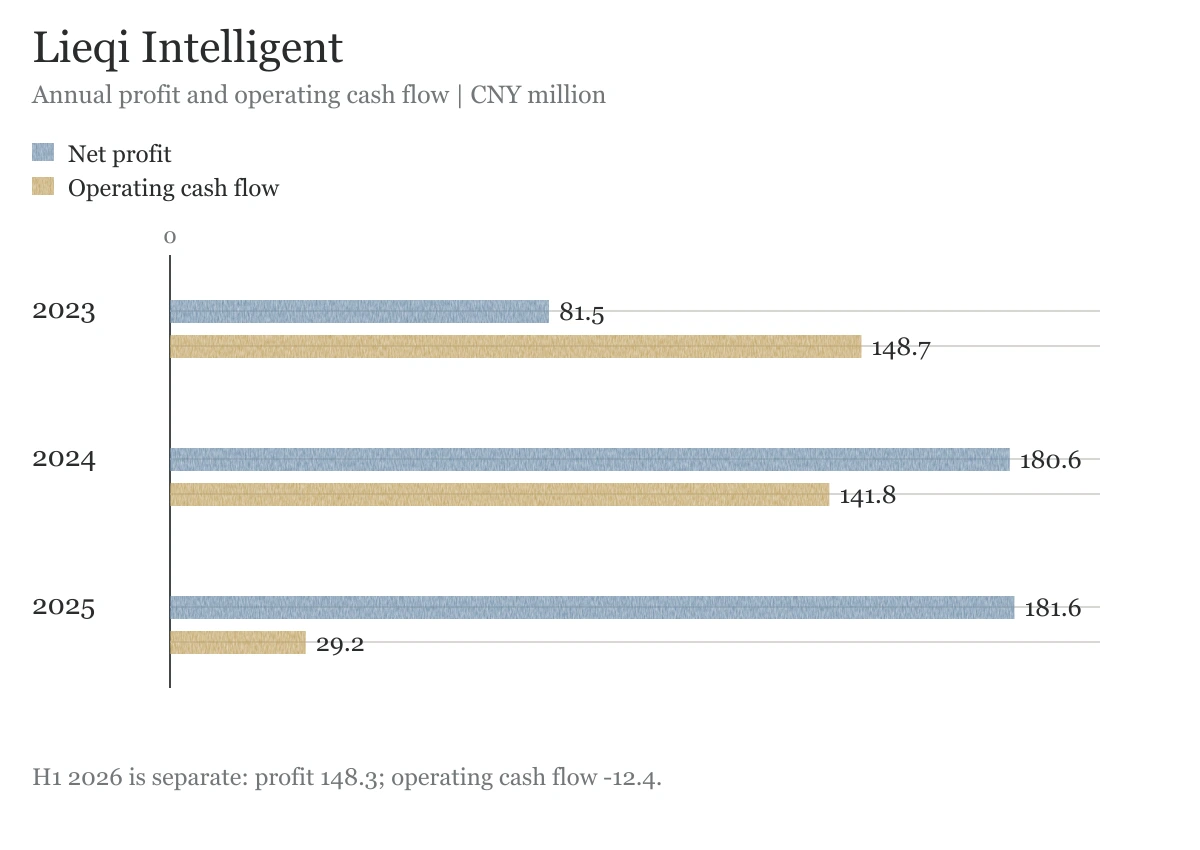
Key disclosed financial data are as follows:
| RMB million | 2023 | 2024 | 2025 | H1 2026 |
|---|---|---|---|---|
| Revenue | 289.2 | 542.9 | 697.8 | 581.4 |
| Net profit | 81.5 | 180.6 | 181.6 | 148.3 |
| Net profit attributable to the parent | 81.6 | 180.8 | 182.4 | 148.7 |
| Adjusted net profit attributable to the parent | 90.2 | 174.3 | 171.4 | 143.2 |
| Net operating cash flow | 148.7 | 141.8 | 29.2 | -12.4 |
The prospectus shows rapid revenue expansion, but operating cash conversion weakened in 2025 and remained negative in the first half of 2026. This does not by itself indicate improper accounting. It does, however, support closer review of customer acceptance terms, receivables, bill settlement, inventory build-up and payment timing.
The company plans to raise approximately RMB913 million: RMB582 million for a high-end intelligent equipment manufacturing project, RMB251 million for an R&D center and RMB80 million for working capital. The registration prospectus cites Frost & Sullivan data stating that the company held a 20% global share of optical module die-bonding equipment by unit volume in 2025 and ranked first, while holding a 23% share of optical module coupling equipment and ranking second. Those market-share statements are issuer disclosures based on a third-party report; this article has not independently obtained the underlying report.
Lieqi Intelligent registration prospectus
Inquiry Responses: Revenue Quality, Customer Stability and Capacity Remained Central
Ten full inquiry response documents were obtained and reviewed. The two ChiNext responses addressed:
- Youbang Materials: product applications, customer cooperation, supplier qualification and switching costs, expansion into AI servers and semiconductor packaging, technological differentiation and growth characteristics.
- Yulong Optoelectronics: earnings stability, end-market demand, memory chip price increases, utilization rates at major customers and downside risk.
The eight BSE responses covered a broader but recurring set of issues: revenue recognition, consignment sales, inventory checks, gross margin, receivables and contract assets, overseas subsidiaries, customer stability, related-party transactions, shareholder arrangements, R&D, innovation claims and the capacity rationale for fundraising projects.
For Youbang, the customer relationships and costs of switching suppliers help test the claimed competitive position. For Yulong, earnings stability depends in part on end-market demand and conditions at major customers. The broader responses also invite readers to follow sales through delivery, acceptance, and collection, and to check the metric and source behind market-leadership claims.
Official response documents include:
- Youbang Materials third-round response
- Yulong Optoelectronics implementation letter response
- Senfeng Laser second-round response
- Gaoyi Packaging second-round response
- ASD second-round response
- Hengji Metal second-round response
- Chongshu Media first-round response
- Shaanxi Ruike second-round response
- Standard Testing first-round response
- Benxing New Materials first-round response
The STAR Market project status for Biyuntian Biotechnology newly moved to inquiry on July 27, but the new inquiry letter itself had not been obtained by the cutoff. No substantive inquiry summary is therefore provided.
Enforcement: Investment Banking Controls Received Direct Attention
On July 31, the CSRC published nine administrative supervisory measures involving securities firms and former heads of investment banking. The measures addressed due diligence execution, quality control and internal review, workpaper acceptance, submission approval, project fee arrangements, compensation management and integrity controls.
The affected firms included Hongta Securities, Century Securities, GF Securities, Yongxing Securities, Guorong Securities and Guoyuan Securities. The CSRC issued warning letters or corrective orders to the firms and, in several cases, warning letters to responsible investment-banking executives.
These were administrative supervisory measures, not administrative penalties. The distinction matters. A warning letter or corrective order should not be described as a fine, punishment decision or market ban.
For transaction counsel and other advisers, the official decisions reinforce several controls:
- Fieldwork should have a documented scope, evidence base and conclusion.
- Quality control and internal review should retain issue lists, responses, closure evidence and final approval records.
- Workpapers should allow a reviewer to identify who reached a conclusion, when it was reached and which evidence supported it.
- Submission versions and approval trails should be traceable.
- Fee and remuneration structures should not compromise independent quality judgments.
Selected CSRC decisions:
- Hongta Securities warning letter
- Century Securities warning letter
- GF Securities warning letter
- Yongxing Securities corrective order
- Guorong Securities corrective order
- Guoyuan Securities corrective order
Regional CSRC offices also published measures involving delayed return of temporarily used offering proceeds, inaccurate annual report information, incomplete performance-compensation obligations following a major asset restructuring, untimely approval and disclosure for offering-proceeds cash management, financial reporting corrections, private fund conduct, fund sales controls, futures compliance and employee conduct.
Examples include:
- Beijing office corrective order concerning Tianyi Shangjia and responsible officers
- Zhejiang office corrective order concerning performance-compensation obligors connected with Century Huatong
- Shaanxi office warning letter concerning Pairui Co. and responsible officers
- Gansu office measures concerning Lanzhou LS Heavy Equipment and responsible officers
- Qingdao office corrective order concerning Huaren Pharmaceutical
The CSRC’s official administrative penalty and market ban databases did not show a new publication during this reporting window as of the cutoff. That finding is limited to newly published decisions and should not be read as evidence that no investigation or enforcement process was underway.
Shenzhen Stock Exchange’s weekly regulatory bulletin reported six disciplinary cases and three regulatory letters for listed-company matters during July 24-30. Because that official window begins three days before this article’s reporting period, those counts are not incorporated into a precise weekly total here. The same bulletin reported self-regulatory measures involving 138 abnormal trading incidents during July 27-31, including intraday price ramping or suppression and false orders. The bulletin did not identify each account or measure.
SZSE weekly regulatory bulletin
What to Watch Next
- Publication of the full Biyuntian inquiry letter.
- Listing committee results for projects with meetings announced after the cutoff.
- Registration progress for Lieqi Intelligent and Mosentech.
- Further disclosure on Lieqi Intelligent’s cash conversion, customer concentration and capacity expansion.
- Individually published decisions underlying SZSE’s six disciplinary cases and three regulatory letters.
- Any official publications during the uncovered remainder of August 3.
Disclaimer
This article is based solely on publicly available information retrieved by the stated cutoff, with regulatory legal materials supplemented and checked on October 3, 2026. It is intended as a review of regulatory disclosure and IPO review activity. It does not constitute investment advice, legal advice, accounting advice, or a factual determination regarding any person or entity. Public filings and regulatory materials may later be corrected, supplemented or updated. Readers should consult the original documents and qualified professional advisers before making any decision.
Public sources
At the October 3, 2026 accessibility check, some BSE project and disclosure links returned redirect or access restrictions. Historical official URLs are retained for source identification, but their current accessibility could not be confirmed. The access limitation is not evidence that the underlying documents or review events did not exist.