Weekly Brief / Issue 04
China Capital Markets Weekly: Chip Growth Meets the Cash Flow Test
Calterah’s new filing and the CSRC’s annual accounting review connect commercialization claims with recognition, impairment and cash realization
- Reporting period
- 10 to 16 August 2026
- IPO data cutoff
- 2026-08-18 14:44:04 Beijing time
- Legal materials checked
- 3 October 2026, 16:21 Beijing time
Weekly dashboard
Review activity at a glance
- 1
- New acceptances
- 4
- Published responses
- 2
- Committee passes
- 2
- Registration results
Counts describe distinct procedural events, not completed listings. The ledger and text below specify their scope.
Executive summary
This week in focus
Calterah’s STAR Market filing pairs rapid growth with continuing losses and negative operating cash flow. The CSRC’s August 14 accounting review adds an important regulatory reference on revenue recognition, impairment, development expenditure and disclosure. The review is not a new accounting standard.
Contents
Weekly overview
China’s principal IPO review venues recorded one new acceptance, four newly published responses to review questions, two committee hearings with two approvals, two submissions for registration, two disclosed registration outcomes, and three review terminations during the week of 10–16 August 2026.
The only new acceptance was Calterah Semiconductor Technology (Shanghai) Co., Ltd., a fabless designer of automotive-grade millimeter-wave radar and ultra-wideband chips seeking a STAR Market listing. The company reported rapid revenue growth in 2025, but it remained loss-making and cash-flow negative throughout the reporting period. Its planned RMB 3.489 billion fundraising programme, sustained research and development intensity, customer qualification cycles, and dependence on external semiconductor manufacturing will likely remain important review topics.
No newly published formal regulatory rule, normative document, or consultation paper falling within the reporting period was identified in the principal official channels reviewed. This is a statement about the reviewed public channels, not an assurance that every regional or dynamically indexed regulatory page contained no update.
An accounting review adds a second lens
On August 14, the CSRC published its review of listed companies’ 2025 financial reports. This is a regulatory review of accounting practice, not a new accounting standard or an issuer-specific enforcement decision.
Pages 1–4 of the report address principal-versus-agent assessment, recoverable contract-fulfillment costs and the timing of revenue recognition. A deemed-acceptance clause does not by itself justify recognizing equipment revenue while a substantive installation obligation remains. Pages 12–17 discuss impairment and development expenditure; pages 21–24 address presentation and disclosure.
For a growth-stage chip issuer, contracts, customer acceptance, collections, impairment assumptions and development milestones should reconcile. The regulator’s anonymous examples do not establish an error by Calterah or any other applicant. They provide a checklist for testing the evidence behind recognition and asset values.
Weekly IPO review dashboard
| Review event | Count | Companies or notes |
|---|---|---|
| New acceptances | 1 | Calterah Semiconductor, STAR Market |
| New review questions | 0 | The questions underlying this week’s responses pre-dated the period |
| Newly published responses | 4 | Xintong Pharmaceutical, Autotech, Youbang Materials, Tiejin Technology |
| Committee hearings | 2 | Tianguangshi and Hongyi, both on the Beijing Stock Exchange |
| Approved / deferred / rejected | 2 / 0 / 0 | Both reviewed applicants passed |
| Submitted for registration | 2 | Huanneng Turbine and Fangyi |
| Registration outcomes disclosed | 2 | Bairuiji and Century Digital |
| Reviews terminated | 3 | Yangguang Coking, Dexin Technology, Huadatong |
The figures are event-based and deduplicated. A project-page refresh, a newly uploaded registration draft, or a meeting notice was not counted as a new substantive event. Registration decision dates and public disclosure dates were recorded separately where they differed.
New STAR Market acceptance: Calterah Semiconductor
Business and listing standard
Calterah describes itself as a fabless semiconductor company focused on automotive-grade wireless sensing and communications chips. Its principal products include millimeter-wave radar chips and ultra-wideband chips. Sales are primarily made through buyout distributors, with a smaller direct-sales component.
The sponsor is China International Capital Corporation Limited. JunHe LLP acts as issuer’s counsel, and Ernst & Young Hua Ming LLP is the reporting accountant. The company selected the fourth STAR Market listing standard under Rule 2.1.2, which requires an expected market capitalisation of at least RMB 3 billion and most recent annual revenue of at least RMB 300 million.
Three years and one quarter of financial data
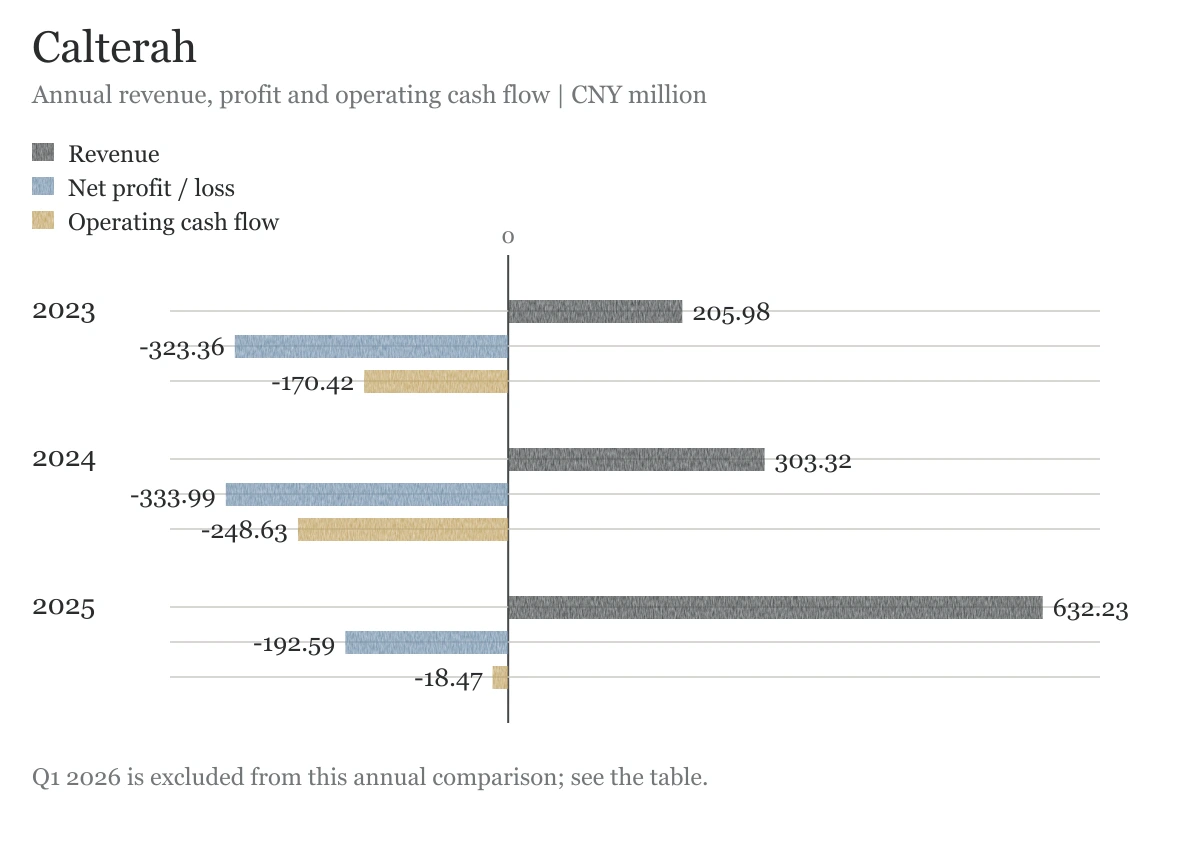
RMB million, except percentages.
| Metric | 2023 | 2024 | 2025 | Q1 2026 |
|---|---|---|---|---|
| Revenue | 205.98 | 303.32 | 632.23 | 154.44 |
| Net profit | -323.36 | -333.99 | -192.59 | -60.29 |
| Net profit excluding non-recurring items | -291.54 | -342.20 | -197.14 | -65.84 |
| Net cash flow from operating activities | -170.42 | -248.63 | -18.47 | -120.54 |
| R&D expenditure as a percentage of revenue | 147.75% | 120.17% | 58.55% | 63.67% |
Revenue more than doubled in 2025, while the company remained loss-making. Operating cash outflow narrowed significantly in 2025 but increased again to RMB 120.54 million in the first quarter of 2026. These figures do not by themselves indicate misconduct or an inability to satisfy the listing requirements, but they make the pace and quality of commercialisation, cash requirements, and funding assumptions particularly relevant.
Proposed use of proceeds
Calterah plans to raise RMB 3.489 billion for three projects:
- RMB 2.093 billion for research, development, and industrialisation of high-performance millimeter-wave radar chips;
- RMB 694.85 million for research, development, and industrialisation of high-precision ultra-wideband connectivity chips; and
- RMB 702.06 million for a frontier technology innovation centre and headquarters.
The proposed fundraising is approximately 5.5 times the company’s 2025 revenue. A careful review should therefore connect project budgets with the company’s staffing plan, equipment needs, product roadmap, automotive customer qualification cycles, addressable market, and existing funding position.
The prospectus cites third-party estimates indicating a roughly 4% share of the global automotive millimeter-wave radar chip market and a 31.1% share of the domestic market in 2025. These are issuer-disclosed third-party estimates, not findings by the Shanghai Stock Exchange or the China Securities Regulatory Commission. The underlying reports, product definitions, geographic scope, and methodology would need to be reviewed before those rankings could be treated as independently verified.
Review responses published during the week
Xintong Pharmaceutical
Xintong Pharmaceutical published a 440-page response covering 14 principal questions. Business and scientific topics included the origin of its core pipelines, independent research capability, claimed technological advancement, and the clinical and commercial prospects of PDF, MB07133, and HTS. Legal topics included shareholder history, connected entities, and pending litigation. Financial topics included revenue, costs, gross margin, receivables, research expenditure, intangible assets, inventories, prepayments, payables, and the use of proceeds.
The central disclosure issue is the boundary between licensed technology and internally created research capability. The company’s explanations about scientific merit, product potential, and independence represent its filing position; they should not be presented as conclusions reached by the exchange.
Autotech
Autotech’s second-round response addressed eight questions concerning market position and growth, control, revenue and customers, receivables, gross margin, inventory, parties acting in concert, and the proposed fundraising projects. The mix of questions connects the company’s growth narrative with revenue quality, working capital, inventory formation, and governance arrangements.
Youbang Materials
Youbang Materials responded to an implementation letter from the Shenzhen Stock Exchange review centre. The single principal question concerned the sustainability of earnings growth. It covered the absorption of 51,110 tonnes of planned annual capacity, the stability of major customers including Foxconn, differences among business lines, slower revenue growth in 2025, and related risk disclosure.
Tiejin Technology
Tiejin Technology’s 314-page second-round response covered five principal questions: the authenticity of earnings growth and compliance of revenue recognition; gross-margin growth and the risk of a subsequent decline; the reasonableness of fixed-asset growth; the proposed fundraising projects and their scale; and other accounting and compliance matters, including the treatment of research prototypes.
The publication of a response confirms the applicant’s and intermediaries’ position at that stage. It does not constitute final regulatory acceptance of the explanations or predict the final review outcome.
Committee, registration, and termination developments
The Beijing Stock Exchange Listing Committee found Tianguangshi and Hongyi compliant with the applicable offering, listing, and disclosure requirements. Questions for Tianguangshi focused on the commercialisation prospects of its core product and measures to address operating risk under cash-flow pressure. Hongyi was asked to explain the fairness of related-party transactions with Chery Automobile, considering their relationship, purchasing and sales policies, and changes in transaction amounts.
Huanneng Turbine and Fangyi submitted their applications for registration. Registration approvals for Bairuiji and Century Digital were publicly disclosed on 14 August, although the underlying decisions were dated 31 July. The analysis therefore distinguishes the decision date from the public disclosure date.
Yangguang Coking’s Shanghai Main Board review was terminated after the issuer and sponsor separately applied to withdraw the application. Dexin Technology and Huadatong were also recorded as terminated on the Beijing Stock Exchange. A termination is a procedural review outcome and should not be described as a committee rejection or a finding of illegality.
Regulatory and enforcement observations
The Shenzhen Stock Exchange’s weekly regulatory bulletin reported that, from 10 to 14 August, it took self-regulatory measures in relation to 114 instances of abnormal securities trading. It also placed Landun Photoelectron under focused monitoring, examined eight major matters involving listed companies, and referred two suspected violation leads to the CSRC. A monitoring arrangement, an examination, and a case-lead referral are not final findings of misconduct.
The exchange also reported oral warnings to two member firms for violations in the publication of securities research reports. Those oral warnings are described as self-regulatory measures and should not be characterised as administrative penalties.
The same bulletin reported three disciplinary actions and three regulatory letters during a listed-company supervision window running from 7 to 13 August. Because that window begins before the reporting period, the figures cannot be cleanly allocated to this week and are disclosed only as an overlapping-window statistic.
No new central CSRC administrative penalty or market-entry ban publicly dated within the reporting period was identified in the centralised official lists reviewed. Coverage of regional CSRC bureau measures and dynamically indexed exchange pages was not sufficient to support a nationwide “zero-event” statement.
Questions for readers
Calterah’s proposed fundraising is large relative to current revenue. The useful questions are how the planned projects fit its product roadmap, how long customer qualification takes, and when new capacity could be used. For Haihe Biopharma, the boundary between licensed technology and internally developed capability is central. In both cases, the response gives the applicant’s explanation; later review milestones show how the application progresses.
Public sources
At the October 3, 2026 accessibility check, some BSE project and disclosure links returned redirect or access restrictions. Historical official URLs are retained for source identification, but their current accessibility could not be confirmed. The access limitation is not evidence that the underlying documents or review events did not exist.
Disclaimer
This article is based solely on publicly available information accessible as of 18 August 2026, with regulatory legal materials supplemented and checked on October 3, 2026. It is provided for research and professional discussion only and does not constitute investment advice, legal advice, accounting advice, or a finding of fact concerning any issuer, intermediary, or individual. Public disclosures may be updated, supplemented, withdrawn, or presented under different reporting conventions. Readers should consult the latest original documents published by the relevant regulator, stock exchange, and issuer before relying on any information in this article.