Weekly Brief / Issue 05
China Capital Markets Weekly: A Memory Giant Enters the IPO Queue
Yangtze Memory's STAR Market filing shows the scale of a recovering chip business and the investment still ahead
5 min read
Yangtze Memory entered the IPO pipeline with CNY63.18 billion of 2025 revenue and a CNY33 billion fundraising plan. Its financial recovery, updated bond and REIT guidance, and an enforcement decision on market manipulation show how different parts of the capital market demand different kinds of evidence.
Contents
A memory-chip recovery arrives in the IPO pipeline
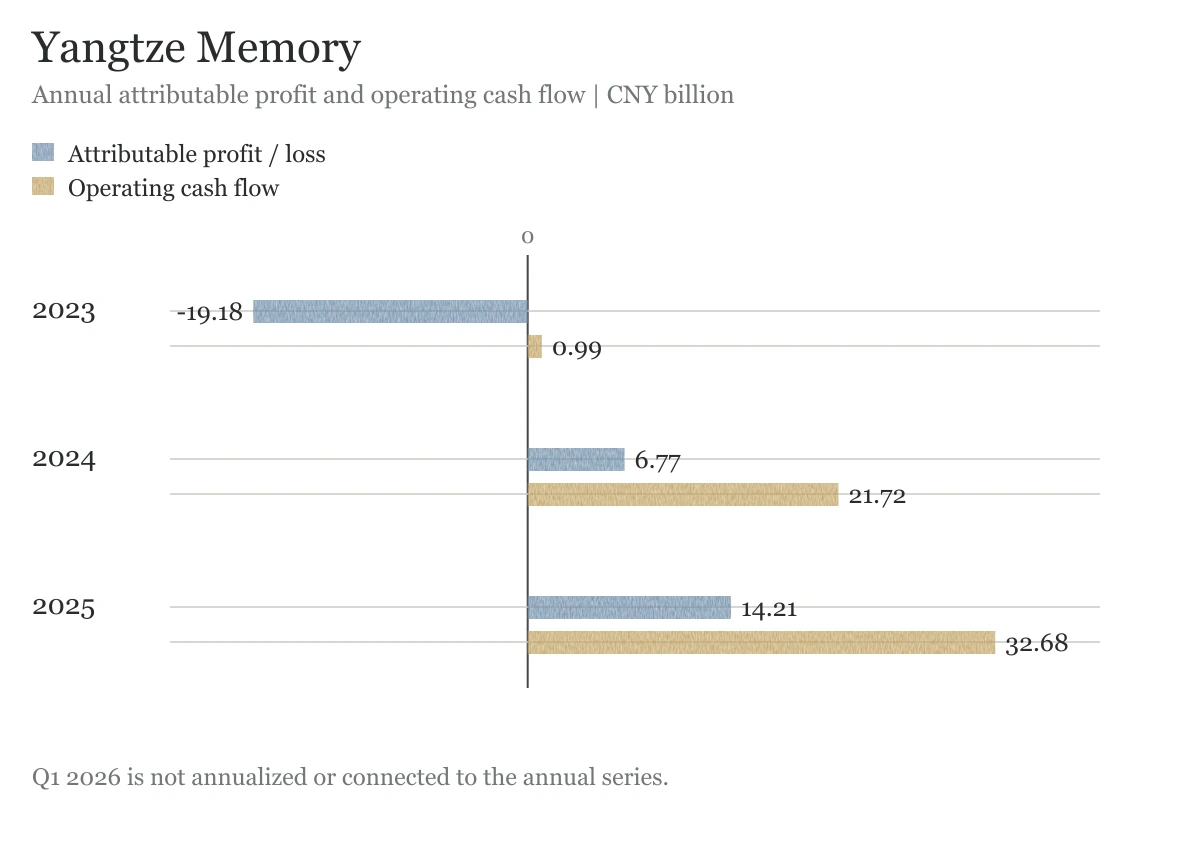
Yangtze Memory's STAR Market application was accepted on August 21. The NAND memory manufacturer reported CNY63.18 billion of 2025 revenue, CNY14.21 billion of profit attributable to shareholders and CNY32.68 billion of operating cash flow. It proposes raising CNY33 billion for technology upgrades and research.
The scale makes this a significant application. The financial history makes it a cyclical one. A CNY19.18 billion attributable loss in 2023 gave way to profits in 2024 and 2025, followed by a particularly strong first quarter in 2026. The central question is how much of that recovery can support the next investment cycle.
What the new filing says about the business
Yangtze Memory operates an integrated device manufacturing model covering design, fabrication, packaging and testing, as well as storage products. Unlike a fabless designer, it must sustain investment in manufacturing technology and production facilities as well as product development.
It applies under STAR Market's fourth listing standard, with an expected market capitalization of at least CNY3 billion and latest-year revenue of at least CNY300 million, subject to the other applicable requirements. Meeting a size threshold does not establish the durability of margins or the return on a new production investment.
| CNY billion | 2023 | 2024 | 2025 | Q1 2026 |
|---|---|---|---|---|
| Revenue | 18.74 | 45.20 | 63.18 | 47.04 |
| Profit / loss attributable to shareholders | -19.18 | 6.77 | 14.21 | 33.38 |
| Adjusted attributable profit / loss | -19.36 | 6.23 | 13.31 | 33.17 |
| Operating cash flow | 0.99 | 21.72 | 32.68 | 26.74 |
Source: August 21 application prospectus, financial overview. Q1 is a three-month period; it is not an annual forecast.
Operating cash flow exceeds attributable profit in 2024 and 2025. That is important, but it does not mean the same amount is freely available after capital expenditure. Manufacturing cash flows include the effect of depreciation and working-capital movements; the company must also pay for equipment and technology upgrades outside operating cash flow.
The proposed fundraising divides into CNY20.8 billion for upgrades and CNY12.2 billion for research. Readers should connect those uses to technology generations, yield, utilization and demand assumptions. A recovery in selling prices can generate cash quickly, while a production expansion creates costs that remain when prices fall. The prospectus's forecasts need to accommodate both sides of that cycle.
The first-quarter 2026 figures are striking relative to the prior annual totals. They warrant an explanation of pricing, shipment mix and costs, not simple multiplication by four. A quarter's exceptional conditions are not a reliable substitute for a full-year business model.
Inquiry activity extends across chips, equipment and materials
The week's replies included Xihe and Baolun in Shanghai; Jiashijia, Topsun and Hengyineng in Shenzhen; and Aotu, Suxun, Xinzhanjiang and Qianjing Wuyou on the Beijing exchange. Their publication gives investors more evidence about businesses already in review, separate from the new Yangtze Memory application.
Committee passes included Keruisi, Youbang, Zhengdao, Xinjuhong and Yuanli. Registration results appeared for Huangguan, Kaida, Anda and Lieqi. Lieqi's formal approval was dated August 18 and published on August 21. Moku and Dingxi reached termination.
These developments should be read by stage. A reply is an explanation to the exchange, a committee pass moves an application forward, and registration approval permits the issuer to proceed subject to the offering requirements. None is a guarantee of future operating performance.
The range of applicants also cautions against treating one large semiconductor filing as evidence of a wholesale change in admission policy. Yangtze Memory's scale and manufacturing position make it distinctive. Other applicants still have to explain their own customer relationships, financial histories and use of funds.
Bond and REIT guidance concerns execution after the headline
Shanghai published updated corporate-bond business guidance and continuing-disclosure guidance for REITs on August 21. These operational texts belong to debt and fund markets, not to a new equity IPO listing standard.
Continuing disclosure is important because investors' information needs do not end at issuance. A REIT's operating assets, distributions and material changes need to remain intelligible over time. A bond issuer's funding and disclosure obligations likewise continue after an initial transaction closes. A successful capital raising is the beginning of an investor relationship, not the end of the reporting task.
For issuers and intermediaries, changes to business guidance should reach the actual timetable and responsibility allocation. A revised checklist has limited value if the underlying team continues to use an old process.
A manipulation decision has a different evidential status
A CSRC administrative penalty decision concerning four individuals' market manipulation described approximately CNY156.78 million in unlawful gains and CNY470.34 million in fines. These are amounts stated by the authority, not estimates inferred from price movements. The decision's findings should not be extended to unrelated companies or market participants.
Regional measures addressed more routine, but still consequential, conduct. A Hunan matter concerned a 250,000-share transaction and disclosure of a trading plan. Jiangsu addressed futures suitability records. Shaanxi addressed the period in which employee compensation was recognized, while Zhejiang addressed delayed annual reporting by a non-listed public company.
The accounting case is a reminder that the period assigned to an expense can change the profit readers see. The suitability case concerns the evidence supporting the service offered to a client. Both require records of actual conduct rather than a retrospective assurance that the outcome was acceptable.
Yangtze Memory's filing is the week's largest capital-raising story. Its most informative details lie below that headline: how cash was generated, how much the next technology cycle will consume, and which assumptions survive a less favorable market.
Sources
- Yangtze Memory application prospectus, August 21
- Shanghai corporate-bond guidance
- Shanghai REIT continuing-disclosure guidance
- CSRC administrative penalty decision
- Hunan measure, Jiangsu measure, Shaanxi measure, Zhejiang measure
- Shanghai IPO filings, Shenzhen IPO filings, Beijing IPO filings
Disclaimer
This article examines public records relating to the reporting period. It is for research and educational purposes and is not investment, legal or accounting advice, or a recommendation concerning any security. Official findings are attributed to the relevant authority; analytical observations are not findings of misconduct. Public documents may subsequently be corrected or supplemented.
Continue reading
View all records
Weekly Brief · 28 September to 4 October 2026
China Capital Markets Weekly: A Medical Approval Is Not Yet a Revenue Stream
Neuracle's brain-computer interface filing separates clinical progress from commercial revenue as semiconductor replies test the assumptions behind growth
Disclosure EvidenceCash Flow QualityRegulatory Scope & Timing

Weekly Brief · 21 to 27 September 2026
China Capital Markets Weekly: Airline Growth Meets the Balance Sheet
Loong Airlines' reply brings fleet financing into view, while review decisions and Beijing measures put the week's milestones in context