Weekly Brief / Issue 08
China Capital Markets Weekly: Futures Firms Face a New Rulebook
Futures firms must map activities to licenses and separate transition deadlines; IPO replies examine a different set of operating risks
5 min read

The CSRC's revised futures-company measures take effect on January 1, 2027. Their twelve-month, eighteen-month and two-year transition periods apply to different activities. Meanwhile, Olight's IPO response examines the durability of an overseas online business, from repeat purchases to tax and foreign-exchange compliance.
Contents
Futures firms cannot treat every business as one licensed activity
The CSRC's September 11 futures-company measures require firms to examine which entity conducts each activity, what authorization it needs and how it will operate after January 1, 2027. The accompanying implementation announcement sets several transition periods. They are not interchangeable.
For a group with subsidiaries and existing business lines, the difficult work is the allocation of activities and responsibilities. A two-year deadline for certain legacy asset-management plans is not a two-year exemption from every new requirement.
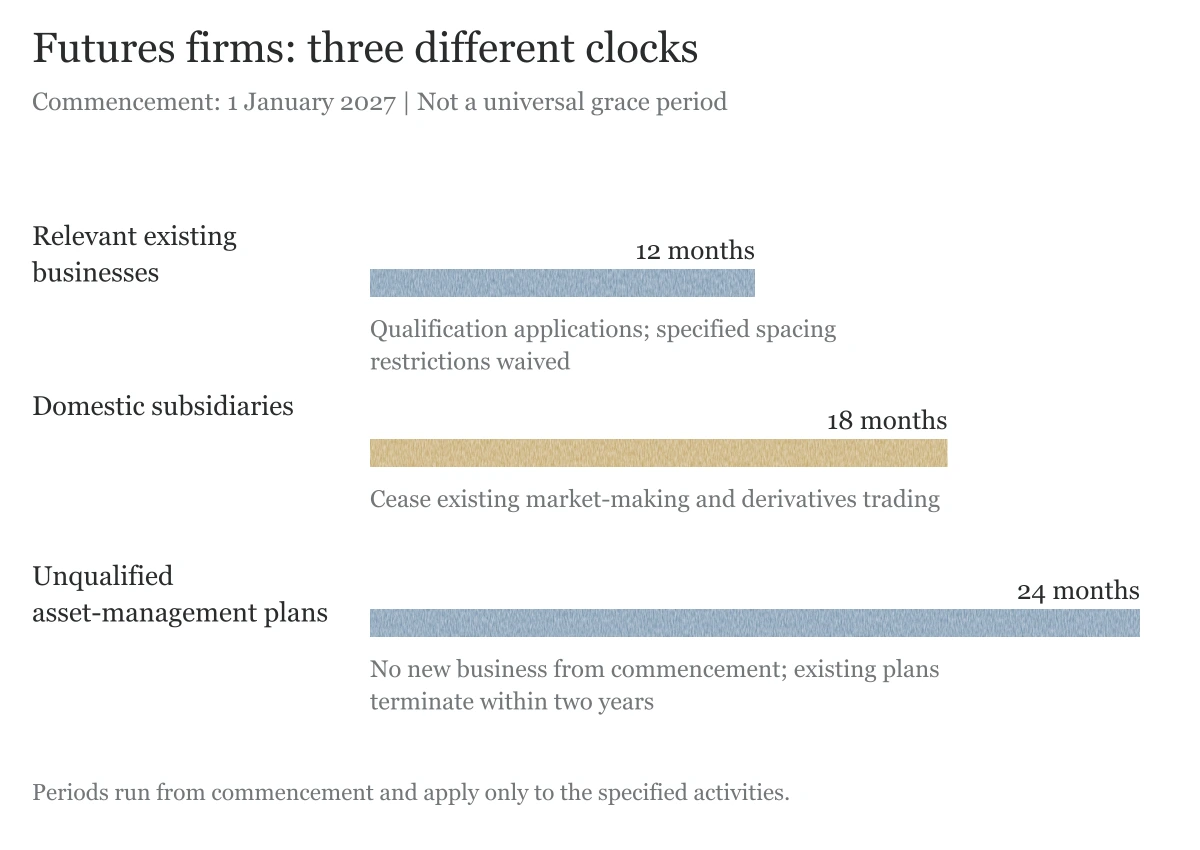
Three clocks start in 2027
The measures address licensing, ownership transparency, subsidiary oversight, risk management, business separation and client protection. The implementation announcement explains how certain existing activities move to the new framework.
| Transition | What it concerns | What it does not mean |
|---|---|---|
| Twelve months after commencement | Relevant existing businesses may apply for qualifications without the usual one-activity and six-month spacing restrictions | Every unlicensed activity may continue indefinitely |
| Eighteen months after commencement | Domestic subsidiaries must cease specified existing market-making and derivatives-trading activities | All subsidiary businesses have the same cessation requirement |
| Two years after commencement | Specified legacy asset-management plans must end; new business cannot be added after commencement where the rule applies | A general two-year grace period for the entire group |
Source: CSRC implementation announcement, September 11.
Ownership transparency matters because the licensed company is not always the end of a group's risk. Subsidiary exposures, related funding and control arrangements can affect the firm's ability to protect clients. Business separation helps define which resources support which obligations and prevents an apparently successful activity from masking exposure elsewhere.
The transition also creates an information need for customers. A business may remain within a permitted run-off arrangement without accepting new business. Clients need to understand whether their relationship will continue, be transferred or end, and on what timetable. A group-level statement that it is preparing for the new rules does not explain the status of an individual service.
The new texts are formal published regulation, but their commencement date is January 1, 2027. They do not change general IPO admission standards during this reporting week.
Olight's growth depends on the customer returning
Olight, the brand operated by Aolei Technology, published an IPO response on September 7. Its business focuses on consumer portable lighting, with revenue chiefly from overseas online sales. The inquiry asks about market competition, customer loyalty, repeat purchases and the company's ability to expand into China's domestic market.
For a consumer brand, a growing market estimate is less informative than what buyers actually do. A customer may replace a worn product, buy a second category or respond to a short promotion. These produce different revenue patterns. The exchange asks for evidence of purchase cycles, repeat-purchase rates and multi-category buying rather than relying on a general claim of loyalty.
The response also covers technology and patent protection, online selling arrangements, tax and foreign-exchange compliance, inventory, receivables and selling costs. That is a coherent commercial set of questions. The company has to reach overseas consumers, collect payment through its channels, manage stock and protect the margin after distribution and marketing expenses.
Domestic expansion requires its own explanation. A product's position and price overseas may not match domestic consumers' use cases or buying habits. A successful overseas brand therefore cannot assume the same sales model will work in a second market. The response discusses those differences; investors can assess them against the actual customer evidence rather than the size of the potential market alone.
Applicants advance, reply and withdraw
Autotuo passed Shanghai's listing-committee review on September 7 and submitted registration materials on September 9. The same application completed two stages; those events are not two completed listings. Shenzhen replies also appeared for Kerun New Materials on September 8, Anyou Biotechnology on September 9, Intermold on September 10 and Dianduo Technology on September 11.
Jiuyi Agriculture's review ended on September 13 following withdrawal by the applicant and sponsor. The termination decision establishes the procedural outcome. It does not, without further findings, establish a legal violation or a committee rejection. Tianxingjian New Materials also reached termination on the Beijing exchange.
The difference between a reply and a result matters here. The reply gives the applicant's explanation and supporting material. A committee result records the exchange's decision at that stage. A registration submission begins the next process. Readers following a company need the sequence, not a total that combines all three.
Shanghai's supervision bulletin covers disclosures as well as trades
The September 7–11 bulletin reported thirteen company supervisory work letters, four supplementary or corrected announcements and sixteen requests to initiate checks concerning inside information or abnormal trading. It separately reported 53 abnormal-trading incidents subject to self-regulatory measures, 32 checks concerning major company matters and one suspected-violation lead sent to the CSRC.
These figures describe Shanghai's actions within its stated period. A request to check trading is not proof of insider trading. A referred lead is not a completed enforcement case. For an issuer, however, the links between sensitive disclosure and trading make the timing and accuracy of public information important before any final finding.
The futures rules now supply a dated transition for regulated firms. The IPO replies supply business-specific questions for applicants. Both require an explanation of the actual activity: who performs it, what evidence supports it, and which obligations follow from it.
Sources
- Revised futures-company supervision measures
- Futures-company implementation announcement
- Aolei Technology first-round reply, questions 1, 3 and 5
- Autotuo committee result
- Jiuyi withdrawal and termination decision
- Shanghai supervision bulletin, September 7–11, pp.2–3
- Shenzhen project filings, Beijing project filings
Disclaimer
This article examines public records relating to the reporting period. It is for research and educational purposes and is not investment, legal or accounting advice, or a recommendation concerning any security. Official findings are attributed to the relevant authority; analytical observations are not findings of misconduct. Public documents may subsequently be corrected or supplemented.
Continue reading
View all records
Weekly Brief · 28 September to 4 October 2026
China Capital Markets Weekly: A Medical Approval Is Not Yet a Revenue Stream
Neuracle's brain-computer interface filing separates clinical progress from commercial revenue as semiconductor replies test the assumptions behind growth
Disclosure EvidenceCash Flow QualityRegulatory Scope & Timing

Weekly Brief · 21 to 27 September 2026
China Capital Markets Weekly: Airline Growth Meets the Balance Sheet
Loong Airlines' reply brings fleet financing into view, while review decisions and Beijing measures put the week's milestones in context