Weekly Brief / Issue 09
China Capital Markets Weekly: Chip Expansion and the Quality of Earnings
Chip-equipment and semiconductor replies connect technical claims with losses, assets and the economics of expansion
5 min read

Huazhuo Jingke's precision-equipment story and Changjing's move toward a Fabless-plus-IDM model face different financial tests. Their replies address the evidence behind technology, revenue and asset values. A whistleblower reward notice and Shenzhen measures also put responsibility for public information in focus.
Contents
Chip expansion has to explain the assets it creates
Changjing Technology's September 18 reply connects its move toward a combined Fabless-and-IDM model with customers, suppliers, margins, receivables, inventories and goodwill. The strategy is not simply a change in industry terminology. Moving further into manufacturing changes what the company owns, what it spends and how much demand it needs to keep those assets productive.
Huazhuo Jingke's first-round response, published the same day, supplies a different semiconductor case. Its precision-equipment narrative sits alongside continuing losses, revenue recognition and accounting corrections. Both filings ask readers to examine the financial consequences of technology and expansion claims.
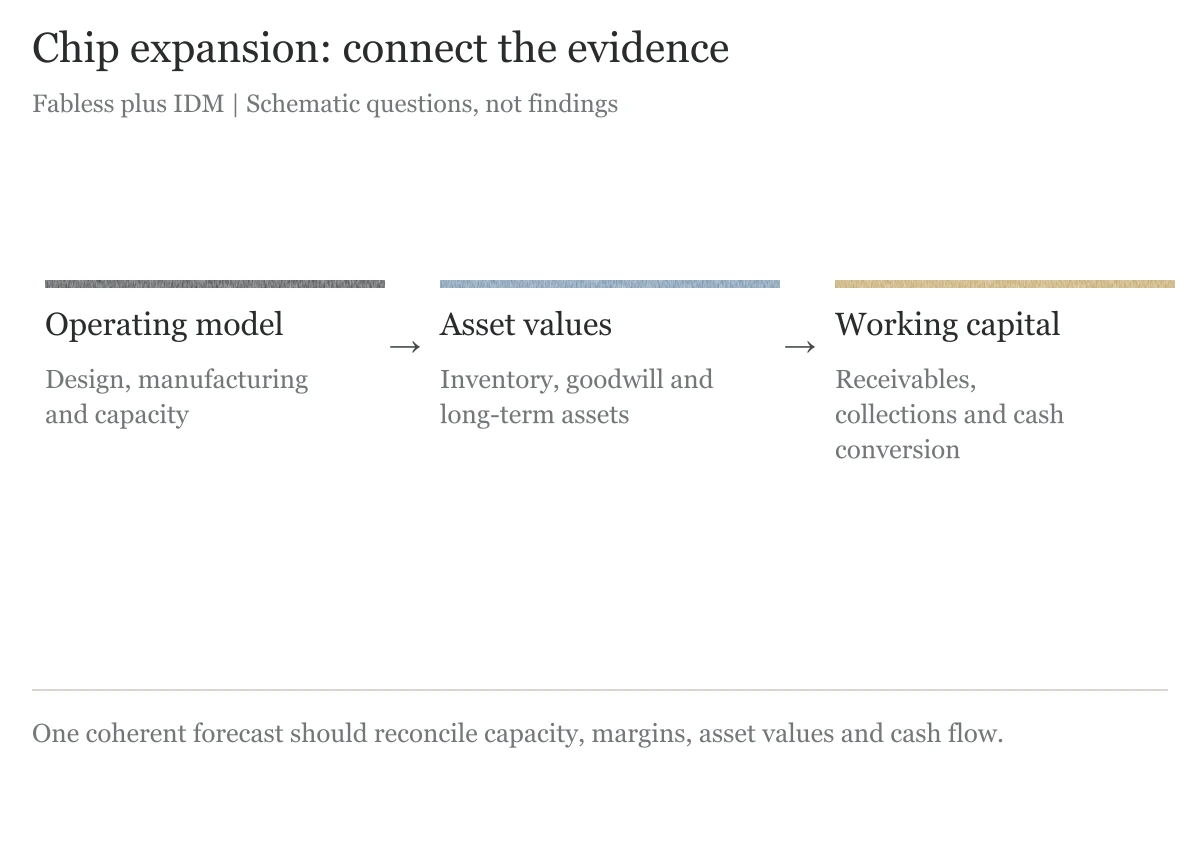
Two chip businesses, two operating models
A fabless business designs products and buys manufacturing services. An integrated device manufacturer also carries manufacturing operations within its business. Combining the two can offer advantages in process control or supply, but it changes the cost structure. Equipment, utilization, depreciation and production inventory become more prominent.
Changjing's response also covers historical shareholding matters and related-party issues. These are relevant to the economic story because ownership and related arrangements can determine which operations enter the group and on what terms. Goodwill requires attention to the expectations attached to acquisitions, not merely to the original purchase price.
A capacity forecast should reconcile with the sales forecast. If equipment is installed ahead of customer demand, depreciation and other costs can precede the expected revenue. If a production ramp takes longer than expected, inventory and fixed-asset values may need another assessment. These are analytical consequences of the operating model, not findings that Changjing's assets are impaired.
Huazhuo Jingke faces a different question: how technical capability translates into customer orders, accepted equipment and repeat sales. Its reply covers product competitiveness, core technology, continued losses, customers, procurement, gross margin, receivables, inventory and long-term assets. Share-based payments and accounting corrections also appear in the questions.
For an equipment supplier, shipment and customer acceptance may be separate events. A reader should be able to determine what remains to be done before revenue is recognized and when collection follows. A technical demonstration may support the product's capability; it does not establish that a customer has accepted a commercial order or paid for it.
Share-based payments need a bridge, not an erasure
Share-based compensation can complicate a loss-making applicant's results. Management may explain that a reported loss includes a large non-cash charge. That explanation can help readers understand changes between periods, but an adjusted result should not replace the reported one.
The useful presentation shows the statutory result, the adjustment, its period and the reason for it. If a company still loses money after removing the charge, the operating business has a separate profitability problem to explain. If an acquisition or restructuring changes the consolidation boundary, comparisons need to reflect that change as well.
These distinctions matter for the two chip applicants because a technology-led narrative can otherwise obscure the cost of reaching commercial scale. The replies make those costs part of the public discussion.
Committee and registration milestones continue
Guangdong Biomed Technology passed Shenzhen's listing-committee review during the week. Youbang Technology received an IPO registration approval. Other replies included Shenzhen main-board and ChiNext applicants in addition to the two semiconductor cases.
The milestones show existing applications advancing. They do not by themselves establish a relaxation of standards, and the response files should not be treated as approvals of every explanation they contain. A committee pass and registration approval record different stages of the same overall process.
The whistleblower notice concerns evidence and eligibility
On September 18, the CSRC published a reward notice concerning seventeen qualifying leads under its existing framework. Applications run until December 18 and require the relevant identity and evidentiary materials.
The notice is an implementation of the reward mechanism, not a new general rule or a count of seventeen penalties imposed this week. A submitted allegation, a rewarded lead and an authority's established finding have different statuses. Keeping them separate matters when a concern about a company begins to circulate publicly.
The reward process can bring information to regulators that is not visible in a filing. Public readers should nevertheless rely on formal findings for legal conclusions. A claim's prominence is not a substitute for its evidential basis.
Shenzhen measures address responsibility for public communications
The Shenzhen bureau's measures included a warning involving Chen Dalu's duties as an independent director in annual reporting and a corrective order for Wealth Online's investment-consulting operations. The latter addressed internal controls, marketing, personnel qualifications, investor suitability and compliance management. It also suspended new clients for three months, with resumption subject to the bureau's review of rectification. The Wealth Online decision was dated September 7 and published September 16.
For an independent director, the annual report is not merely a document that arrives for signature. The role carries responsibilities that need to be performed and evidenced. For an advisory firm, control over communications must extend to the people and channels through which the business reaches investors.
These were administrative regulatory measures. They should not be described as fines or administrative penalties where the authority has not made that classification. The distinction does not make the problems trivial; it identifies the actual consequence and the required response.
Changjing's manufacturing transition and Huazhuo's customer-facing equipment business will be tested through later disclosures of utilization, acceptance, collection and asset values. Those figures will show more about commercial progress than the adoption of a new business-model label.
Sources
- Changjing Technology inquiry response, September 18
- Huazhuo Jingke first-round response, September 18
- Shenzhen IPO project filings
- CSRC whistleblower reward notice
- Shenzhen bureau warning to Chen Dalu
- Shenzhen bureau corrective order and new-client suspension for Wealth Online
Disclaimer
This article examines public records relating to the reporting period. It is for research and educational purposes and is not investment, legal or accounting advice, or a recommendation concerning any security. Official findings are attributed to the relevant authority; analytical observations are not findings of misconduct. Public documents may subsequently be corrected or supplemented.
Continue reading
View all records
Weekly Brief · 28 September to 4 October 2026
China Capital Markets Weekly: A Medical Approval Is Not Yet a Revenue Stream
Neuracle's brain-computer interface filing separates clinical progress from commercial revenue as semiconductor replies test the assumptions behind growth
Disclosure EvidenceCash Flow QualityRegulatory Scope & Timing

Weekly Brief · 21 to 27 September 2026
China Capital Markets Weekly: Airline Growth Meets the Balance Sheet
Loong Airlines' reply brings fleet financing into view, while review decisions and Beijing measures put the week's milestones in context