Weekly Brief / Issue 07
China Capital Markets Weekly: Fundraising Controls and Faster Bond Review
Private-fund fundraising proposals and faster bond review address different sides of the financing process
5 min read

A private-fund consultation focuses on who supplies the money and how fundraising is controlled. New bond guidelines offer qualified mature issuers a faster review route. In the IPO pipeline, Ditong's dependence on Geely makes customer concentration a financial question as well as a commercial one.
Contents
Faster financing comes with different checks
Two September 4 texts address opposite ends of financing. The CSRC's draft private-fund fundraising measures focus on investors, fundraising institutions and the movement of subscription money. Shanghai and Shenzhen's revised bond-review guidelines address how qualifying mature issuers can move through review more efficiently.
Neither removes the need to understand the underlying business. Ditong Industrial's September 1 IPO response makes that point particularly clearly: 90.09% of sales in its latest annual period came from the Geely group. A faster or more orderly financing process cannot eliminate the economic consequences of depending on one customer group.
Private funds: eligibility has to survive the structure
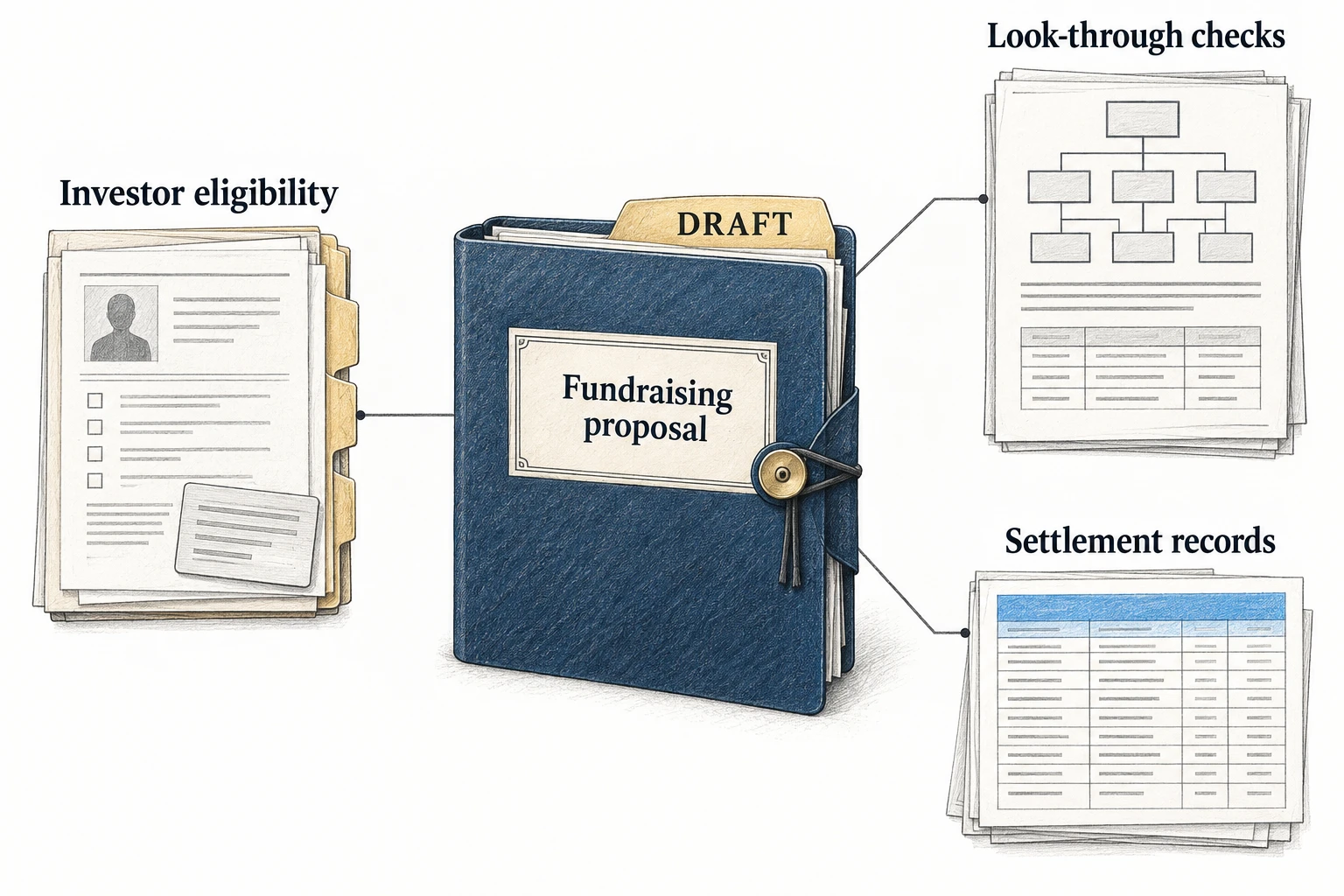
The private-fund proposal is open for comment until October 4. Its subjects include qualified investors, initial paid-in commitments, look-through checks, eligible fundraising institutions, settlement-account supervision and record retention. It is a consultation draft, not a set of duties already in force.
Investor qualification is more than the name on a subscription form. Where money passes through an investment vehicle, the relevant question may be who ultimately provides it and whether that arrangement satisfies the applicable requirements. An exemption from one look-through test does not automatically remove every obligation to examine investors and sources of funds.
The proposed tests for ordinary individual investors include alternative financial criteria; funds investing in specified higher-risk assets face additional conditions. Their wording matters. A fund cannot assume that a threshold applicable to one category settles eligibility for another, or apply a proposed provision retrospectively as though it were already law.
Settlement arrangements address a separate risk: subscription money being controlled or used outside the intended fundraising process. Records of the transfer, the party handling the money and the investor's decision matter because a later statement that the investor understood the product cannot reconstruct what actually happened.
Mature bond issuers receive a shorter route, not a guarantee
Both exchanges revised corporate-bond review guidance on September 4, with immediate effect. Shanghai's eligibility confirmation lasts 36 months, subject to the issuer continuing to qualify. Project review should generally take no more than ten working days under the relevant arrangement.
The benefit is procedural efficiency for issuers that meet the conditions. Governance, audit opinions, debt performance and adverse developments remain material. The confirmation period does not freeze the assessment for three years if the issuer's circumstances deteriorate, and the timetable does not promise registration regardless of what review uncovers.
Bond underwriting teams need to distinguish the initial eligibility assessment from continuing monitoring. The issuer's debt performance may change between transactions. A shorter review route makes accurate updates more important, not less. These are corporate-bond arrangements; they do not set a ten-day timetable for equity IPO review.
Shanghai also revised its law-enforcement query guide. That concerns requests by authorized agencies, not a public right to obtain confidential enforcement information.
Ditong's customer dependence is visible in the accounts
Ditong's first-round reply opens with its relationship with Geely. The inquiry describes sales to the Geely group of 83.38%, 83.76% and 90.09% across the three annual periods. The top five customers accounted for 91.68%, 93.80% and 96.11%.
The company points to concentration elsewhere in the automotive supply chain and to progress with other vehicle manufacturers. The comparison helps explain why a supplier may grow around a large customer. It does not make the dependence disappear. The exchange asks about Ditong's place in Geely's supply chain, the products supplied and the prospects for broader customer sales.
There is an important difference between entering a manufacturer's supplier system, receiving a project nomination and generating recurring production revenue. Each is progress, but only the last supplies the sales and cash assumed in a financial forecast. The response needs to show how the company's diversification claims move through those stages.
The filing also identifies deterioration in WM Motor's credit or financial condition among major receivable counterparties. That adds a collection question to the customer-concentration question. A diverse list of customer names provides little protection if the newer sales are difficult to collect.
For readers, the relevant sequence is customer demand, production scheduling, delivery, invoicing and collection. A dominant customer may support scale and predictable orders; it may also influence prices, credit terms and the utilization of dedicated equipment. Both explanations can be true at once.
Existing IPO applications supply the week's activity
Shanghai replies included Ditong, Calterah, Yangtze Memory, Longxing Tianxia and Haihe Biopharma. Shenzhen replies included Tianyuan Biochemical, Nisoko, Sanlü Technology, Zhiyan Technology, Chengli Aviation, Chenxin Technology and Anwen Technology. These publications add evidence to existing applications, rather than representing twelve new applicants.
Jiahong New Materials, Xinpa Intelligent and Changde New Materials passed Beijing exchange committee reviews. Registration-result publications concerned Keruisi, Yulong Technology and Yuexin Semiconductor. Yulong's approval was dated August 24 and Yuexin's August 25, although the exchange files appeared during this reporting period. Their appearance is useful news for following the applications; it does not make the decisions newly taken in September.
Supervision asks companies to correct the public record
Shanghai's August 31–September 4 bulletin reported eleven supervisory work letters and nine supplementary or corrected announcements. It also reported 57 abnormal-trading incidents subject to measures and one suspected-violation lead referred to the CSRC.
The nine announcement changes concern information already in circulation. For a company, the cost of an inaccurate disclosure is not limited to revising a paragraph: investors may already have compared results, assessed a transaction or misunderstood a commitment. An intermediary reviewing a financing application should therefore consider whether later corrections also change earlier assumptions.
The private-fund consultation closes on October 4. Before then, its proposed eligibility and settlement requirements remain open to feedback; the bond guidelines are already operative. The two timelines should not be conflated in advice to issuers or investors.
Sources
- Private-fund fundraising consultation
- Shanghai mature-issuer bond guidelines
- Shenzhen corporate-bond guidelines
- Shanghai law-enforcement query guide
- Ditong first-round response, especially question 1, beginning at internal p.3
- Longxing Tianxia response, Haihe Biopharma response
- Shanghai supervision bulletin, August 31–September 4, pp.2–3
- Shenzhen project filings, Beijing project filings
Disclaimer
This article examines public records relating to the reporting period. It is for research and educational purposes and is not investment, legal or accounting advice, or a recommendation concerning any security. Official findings are attributed to the relevant authority; analytical observations are not findings of misconduct. Public documents may subsequently be corrected or supplemented.
Continue reading
View all records
Weekly Brief · 28 September to 4 October 2026
China Capital Markets Weekly: A Medical Approval Is Not Yet a Revenue Stream
Neuracle's brain-computer interface filing separates clinical progress from commercial revenue as semiconductor replies test the assumptions behind growth
Disclosure EvidenceCash Flow QualityRegulatory Scope & Timing

Weekly Brief · 21 to 27 September 2026
China Capital Markets Weekly: Airline Growth Meets the Balance Sheet
Loong Airlines' reply brings fleet financing into view, while review decisions and Beijing measures put the week's milestones in context